AI mRNA vaccine control — a batch is not signed off on hunches.
An mRNA vaccine means cross-checking three realities in every batch — mRNA synthesis, LNP encapsulation and the Annex 1 CCS. iLEAN Edge sees the result in line, Connect captures the parameters whether they come from the modern skid or from the lab spreadsheet, and the agents cross-check the batch against the recipe. The person signs — the vial does not ship without its dossier.
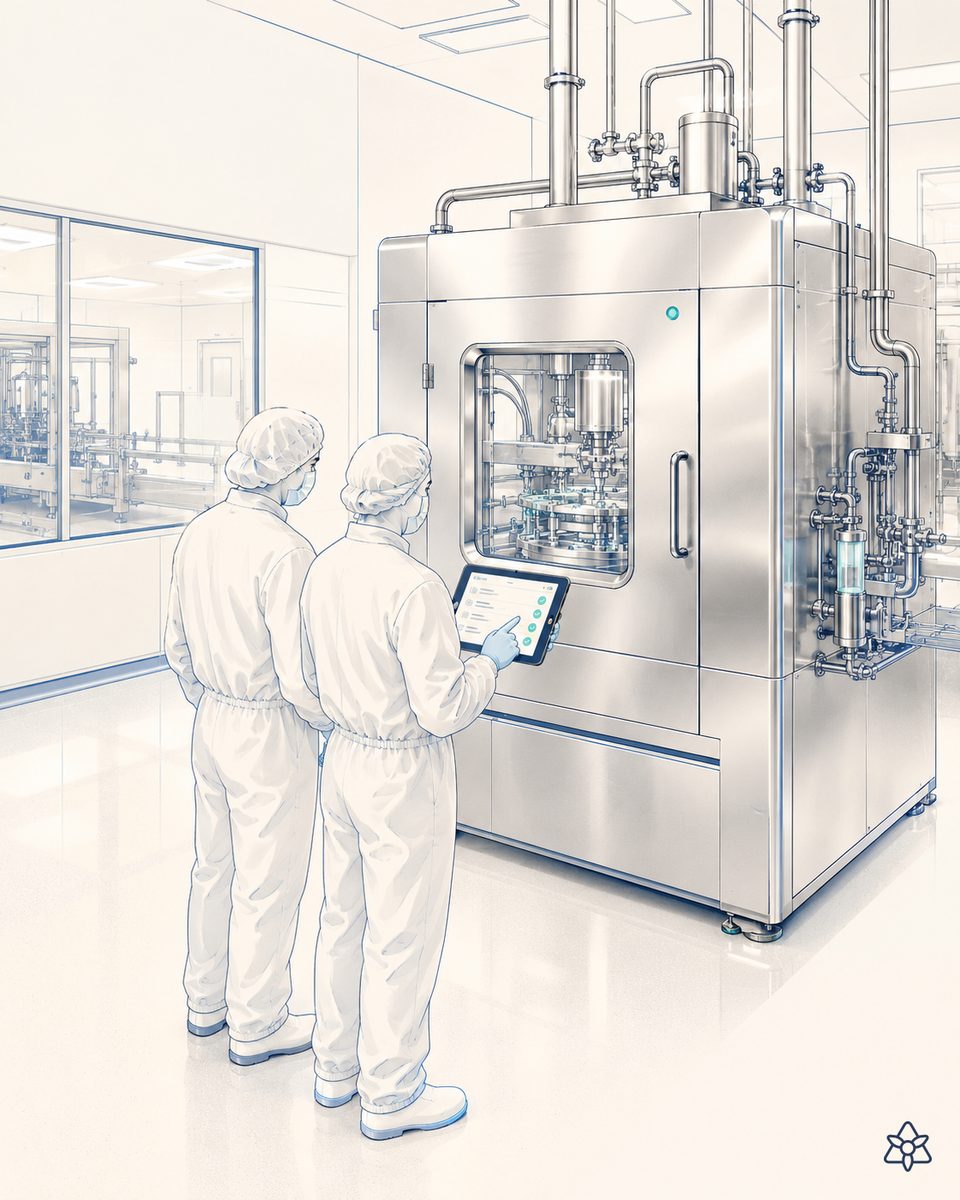
Three critical processes that almost never talk to each other within the same batch.
A signable mRNA vaccine is the clean cross-check of three processes that, in most plants, each live in a different system:
- mRNA synthesis — T7 polymerase, capping, polyadenylation, purification by chromatography. The batch record lives in the vertical LIMS/MES or in the bioreactor's forms.
- LNP encapsulation — microfluidic mixing of the mRNA with PEG-lipid, ionizable lipid, cholesterol and helper. Critical parameters (flow rates, ratio, temperature) in the skid's SCADA; size/PDI/encapsulation efficiency in the QC lab's DLS.
- Annex 1 environment — particles, microbiology, filter integrity, operator training. A documented CCS that has to add up for every single vial.
The QC director knows it, but cannot be in three places at once. The operator has three different screens and a paper batch record signed across four shifts. The classic system works 99% of the time. That 1% is the OOS that reaches the FDA inspector — and in a vaccine that is not an incident, it is a campaign put on pause.
iLEAN does not add a fourth system — it seals the cracks between the three you already have.
The mRNA vaccine problem is not a lack of information: it is information living on islands — the LIMS, the LNP skid's SCADA, the environmental monitor, the QC LIMS — that at the critical moment (formulation, filling, release) does not reach the person who signs already cross-checked. iLEAN acts as the putty that fills those gaps, without asking you to change your validated MES, your LNP skid or your EBR system.
Edge sees the DLS and the filling line. Connect reads parameters from the LNP skid, the bioreactor and the environmental monitor. The agent cross-checks against the GMP recipe and Annex 1 — and if something does not add up, it holds the batch. The person signs — never the other way round.
The three iLEAN pieces applied to mRNA vaccine control:
- Edge — a terminal with machine vision (CNN) on the filling line and at the DLS bench. It reads nanoparticle size and PDI in real time, inspects the vial (volume, seal, stopper, label) and fires the actuator (rejector, stack light) if it does not match the recipe. It works without a network.
- Connect — captures the LNP skid parameters whether the SCADA is modern (OPC UA, MQTT) or an old industrial PC from the manufacturer. It captures the MES batch record and the Annex 1 environmental monitor. And it captures whatever arrives from outside — the ionizable lipid supplier's certificate, an alert from the transport data logger — at second zero, without anyone forwarding anything.
- Agent — cross-checks synthesis, encapsulation, environment and the GMP recipe. If there is a deviation, it does not wait for final QC: it holds the batch and prepares the deviation file with a cross-checked root cause. The QC manager validates and signs; the campaign does not restart on its own.
Manual release of the mRNA batch vs. cross-checked release with iLEAN
| Aspect | Manual batch record + offline QC | With iLEAN Edge + Connect + Agent |
|---|---|---|
| LNP skid parameters | SCADA on an island, daily CSV export | Second zero, tied to every vial |
| LNP size/PDI | Offline DLS, result in hours | Edge at the bench, result in line |
| Annex 1 environment | Separate vertical system, weekly review | Cross-checked per batch, immediate alert |
| OOS detection | Final QC after the whole fill | Before filling, batch held |
| Deviation file | Rebuild by hand, weeks | Cross-checked root cause, ready for CAPA |
| Operation without a network | n/a | Edge keeps running on the panel's own power |
Impact estimate for your plant — to be validated with your numbers.
The block below is an estimate to be validated with the specific data of your plant. We put it forward so the committee has an order of magnitude; we refine it during the diagnostic.
- GMP mRNA vaccine plant with one or two LNP skids, a grade A aseptic filling line in RABS or isolator, a vertical Annex 1 environmental monitor, partial EBR.
- Connect + Agent pilot on the LNP skid (without touching the validated recipe) + Edge at the DLS bench. First value expected within a few weeks.
- Indicative payback between 4 and 9 months, depending on the frequency of LNP-driven OOS in historical batches and the average cost of a lost batch in your market.
- The hard lever is a single batch rescued plus the QC time saved on every routine release. One campaign batch pays for the pilot several times over.
And the pharma CAIO's reasonable doubt
“What if the AI hallucinates about a DLS or SCADA reading and releases a batch it should not?” — hallucination is a problem of free generation, not of anchored tasks. In tasks where the AI recontextualizes a piece of data from one system to another (reading the DLS and cross-checking it with the GMP recipe), the best models brought error below 1.5% [1]. And even so, in pharma what is critical is never decided alone: iLEAN holds the batch and the person signs. The three safety rings exist precisely for this — ring 1, OT, is sacred; ring 2 validates; ring 3 proposes.
[1] OpenAI paper “Why Language Models Hallucinate”, 2025 — on the reliability of AI in anchored tasks.
What people ask about AI mRNA vaccine control
What does GMP Annex 1 require of an mRNA vaccine line?
Annex 1 (the version in force since 2023) requires a documented Contamination Control Strategy (CCS) that cross-checks, for every batch, the classified environment (grade A/B in filling, C/D in LNP encapsulation), continuous monitoring of viable and non-viable particles, sterile filter integrity, and operator traceability. In an mRNA vaccine that also means tying mRNA synthesis (T7 polymerase, capping, purification) and LNP formulation (PEG-lipid, ionizable, cholesterol, helper) to each individual vial — not just to the batch. The person signs the release; the system hands them the complete dossier in minutes, not weeks.
How is LNP encapsulation controlled in real time?
Encapsulation into lipid nanoparticles is done by microfluidic mixing of the aqueous mRNA with the lipids in ethanol. The critical parameters — flow rate, aqueous/organic ratio, temperature — live in the skid manufacturer's SCADA, and size/PDI/encapsulation efficiency are measured offline by DLS or Malvern. iLEAN Connect captures the process parameters from the SCADA in real time (whether it is Siemens, Rockwell or a pharma vertical), iLEAN Edge reads the DLS result in the lab, and the Agents cross-check both against the batch recipe. If LNP size drifts or encapsulation efficiency drops, the agents hold the batch and alert the QC manager. The person signs — the line does not restart on its own.
What happens if LNP integrity fails in a batch?
An LNP integrity failure (size out of range, high PDI, low encapsulation efficiency) means the mRNA will not reach the cell intact, or will reach it at a dose different from the one designed — it is a potency OOS. Without IRIS, detection arrives days later through final QC; with iLEAN it is detected in line, the batch is segregated, and the agents generate the deviation file (root cause cross-checked against the batch record, the Annex 1 environment and the supplier's raw material) ready for CAPA. The quality manager signs; the agents propose, they do not decide.
Can iLEAN integrate with a legacy bioreactor or LNP skid without touching the recipe?
Yes. iLEAN Connect has three levels of capture: (1) direct integration if the skid has a modern interface (OPC UA, MQTT, REST API); (2) intermediate extraction if there is only a local computer with spreadsheets, CSV files or a historian screen — the agents recontextualize at almost zero cost, with less than 1.5% error on anchored tasks; (3) manual capture if the equipment is analog — a person photographs the skid screen and Connect digitizes it. The validated recipe is not touched, the skid's SCADA is not modified; iLEAN acts as putty filling what your system left exposed.
How is the batch's cold chain maintained all the way to the vaccination center?
An mRNA vaccine requires a −20 °C or −70 °C cold chain depending on the formulation, and batch traceability does not end when it leaves the plant — it ends in the vial injected into the patient. iLEAN Connect captures the records of the transport data loggers (whether a modern IoT sensor or a CSV the carrier emails over), the Agents cross-check them against the date/time of every stop along the chain, and if there is a temperature excursion, the shipment is segregated and the recipient is warned before landing. It connects naturally with the vaccine and biologics cold chain module and with ATMP vein-to-vein.
More cases in pharma
- Pharma lyophilization with AI predictive control — a 48-hour cycle, and a deviation takes 5 minutes to destroy the batch.iLEAN tracks the freeze-drying cycle in real time and predicts equipment failures. Every batch keeps its…
- mAb/ATMP bioreactor control — anticipate drift minute by minute and hold per-patient traceability.iLEAN monitors pH, DO, glucose and critical bioreactor metrics, plus per-patient traceability for ATMP.
- MDI inhaler control with AI — one gram of propellant out of range is one delivered dose out of range.How iLEAN cross-checks propellant fill, valve crimping and leak testing to secure the right MDI inhaler…
- AI nasal spray control — a crimp out of height is a dose out of specification.How iLEAN cross-checks volumetric dose, pump actuation testing and valve crimping to secure the right…
- OOS and GMP deviations with AI — QA should not spend weeks looking for what is already in the system.iLEAN cuts OOS investigation time and keeps every CAPA under real follow-up. No deviation forgotten, no…
- Granulation and compression in oral solids with AI — real RTRT, not a slide deck for the audit.iLEAN controls granulation, hardness and dissolution in line. Support for real Real-Time Release Testing…
Tell us your case and in 48h we'll send you the estimated ROI of this AI project for your mRNA vaccine line.
We work on your plant's real data, not ours. Diagnostic with no commitment.
Request estimated ROI in 48h See pharma