Radiopharmacy with AI — short half-life, no margin to rebuild the batch afterwards.
An FDG PET batch lasts hours; a [11C] batch lasts minutes. QP release has to be done before the batch decays — and that forces you to cross-check the HPLC, the gamma counter, the synthesis module, the patient schedule and the monograph in real time. iLEAN captures the sources at second zero, leaves the dossier pre-assembled and the QP signs. The dose is never released by an agent — the three rings exist precisely for this.
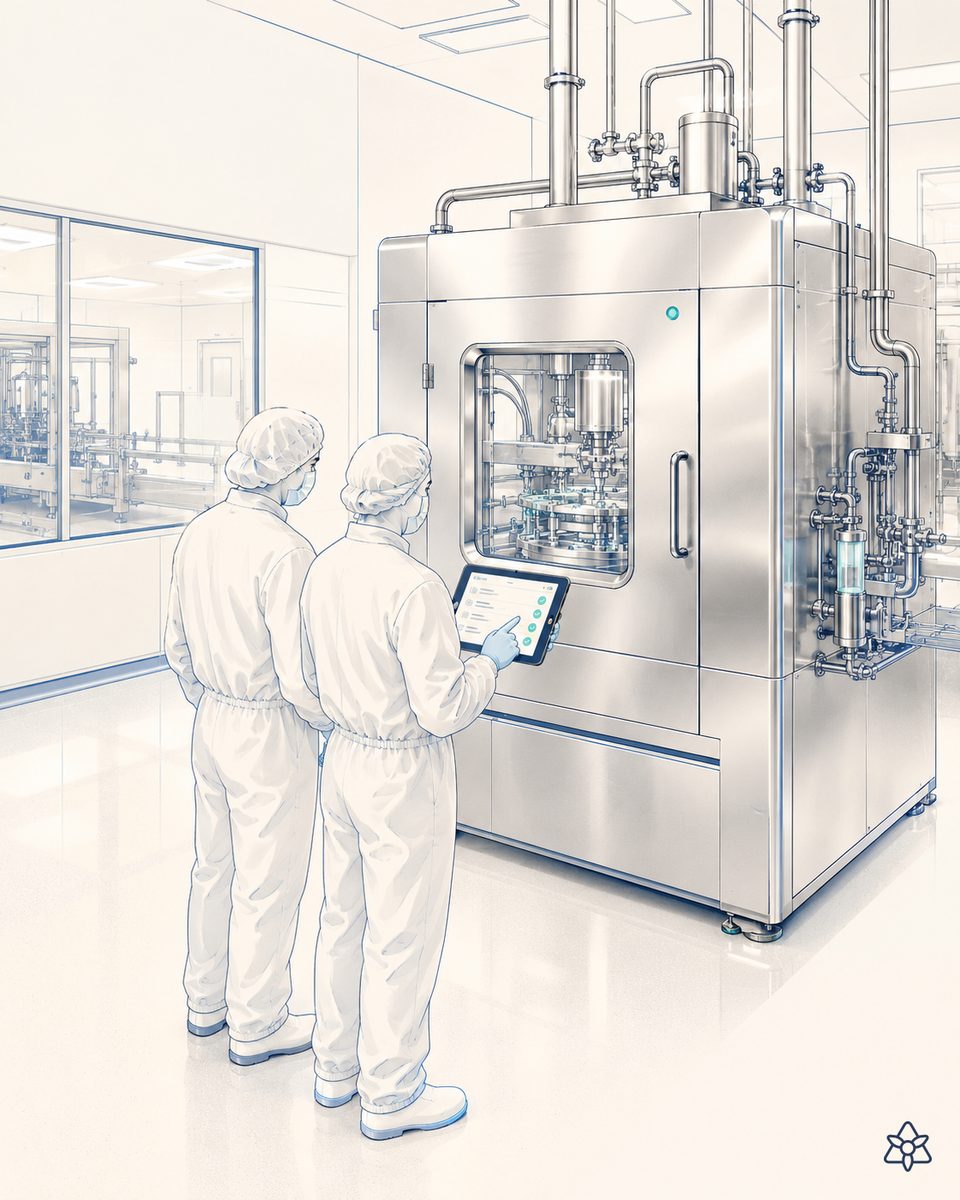
The clock is running, the sources sit on five islands, and the signature has to be in before decay.
Radiopharmacy is one of the few cases in pharma where time is the governing regime of the process:
- Short half-life — FDG lasts hours, [11C] lasts minutes, therapeutic isotopes somewhat longer. The batch decays, and with it the possibility of injecting it. There is no next day for rebuilding the dossier.
- Five sources that have to reach the QP at once for the signature: radiochemical purity from the HPLC, radionuclidic purity from the gamma counter, sterility from the protocol applied, the dose calculated per patient (weight, injection time, PET geometry) and traceability from the synthesis module (precursors, columns, program). If one is missing, the batch does not go out.
- A double regulatory regime — pharma GMP (EudraLex Vol. 4, radiopharmaceuticals annex) and radiation protection (Euratom Directive 2013/59 + national regulation). The QP signs; the radiation protection supervisor is answerable too.
The QP, the radiopharmacist and the supervisor are juggling five systems — an HPLC with its own software, a gamma counter with a spreadsheet, a synthesis module on an old isolated PC, the hospital schedule, the ERP. The clock is running. The classic system works 99% of the time. That 1% is the batch that falls through — and a batch that falls through in radiopharmacy is a patient who does not get injected.
iLEAN does not add a sixth system — it seals the cracks between the five you already have.
The problem in radiopharmacy is not a lack of information: it is information living on five islands that has to be cross-checked before decay. iLEAN acts as the putty that fills those gaps, without asking you to change the HPLC, the synthesis module, the gamma counter, the schedule or the ERP.
Connect captures the five sources at second zero. The agent cross-checks against the monograph and leaves the dossier pre-signed. The QP signs — the system does not decide alone. Rings 1-2-3 working with radioactive material in the line.
The iLEAN pieces applied to radiopharmacy:
- Connect is the star piece here, not Edge. It captures the HPLC whether the data comes from the manufacturer's software or from the ticket printer; it reads the gamma counter even on a PC that has been isolated for years; it extracts the synthesis module log without touching firmware; it reads the hospital schedule with the planned injection times; it cross-checks with the ERP. Three modes: manual (a photo of the panel), intermediate (isolated PC), integrated (modern interface).
- Edge comes in wherever there is visual inspection or a critical reading — the injectable vial, patient-dose labeling, reading a unit syringe, the closure seal. A lightweight CNN, a stack light actuator. It works with no network.
- Agent — cross-checks HPLC + gamma + synthesis + dose + monograph + sterility protocol. If all five data points comply, it leaves the dossier pre-assembled for the QP to sign. If they do not, it holds the decision and alerts the QP with the deviation spelled out. It never releases on its own — never. The three rings guarantee that the human signature is mandatory at release.
Manual radiopharmacy release vs. release cross-checked with iLEAN
| Aspect | Classic release + 5 systems on islands | With iLEAN Connect + Agent + Edge |
|---|---|---|
| HPLC, gamma, synthesis, schedule, ERP | Each on its own island; the QP joins them by hand | Captured at second zero, cross-checked automatically |
| QP decision before decay | Dossier rebuilt under pressure | Dossier pre-assembled; the QP signs with full context |
| Old isolated synthesis module | “It cannot be integrated” | Connect reads the local PC without touching firmware |
| Dose per patient | Spreadsheet + the radiopharmacist's calculator | Calculation cross-checked with weight, time, PET geometry |
| Batch dossier for the regulator / inspection | Rebuild it across 5 systems, days of work | Generated continuously, with JSON signed by ring 2 |
| Radioactive material on the OT network | An informal isolation protocol | Rings 1-2-3 formalized (IEC 62443, AI Act) |
Impact estimate for your plant — to be validated with your numbers.
The block below is an estimate to be validated with the specific data of your plant. We put it forward so the committee has an order of magnitude; we refine it during the diagnostic.
- Hospital radiopharmacy with one or two synthesis modules (FDG + a second tracer), HPLC + gamma counter, and a patient schedule integrated in the HIS.
- Pilot focused on Connect (bridging HPLC + gamma + synthesis + schedule) + one pre-assembled release agent. Edge optional over unit vial labeling. First value expected within a few weeks.
- Indicative payback between 4 and 9 months, depending on the current frequency of batches discarded because the dossier was not complete in time, QP hours spent on manual reconciliation and the workload on the radiation protection supervisor.
- The hard lever is every PET batch saved from decay because the dossier was ready in time + workload taken off the QP. A single batch rescued per week pays for the pilot in a few months.
- Quality bar per million anchored in automotive (a cross-sector reference): on the order of 25 PPM [1]. Radiopharmacy is not automotive, but the logic of the bar holds.
And the QP's reasonable doubt
“What if the AI gets it wrong cross-checking the HPLC with the monograph?” — hallucination is a problem of free generation, not of anchored tasks. In tasks where the AI simply recontextualizes a piece of data from one system into another (reading the HPLC chromatogram and comparing it with the spec), the best models brought error below 1.5% [2]. And even so: in radiopharmacy the agent never releases. It leaves the dossier pre-assembled; the QP signs. The three rings are there precisely to make that inviolable.
[1] The 25 PPM standard in automotive quality — Symestic.
[2] OpenAI paper “Why Language Models Hallucinate”, 2025 — on the reliability of AI in anchored tasks.
What people ask about radiopharmacy with AI
What makes radiopharmacy a special case within pharma manufacturing?
Three things at once: (1) a very short half-life — an FDG PET radiotracer lasts hours, [11C] tracers last minutes, so release has to be done before the batch decays; (2) manufacturing per patient, not in mass batches, with dose calculations adjusted to weight, injection time and the geometry of the receiving center; (3) a double regulatory requirement — pharma GMP (EudraLex Vol. 4, radiopharmaceuticals annex) plus radiation protection (Euratom Directive 2013/59) and marketing authorization. Rebuilding the dossier the next day is useless: the batch no longer exists.
How does AI help release a radiopharmaceutical before decay?
QP release of a radiopharmaceutical depends on five things that all have to arrive at once: radiochemical purity from the HPLC, radionuclidic purity from the gamma spectrometer, sterility as declared by the protocol, the dose calculated per patient and traceability of the synthesis module. iLEAN Connect captures the five sources at second zero (old HPLC, gamma counter, synthesis system, patient schedule, ERP), the Agents cross-check them against the monograph and leave the QP the pre-signed dossier with the decision one click away. The human signs — the system does not decide alone.
Can iLEAN integrate with an old synthesis module without touching it?
Yes. Connect has three capture modes: (1) manual — someone photographs the synthesis module's panel; (2) intermediate — if the module has an isolated local computer, Connect connects and extracts the data without touching the firmware; (3) integrated — if it has a modern interface, direct integration. The classic argument that “that old machine cannot be integrated” fell apart with AI: recontextualizing a piece of data from a proprietary panel into structured JSON is exactly what an LLM anchored to a source does best. We do not force you to change the synthesis module.
How does iLEAN meet the safety rings when radioactive material is involved?
iLEAN's three rings are non-negotiable here: ring 1 (the OT network of the synthesis module and the analytical instruments) accepts no inbound connections — it only reads from a mailbox. Ring 2 validates the raw data from ring 3 before it passes to ring 1. Ring 3 handles inference, cross-checking and the release proposal. The QP's signature is always mandatory — the dose is never released by an agent. This architecture is the same one IEC 62443 demands for critical OT networks and the one the European AI Act will require for AI in healthcare.
How much does an AI pilot cost for a hospital or centralized radiopharmacy?
The order of magnitude of a radiopharmacy pilot (hospital-based with one or two synthesis modules, or centralized with several tracers) is close to that of a Connect+Agents pilot in a small pharma unit, because the bottleneck is usually capture from old modules and building the release dossier, not visual inspection of the packaging. A reasonable payback to present to the committee is several months — the hard lever is the cost of a single PET batch discarded because the dossier was not complete in time, plus QP hours recovered. We ask for your plant's data and send you the estimated ROI in 48h.
Related: Drug-device combination products · Always-ready FDA/EMA audit · EBR — electronic batch record.
More cases in pharma
- Pharma pure gas control with AI — the gas is not in the batch, but it decides the batch.How iLEAN cross-checks the purity of N2, O2 and medical compressed air with every batch without…
- Prefilled syringe inspection with AI — every unit leaves with its own file, not just its batch number.iLEAN Edge inspects particles, dose, plunger integrity and serialization on prefilled syringe lines; the…
- Protein purification with AI — chromatography curve drift shows up before the peak, not after the batch.iLEAN cross-checks the real chromatography curve, pressure and conductivity with the good-batch…
- Rapid microbiology with AI — release batches sooner without touching the reference method.How iLEAN cross-checks plating, environmental monitoring and rapid methods (PCR, ATP, flow) to release…
- Spray drying with AI — process drift shows up half an hour early, not after the batch.iLEAN cross-checks temperatures, flow rates, residual moisture and the recipe to anticipate spray drying…
- AI suppository manufacturing control — one degree less in the mass is a run of weights out of spec.How iLEAN cross-checks mass temperature, cavity dosing and strip sealing to guarantee the right…
Tell us your case and in 48h we'll send you the estimated ROI of this AI project for your radiopharmacy.
We work on your plant's real data, not ours. Diagnostic with no commitment.
Request estimated ROI in 48h See pharma