Protein purification with AI — chromatography curve drift shows up before the peak, not after the batch.
In protein downstream, a drop in chromatography yield or incipient fouling in the TFF only shows up in the final assay — when the batch is already compromised. iLEAN Connect captures the real curve (UV, conductivity, pressure, pH) at second zero, an agent compares it with the signature of the good batch on that resin, and anticipates the drift before the peak is cut. The person signs.
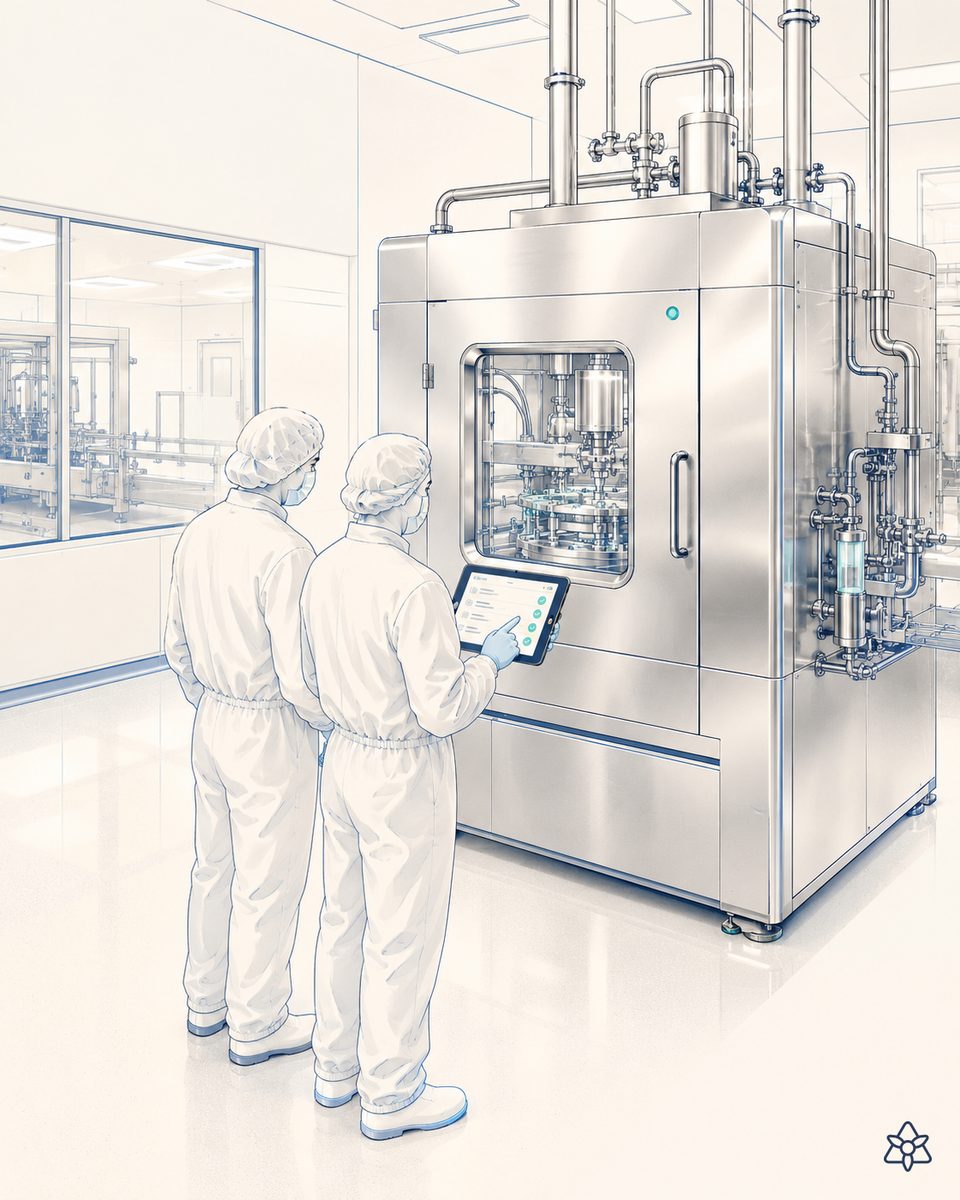
Column drift shows up in the purity assay. By then, it is a batch of protein.
Therapeutic protein downstream (mAbs, recombinant proteins, ATMPs, vaccines) is a chain of steps — capture chromatography, ion exchange, mixed mode, TFF — where each step depends on the one before it. A subtle drift in the first column is amplified in the next one. And the final purity assay arrives when the batch is already made.
The system raises the alarm when the TFF pressure moves out of band or when peak yield drops. By then: the column has drifted, the buffer has been consumed, the purification cycle is compromised. The operator knew something was off — the curve was pulling away from the last good batch — but had no system that compared curves live.
The three pieces of data you would need to cross-check to anticipate the drift live on three islands:
- The good batch signature — the UV, conductivity, pH and pressure curve of a correct batch on that same resin at that same cycle of use. In the historian, not tagged as a “reference signature”.
- Today's real curve — the CPPs in the chromatography system or the TFF skid, second by second. In the equipment's SCADA, never cross-checked with the signature.
- What changed — cycle number 47 on that column (which is no longer the column of batch 1), the buffer from the new supplier, the diafiltration run one degree lower. Every change in a spreadsheet, a label, a maintenance report.
Three islands, none of them talking to the others. The drift lives in the joint between the three — and nobody was there listening in time.
iLEAN does not replace the ÄKTA — it puts a brain on top that compares curves.
Downstream control is not a problem of missing sensors. The modern biopharma plant already logs in-line UV, conductivity, pH and pressure by the second. The problem is that nobody compares today's real curve with the signature of the good batch and nobody cross-checks the drift with what changed. iLEAN is the putty that seals that crack, without asking you to change the ÄKTA, the TFF skid or the historian.
Edge watches the column and the skid with its own sensors when the SCADA is late. Connect captures the whole chromatograph curve and the buffer supplier's emails. The agent compares against the good batch and anticipates. The person signs — never the other way round.
The three iLEAN pieces applied to protein purification:
- Edge — a terminal with its own pressure, conductivity and temperature sensors over the TFF skid or the chromatography line when the equipment's SCADA is slow or does not export in time. It detects the onset of fouling, pressure drift, cavitation. It works with no network.
- Connect — hooks into the existing ÄKTA, BioSC or chromatograph and captures the full curve second by second. And it also captures the external stuff: the certificate of analysis of the buffer, the email from the resin supplier about the new batch, the column usage report (cycle number 47, no longer the column of batch 1). All of it at second zero.
- Agent — trains on the curves of the batches that came out right and compares today's real curve against that signature. If it detects that the elution peak is going to come out 8% lower or that the TFF pressure will cross the threshold in 20 minutes, it proposes diverting the flow, extending the wash or changing the fraction collected. The person validates; the skid does not adjust itself.
Classic downstream vs. downstream anticipated with iLEAN
| Aspect | SCADA + assay afterwards | With iLEAN Edge + Connect + Agent |
|---|---|---|
| Drift detection | In the final purity assay | Against the good batch signature, live |
| TFF fouling | When pressure crosses the threshold | Trend detected 20+ min earlier |
| Column cycle of use | In the column owner's spreadsheet | Connect cross-checks it with the expected curve |
| Buffer / resin change | Assumed equivalent | Capture of the CoA and the supplier's email |
| File for inspection | Rebuild from 4 systems | Dossier per batch with a signed curve |
| Operation with no network | n/a | Edge keeps capturing on the panel's own power |
Impact estimate for your plant — to be validated with your numbers.
The block below is an estimate to be validated with the specific data of your plant. We put it forward so the committee has an order of magnitude; we refine it during the diagnostic.
- Biopharma plant producing mAbs or recombinant proteins, downstream with capture chromatography + ion exchange + TFF, multi-product in campaigns.
- Connect + Agent pilot capturing from the existing chromatography system + the MES recipe. First value expected within a few weeks: anticipation of yield or fouling incidents ≥ 30%.
- Indicative payback between 4 and 9 months, driven by the cost of one deviated protein batch and by extended column lifetime through anticipated maintenance.
- The hard lever: a single batch anticipated. With therapeutic proteins, the cost of one batch justifies the system on a single occurrence.
And the process director's reasonable doubt
“What if the AI proposes diverting the flow at the wrong moment and I compromise the peak?” — hallucination is a problem of free generation, not of anchored tasks. Here the AI is anchored to the good batch curve and to the recorded CPPs: in tasks like that, the best models brought error below 1.5% [1]. And even so, what is critical is never decided alone: the agent proposes, the person signs with their credential — the three rings guarantee that the live process (ring 1, the OT network) only accepts what has been validated and signed. And the aggregate effect in more digitalized plants is striking: the sectors that invested in capturing reality in full raised productivity by as much as 40% compared with the least digitalized ones [2].
[1] OpenAI paper “Why Language Models Hallucinate”, 2025 — on the reliability of AI in anchored tasks. [2] Fundación BBVA / Ivie — productivity through digitalization, 2000-2021.
What people ask about AI in protein purification
What deviations typically show up in protein purification?
In downstream, the classics are a drop in chromatography yield (protein that stays on the resin or elutes outside the expected peak), pressure drift in tangential flow filtration (TFF / UF-DF) that signals incipient fouling, aggregates that increase with subtle changes in pH or conductivity, cross-contamination between batches in multi-product systems, and loss of biological activity between steps. They all share the same thing: they come out of a slow process drift that is only confirmed when the purity assay arrives — late.
Why doesn't an FDA-style PAT system in biopharma solve this on its own?
PAT (UV, conductivity, pH, pressure, turbidity sensors) does its part very well — it measures. What it does not do on its own is compare today's real curve against the signature of the good batch on the same resin, cross-check it with cycle number 47 on that column and with the buffer supplier change that landed last week. That cross-reading is what anticipates the drift — and it is what no sensor gives you on its own.
How does AI fit a bio process validated under ICH Q5 and FDA 21 CFR Part 11?
The AI operates inside the validated design space. Its job is not to replace the quality system or change the purification method: it is to track the CPPs (pressure, conductivity, UV, pH) in real time against the model of the correct batch and to propose stopping, diverting flow or changing the fraction being collected. Every inference is recorded with a timestamp, model version and full traceability. iLEAN's three safety rings guarantee that the critical decision is signed by the person. It meets the Annex 11 principle (human oversight) by design.
Can iLEAN integrate with an already installed chromatography system (ÄKTA, BioSC, etc.)?
Yes. Connect hooks into the existing chromatography system — OPC UA if it is modern, PLC reads if it is old, CSV file export if that is the only option — and captures the whole curve second by second. It does not force you to replace the ÄKTA or the TFF skid. And it also captures what arrives from outside: the certificate of analysis for the buffer received, the email from the resin supplier about a batch change, the column maintenance report. All of it at second zero.
What is the typical ROI of applying AI to protein downstream?
A Connect + Agent pilot on a chromatography system + TFF, with integration into the MES and the recipes, means a moderate up-front investment and a reasonable annual license. Payback lands in a range of several months, driven by the cost of one deviated therapeutic protein batch (which for a mAb or an ATMP is very high) and by the extended column lifetime that comes with anticipated maintenance. The hard lever: a single batch anticipated pays for the pilot. Ask us for the ROI with your numbers — we'll send it in 48h.
More cases in pharma
- OEE on a pharma line — better performance without breaking GMP validation.iLEAN measures OEE per batch and breaks down the losses while respecting GMP compliance. Optimization…
- Pharma pure gas control with AI — the gas is not in the batch, but it decides the batch.How iLEAN cross-checks the purity of N2, O2 and medical compressed air with every batch without…
- Prefilled syringe inspection with AI — every unit leaves with its own file, not just its batch number.iLEAN Edge inspects particles, dose, plunger integrity and serialization on prefilled syringe lines; the…
- Radiopharmacy with AI — short half-life, no margin to rebuild the batch afterwards.How iLEAN cross-checks radiotracer synthesis, patient dose, short half-life and traceability to release…
- Rapid microbiology with AI — release batches sooner without touching the reference method.How iLEAN cross-checks plating, environmental monitoring and rapid methods (PCR, ATP, flow) to release…
- Spray drying with AI — process drift shows up half an hour early, not after the batch.iLEAN cross-checks temperatures, flow rates, residual moisture and the recipe to anticipate spray drying…
Tell us your case and in 48h we'll send you the estimated ROI of this AI project for your biopharma plant.
We work on your plant's real data, not ours. Diagnostic with no commitment.
Request estimated ROI in 48h See pharma