Pharma Class I/II/III recall with AI — in a Class I every hour counts, and the downstream trail is never ready.
A Class I recall demands immediate action. iLEAN identifies the batch, the affected hospitals and pharmacies and prepares the notification to FDA/EMA within hours: the agents cross-reference the downstream trail, the operational communication goes out in parallel with the official one, and the qualified person signs with the full map in hand. The person decides — the clock is not managed by hand.
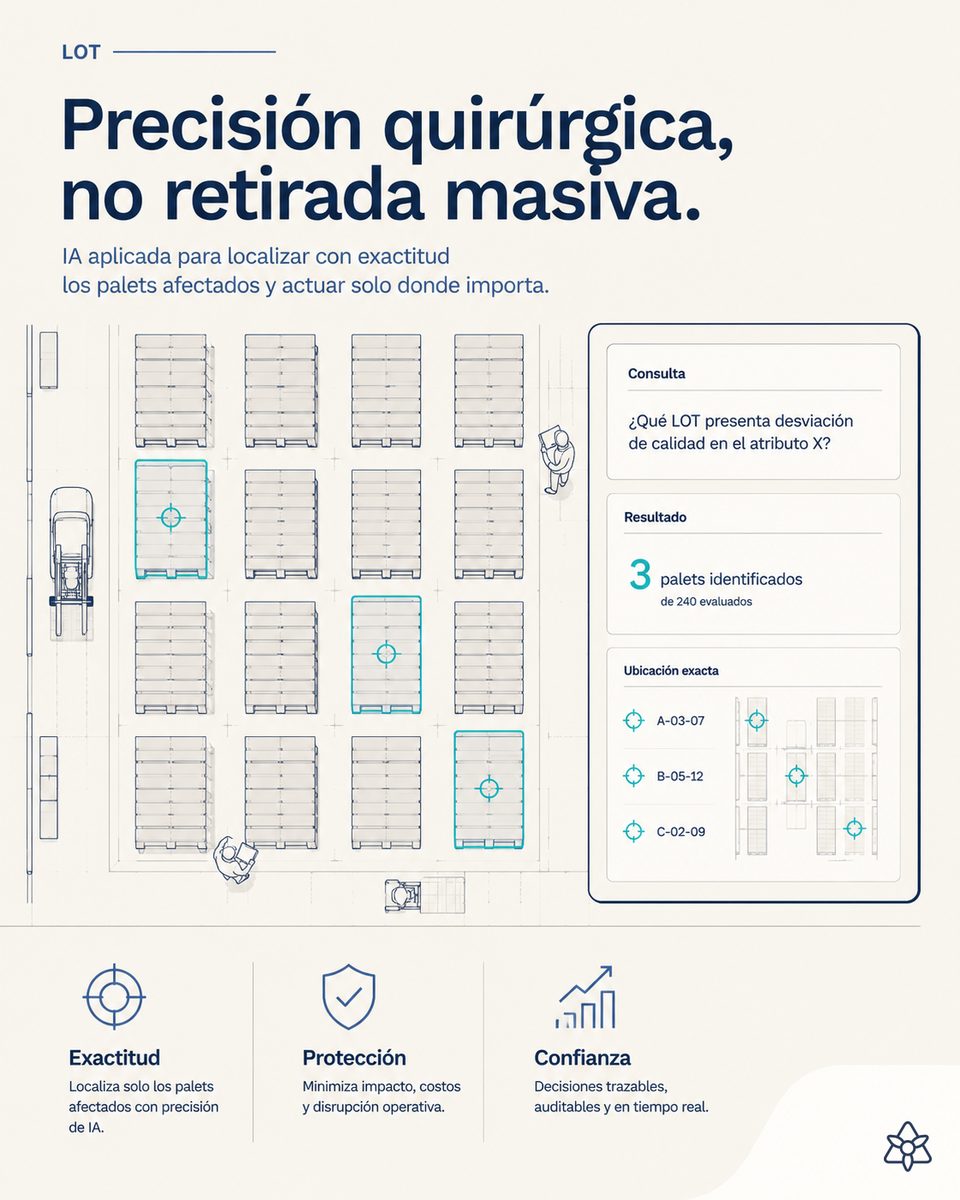
The drill goes well — the real recall, not so much.
Almost every pharma company passes its recall drills. And almost every one struggles when the recall is real, because the conditions change: the alert lands on a weekend, the pharmacovigilance person who knows the procedure is away, the data is split between the manufacturer's ERP, the logistics operator's WMS and the wholesaler's records. The reasons repeat:
- The downstream trail was not live — FMD requires upstream serialization, but it does not guarantee that you know, within hours, who already has your batch on the shelf or already dispensed to a patient.
- The communication is done by hand — someone starts calling hospitals, someone writes the email, someone updates a master spreadsheet while two other people work on the same one, and the qualified person has no idea who is missing.
- The official notification is written from scratch — each authority with its own format, each with a different deadline (Class I vs III, FDA vs EMA vs AEMPS), and the clock has been running since the moment you spotted the cause.
It is not a lack of procedure — the SOPs are written. It is that the information needed to execute them was not joined up, and joining it by hand in the middle of a crisis is exactly the worst thing you can do. This is what iLEAN changes.
iLEAN does not replace your QA or pharmacovigilance team — it puts the map on their desk at second zero.
The promise in a recall is not to decide for you; it is to reach the qualified person with the map already built: which batch, which hospitals, which pharmacies, which countries, which class, which notification, which deadline. iLEAN acts as the putty between the ERP, the WMS, the wholesalers, the hospitals and the authorities — without asking you to change a thing.
Tracer keeps the downstream trail live all year round. Connect carries the communication to hospitals and authorities. The Writer agent prepares the official notification. The person signs — and the clock saves hours, not minutes.
The three iLEAN pieces applied to pharma recalls:
- Tracer (a live downstream trail) — cross-references the manufacturer's serialized batch with every downstream destination (logistics operator, wholesaler, pharmacy, hospital, dispensing to the patient where applicable), all year round, not on the day of the alert. When the recall is triggered, the query returns the list of destinations in minutes.
- Connect (multichannel operational communication) — sends email, WhatsApp, SMS or an automated call to every pharmacy and hospital with the batch, format and recall code. Every response is logged (received, blocked, returned), and the agent chases whoever does not reply. The qualified person sees the map of outstanding items live, not in 48h.
- Writer agent (official notification) — prepares the notification in each authority's format (FDA 21 CFR 7, EMA GVP Module VI, AEMPS), with every data point tied together. The qualified person reviews and signs; the notification goes out through the official channel, and the documentary trail stays in the recall dossier.
A recall run on email and spreadsheets vs. a recall run with iLEAN
| Aspect | Manual recall + SOP in Word | With iLEAN Tracer + Connect + Writer |
|---|---|---|
| Map of the batch's destinations | Rebuilt from the WMS, the wholesalers, the hospitals — hours or days | Available in minutes, live all year round |
| Communication to hospitals | Calls and forwarded emails, with no traceability | Automated multichannel, responses logged |
| Map of outstanding items | A master spreadsheet three people edit at once | A single live view for the qualified person |
| FDA/EMA/AEMPS notification | Written from scratch against the clock | Template per authority filled with tied-together data |
| Class I (maximum urgency) | Critical hours lost on manual work | Focus on the clinical decision, not on logistics |
| Post-recall dossier | Rebuilt weeks later | Live file, exportable, ready for the auditor |
Impact estimate for your plant — to be validated with your numbers.
The block below is an estimate to be validated with the specific data of your organization. We put it forward so the committee has an order of magnitude; we refine it during the diagnostic.
- Pharma company with hospital and community distribution in the EU and/or the US, several SKUs serialized under FMD/DSCSA, documented annual recall drills.
- Tracer + Connect pilot: a live downstream trail on 1-2 critical SKUs and an AEMPS/EMA notification template. First value expected within a few weeks: the next drill runs in hours, not days.
- Indicative payback between 4 and 9 months, depending on the volume of historical recalls and the fully loaded cost of each drill and each real event.
- A ≥30% reduction in total recall time and a dramatic improvement in confirmation that stock has been blocked. The hard lever, on top of that, is the reputational insurance: the official statement goes out before the rumor does.
And the qualified person's reasonable doubt
“What if the AI prepares the official notification wrong?” — hallucination is a problem of free generation, not of anchored tasks. In tasks where the AI merely fills a template with data tied to the batch, the best models brought error below 1.5% [1]. And even so, iLEAN's three safety rings guarantee that the official notification always goes out with a human signature. iLEAN prepares, the qualified person signs. See the architecture.
[1] OpenAI paper “Why Language Models Hallucinate”, 2025 — on the reliability of AI in anchored tasks.
What people ask about pharma Class I/II/III recalls with AI
What is a Class I, II or III recall in pharma?
Class I: a product that may cause serious adverse consequences or death — immediate action, full and fast withdrawal from the market. Class II: a product that may cause reversible adverse consequences or where serious harm is unlikely. Class III: a product unlikely to cause harm but in breach of regulation (labeling, specifications). The FDA and the EMA require different timelines and traceability for each class, but they all share the same bottleneck: knowing which batch reached whom.
How do you trace a batch that is already distributed?
By cross-referencing downstream: from the manufacturer's batch → to the shipper → to the wholesaler → to the hospital or community pharmacy → to the patient where applicable. iLEAN Tracer keeps that chain live at every milestone (not only upstream, as FMD requires, but downstream too). In a recall, instead of starting to cross-reference spreadsheets and emails between departments, you run the query and the agent returns the list of destinations in minutes, not days.
Does iLEAN notify the FDA and the EMA?
iLEAN prepares the official notification in the format each authority requires (FDA 21 CFR 7 for voluntary recalls, EMA/EU GMP Annex 11 + GVP Module VI for medicines in the EU, AEMPS for Spain), with every data point tied together (batch, affected hospitals and pharmacies, distribution by country, reason for the recall, class). The qualified person reviews and signs — the notification goes out through the official channel, and the documentary trail stays in the dossier. Connect carries it, the agents prepare it, the person signs.
And the affected hospitals and pharmacies?
In parallel with the official notification, iLEAN runs the operational communication: an email to every hospital pharmacy with the batch, format and code, WhatsApp/SMS to the hospital coordinator, an automated call on whichever channel each customer prefers. Every response is logged (did they confirm receipt? did they block stock? did they return product?), and the agent chases the outstanding ones so the qualified person has the map of who is missing — not in 48h, but within the hour.
How much does recall time go down?
Estimate to be validated with your data: a ≥30% reduction in total recall time (from the alert to confirmation that stock is blocked at destination), with first value within a few weeks once the downstream trail is unified. The critical lever is Class I: every hour counts. And the hard one, in any class, is the reputational cost of a badly executed recall that hits the press before the official statement. We ask for your data and send you the estimated ROI in 48h.
More cases in pharma
- Granulation and compression in oral solids with AI — real RTRT, not a slide deck for the audit.iLEAN controls granulation, hardness and dissolution in line. Support for real Real-Time Release Testing…
- OTC manufacturing with AI — the line runs too fast to watch. Edge watches it.How iLEAN cross-checks recipe, batch, retail volume and regulation to pack OTC medicines with no…
- Subvisible particles in parenterals with AI — by the time you read it, the batch is already rejected.iLEAN integrates light obscuration data and USP 788 rules to spot subvisible particle trends batch by…
- Real AI cases in hormonal pharma13 real AI cases for hormonal oral solid pharma plants: a paperless MBR, Edge-validated cleaning, zero…
- OEE on a pharma line — better performance without breaking GMP validation.iLEAN measures OEE per batch and breaks down the losses while respecting GMP compliance. Optimization…
- Pharma pure gas control with AI — the gas is not in the batch, but it decides the batch.How iLEAN cross-checks the purity of N2, O2 and medical compressed air with every batch without…
Tell us about your recall program and in 48h we'll send you the estimated ROI of running pharma recalls with AI.
We work on your organization's real data, not ours. Diagnostic with no commitment.
Request estimated ROI in 48h See pharma