LNG plant control with AI — without touching the cryogenic SCADA, without losing the human signature.
Control of a liquefied natural gas plant lives on three planes — the cryogenic process (boil-off, liquefaction ratio, pressures), product quality (HHV, ethane, sulfur) and functional safety (SIS, SIL 2/3). iLEAN joins all three with Connect, Agents and the three safety rings, without drilling into the OT network. The person signs.
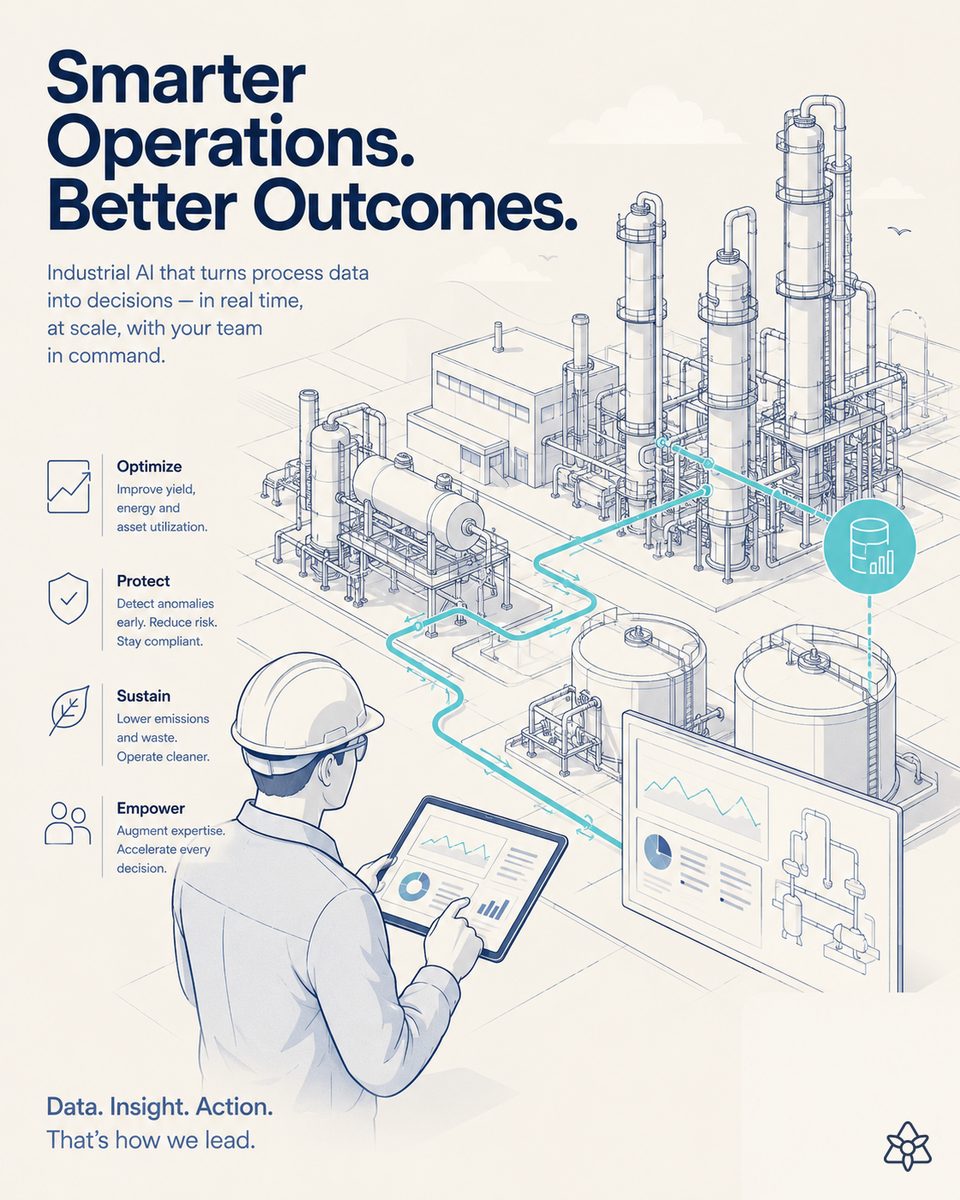
Three planes that never talk to each other — and whoever decides has to be on all three.
An LNG plant is controlled on three planes at the same time, and they almost never come together where it matters:
- The cryogenic process — the liquefaction train at -162 ºC, the pressures, the liquefaction ratio, the boil-off gas from the storage tanks. It lives in the SCADA, on an isolated OT network. It does its job well.
- Product quality — HHV, ethane, propane, sulfur and mercury content. It lives in the lab LIMS, in reports that reach the plant manager hours after the cargo has moved. Sometimes in spreadsheets the chemist on shift keeps in a shared folder.
- Functional safety and scheduling — the SIS units rated SIL 2/3, the interlocks, the jetty plan, the buyers with their windows. Each one in its own system. The shipowner's email about the vessel running late never reaches the person balancing BOG in time.
The operations manager knows it — and knows too that OT isolation is not optional. The cryogenic network cannot be drilled into. And yet the cross-referenced data point is what saves a cargo: a BOG figure climbing faster than ambient temperature justifies, cross-referenced with the composition of the incoming feed and with the shipment plan, anticipates the thermal leak or the quality drift before the buyer rejects the LNG. The classic system works — and when it fails, it fails by millions.
iLEAN does not replace the SCADA — it fills the cracks between the SCADA, the LIMS, the ERP and the shipowner's email.
The problem with LNG plant control is not a lack of data: it is data on islands separated by an OT network that is, quite rightly, isolated. iLEAN acts as the putty that seals those cracks while respecting the isolation, with the three safety rings the OT industry has been applying informally for decades and that now have to be formalized (IEC 62443).
Connect reads from the SCADA through a passive mailbox. The Agents cross-reference BOG, quality and scheduling. The three rings guarantee that the human signature stays where it matters — where a critical valve gets opened.
The three iLEAN pieces applied to LNG plant control:
- Connect — captures the readings from the cryogenic SCADA without asking the PLC to send anything (read-only, passive mailbox from ring 2 toward ring 1). It captures the lab LIMS. And it captures what arrives from outside — the shipowner's email about the vessel running late, the buyer's WhatsApp with the new HHV specification. At second zero, with nobody having to forward anything.
- Agents — they live in ring 3 at full power. They cross-reference BOG vs. ambient temperature vs. shipments, LNG quality vs. incoming feed composition, jetty scheduling vs. what the vessel is actually doing. They spot drift within hours, not in the monthly report. They prepare dossiers for the shift handover and for the committee.
- Three safety rings — ring 1 (SCADA, SIS, cryogenic PLCs) accepts no inbound connections. Ring 2 validates and cryptographically signs any proposal before it reaches ring 1. Ring 3 does the heavy lifting. The LNG plant does not lose its isolation; it gains visibility. The signature for a critical action is still human, backed by the SIS.
LNG control with three systems on islands vs. LNG control with iLEAN
| Aspect | Control with SCADA + LIMS + spreadsheets | With iLEAN Connect + Agents + three rings |
|---|---|---|
| Reading the cryogenic SCADA | Isolated, reachable only from the control room | Passive read-only mailbox, without touching the PLC |
| Detecting BOG drift | In the monthly report | Within hours, cross-referencing ambient temperature and shipments |
| Outbound LNG quality | LIMS report hours after the cargo | Cross-referenced with feed composition at second zero |
| Shipowner's email about a delay | Reaches the planner after the shift handover | Enters the system at second zero |
| OT isolation (IEC 62443) | Intact, but with no cross-referenced visibility | Intact, with cross-referenced visibility through the rings |
| Signature on a critical action | Human, backed by the SIS | Human, backed by the SIS — the AI does not open valves |
Impact estimate for your plant — to be validated with your numbers.
The block below is an estimate to be validated with the specific data of your plant. We put it forward so the committee has an order of magnitude; we refine it during the diagnostic.
- Liquefaction plant with 2 trains, marine jetty, exporting to a buyer with a strict HHV window.
- Connect + Agent pilot over BOG and outbound quality. First daily cross-referenced dossier within a few weeks.
- Indicative payback between 4 and 9 months, depending on the frequency of quality incidents documented over recent years and the average cost of a cargo rejection by a buyer.
- The hard lever is a single correction made in time: one off-spec cargo rejected is worth more than the entire pilot.
And the operations manager's reasonable doubt
“What if the AI proposes an action that breaks a SIS interlock?” — it cannot. iLEAN's Agents live in ring 3 and propose to ring 2, which validates; ring 1 (SCADA, SIS) only picks up what has been signed, and the person signs the execution. And even there, SIL actions are reserved for the SIS system, which runs its interlocks exactly as it does today. AI makes the operator more capable — not less accountable. Reliability on anchored tasks (cross-referencing data from one system with another) dropped below 1.5%[1]; in critical operations, the human signature remains the guarantee.
[1] OpenAI paper “Why Language Models Hallucinate”, 2025 — on the reliability of AI in anchored tasks.
Related topics you may find useful: biofuel control with AI · green hydrogen control by electrolysis · refinery cracking control.
What people ask about LNG plant control with AI
What does an LNG plant control, and why does it fall outside the standard AI mold?
A liquefied natural gas plant controls three planes at the same time: the cryogenic process (pressures, temperatures at -162 ºC, liquefaction ratio, boil-off gas), product quality (HHV, ethane/propane content, sulfur, mercury) and functional safety (SIS systems rated SIL 2/3 over the liquefaction train). That falls outside the standard AI mold for one simple reason: the cryogenic SCADA lives on an isolated OT network that cannot be tapped — and yet the quality batch and the scheduling live in IT systems. iLEAN bridges both worlds through the three rings, without touching the critical PLC.
How do you see boil-off gas with AI without drilling into the SCADA?
Boil-off gas (BOG) — the vapor that forms in LNG storage tanks through heat ingress — is the most sensitive indicator of thermal leaks and of liquefaction train efficiency. iLEAN Connect captures the readings that already exist in the SCADA (it does not ask for them again), cross-references them with the loading curve at the jetty and with actual shipments by vessel, and the Agents detect within hours — not in the monthly report — whether BOG is climbing faster than ambient temperature justifies. The SCADA is not modified. The data is read out, never written in.
Can iLEAN integrate the plant's cryogenic SCADA without touching it?
Yes, and that is precisely why the three rings exist. Ring 1 (the OT network where the SCADA, the SIS and the cryogenic PLCs live) accepts no inbound connections — it only reads from a passive mailbox what ring 2 has already validated. The powerful AI lives in ring 3, outside the isolation, and only what ring 2 has signed ever enters ring 1. This is not paranoia: it is what the OT industry has been doing informally for decades (IEC 62443) and what now, with AI applied to hacking, has to be formalized. The LNG plant does not lose its isolation; it gains visibility.
What guarantees functional safety (SIL) if we add AI to plant control?
The guarantee is structural: iLEAN's Agents have no hands in critical OT. They propose — the person decides and acts. The SIS system (SIL 2/3) over the liquefaction train remains the one that executes the safety interlocks, exactly as it does today. iLEAN adds a layer of cross-referenced information (BOG vs. shipments, LNG quality vs. incoming feed, scheduling vs. what is actually happening at the jetty) that helps the control room anticipate — but the signature to open or close a critical valve is still human, backed by the SIS. Positive preemption: AI makes the operator more capable, not less accountable.
How much does an AI control pilot cost in an LNG plant?
A pilot in an LNG plant does not fit the order of magnitude of an Edge unit over a packing line — the criticality and the complexity of the integrations are of a different kind. The typical pilot starts with Connect + one agent over a specific subsystem (BOG, outbound LNG quality, jetty scheduling) and the first value shows up within a few weeks: a daily cross-referenced dossier that does not exist today and that the committee immediately recognizes as new information. The pilot is billed as immersion + development, and the payback is calculated against the hard cost of a single correction made in time (an off-spec cargo rejected by the buyer runs into the millions). We ask for your plant's data and send you the estimated ROI in 48h, with your numbers.
More cases in petrochemical
- Industrial adhesive control with AI — one drum with out-of-range viscosity means the customer's line is down.How iLEAN cross-references in-line viscosity, tack and open time of industrial adhesive with the batch…
- Industrial paint manufacturing with AI — when delta-E is decided by a spectrophotometer reading that comes too late.How iLEAN cross-references dispersion, color, viscosity and pigment traceability to hold the formula…
- ISO 14001/50001 in a chemical plant with AI — evidence you live day to day, not something you rebuild the night before the auditor arrives.iLEAN keeps environmental and energy KPIs live for ISO 14001/50001, with audit evidence ready at any…
- Multilanguage chemical product SDS with AI — updating stops being a manual sprint.iLEAN generates SDS per product in N languages and keeps the active version current with REACH/CLP…
- Multiproduct campaign changeover with AI — a badly executed changeover is not a delay, it is cross-contamination.iLEAN coordinates campaign changeover on a multiproduct reactor: verified cleaning plus the next recipe…
- NPK fertilizer control with AI — an off-grade bag is not an incident, it is a fine and a lost customer.How iLEAN cross-checks N-P-K dosing, particle size and moisture in line with the customer spec to avoid…
Tell us your case and in 48h we'll send you the estimated ROI of this AI project for your LNG plant.
We work on your plant's real data, not ours. Diagnostic with no commitment.
Request estimated ROI in 48h See petrochemical