ISO 14001/50001 in a chemical plant with AI — evidence you live day to day, not something you rebuild the night before the auditor arrives.
ISO 14001 and ISO 50001 live on continuous evidence, not on reactive audits. iLEAN keeps environmental and energy KPIs live from real plant data, prepares the files for the auditor and proposes improvement actions based on the deviations. Management reviews and signs.
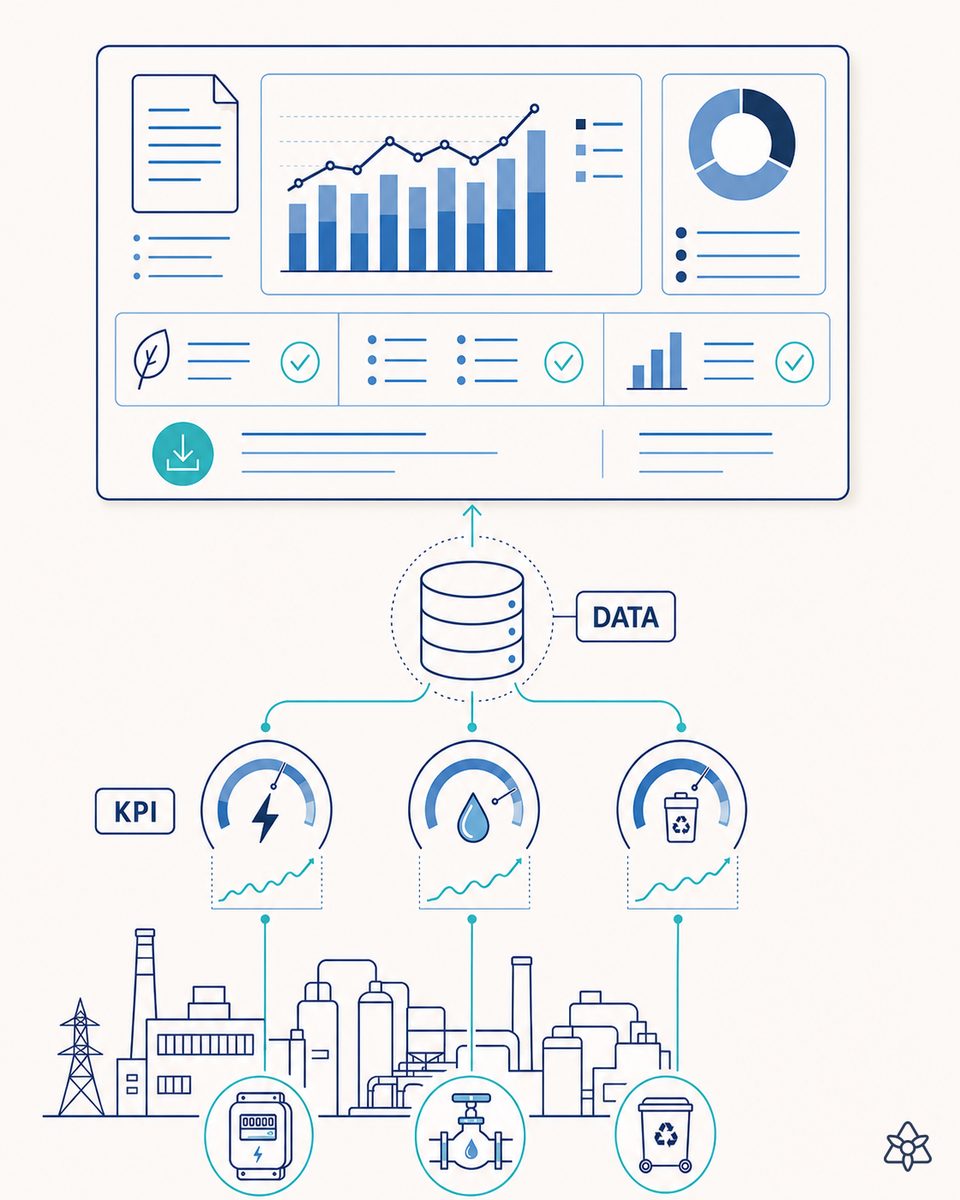
The standard is logical; what weighs is keeping the evidence alive.
The sustainability / EMS manager of a chemical plant lives with three fronts that never talk to each other:
- Operational data lives in SCADA, DCS and meters. It exists, but it is not formatted as a significant aspect or as an EnPI per unit of product. The EMS team re-aggregates it by hand every quarter.
- The qualitative part lives in spreadsheets and procedures. Significant aspects, evaluation of legal compliance, training plan, register of environmental incidents — each one in its own folder, each one with its own version.
- External reporting (CSRD/ESRS, CDP, end customer) lives somewhere else again. It reuses the data, but with its own template, its own aggregation and its own calendar.
The outcome is familiar: the sustainability team spends half the year compiling evidence and the other half putting out audit fires. The continual improvement plan exists on paper; the real PDCA cycle stalls between reviews. This is not a people problem — it is a problem of information living on islands, and serious digitalization closes it.
iLEAN does not add a fourth system — it seals the cracks between the three you already have.
The plant already has SCADA/DCS, an EMS/EnMS platform and an external reporting process. Each one does its own job well. The problem lives in the joints — between operational data and regulated evidence, between the evidence and CSRD reporting, between the deviation detected and the corrective action signed. iLEAN acts as the putty that fills those gaps, without asking you to change your EMS, your SCADA or your reporting tool.
Tracer keeps the KPI live. Brain analyzes the deviation against the baseline. Writer prepares the file and the report. Management reviews and signs — the system never approves actions on its own.
The three iLEAN pieces applied to ISO 14001/50001:
- Tracer — collects electricity, steam, water, gas, auxiliary materials and waste from SCADA/DCS, electricity meters, sensors and, where needed, from the local panel by vision (Edge). It normalizes per unit of product and keeps the baseline and the EnPIs live by line, by shift and by batch. The environmental footprint per product stops being an annual calculation.
- Brain — the analytical agent that cross-references deviation against baseline, against product mix, against process conditions. When the specific steam consumption of a header drifts by X%, it does not send an email — it proposes a probable cause (a leaking steam trap, a fouled exchanger, an operating condition outside the optimum). The person decides whether it enters the PDCA plan or the CMMS as a work order.
- Writer — prepares draft files for ISO 14001/50001 audits, for CSRD/ESRS reporting and for the data your end customer asks for. It cites the sources (which data came from which system, at what moment) and never invents. The sustainability manager reviews and signs; the agent sends nothing without a signature.
Traditional EMS/EnMS vs. live evidence with iLEAN
| Aspect | Classic EMS/EnMS | With iLEAN Tracer + Brain + Writer |
|---|---|---|
| KPI frequency | Monthly or quarterly, re-aggregated by hand | Live, by shift, by line, by batch |
| Significant aspects | Annual review in a meeting room | Recalculated with real data whenever the recipe changes |
| EnPI per product | Approximate annual calculation | Real allocation per batch |
| Deviation from baseline | Seen after the fact | Detected within the shift, with a probable cause proposed |
| Audit file | Weeks of compiling beforehand | Live dossier, evidence traceable back to the source |
| CSRD / customer reporting | Duplicated work, different templates | Same data, drafts generated, management signature |
Impact estimate for your plant — to be validated with your numbers.
The block below is an estimate to be validated with the specific data of your plant. We put it forward so the committee has an order of magnitude; we refine it during the diagnostic.
- Mid-sized chemical plant certified to ISO 14001 and ISO 50001, CSRD reporting under way, a sustainability team of 1-3 people plus engineering support.
- Tracer pilot on a priority energy sub-process (steam header, critical pumping train, utilities plant), integrated with SCADA and with the current EMS platform. First value expected within a few weeks.
- Expected reduction in hours spent compiling evidence above 30% in the first months — the sustainability team gets time back for real improvement, not for photocopying.
- Indicative energy savings in the pilot sub-process between 5% and 15%; combined payback (hours + energy + reporting) between 4 and 9 months.
- The hard lever adds up: avoiding a non-conformity in the audit, cutting compilation time, saving energy, avoiding a penalty for an incorrect CSRD report.
And management's reasonable doubt
“What if the agent reports wrong data to the auditor or the regulator?” — hallucination is a problem of free generation, not of anchored tasks. Regulatory reporting is exactly an anchored task: the data comes from SCADA, from the meter, from the lab; the agent recontextualizes it into the format of the report. In this kind of task, the best models brought error below 1.5% [1]. And even so, what is critical is never decided alone: iLEAN assembles the draft; the person signs. The three safety rings exist precisely for this. And one more data point: the most digitalized sectors raised productivity by up to 40% compared with the least digitalized ones [2] — serious digitalization of the EMS/EnMS is a competitiveness lever, not just a compliance one.
[1] OpenAI paper “Why Language Models Hallucinate”, 2025 — on the reliability of AI in anchored tasks.
[2] Fundación BBVA / Ivie — productivity of the most digitalized sectors vs. the least digitalized ones (2000-2021).
What people ask about ISO 14001/50001 in a chemical plant with AI
What do ISO 14001 and ISO 50001 require?
ISO 14001 requires an Environmental Management System built on significant aspects, a policy, measurable objectives, operational controls, evaluation of legal compliance, internal audit and continual improvement. ISO 50001 requires an Energy Management System built on the energy review, identification of significant energy uses (SEUs), a baseline, indicators (EnPIs) and verifiable objectives. Both share the high-level structure (Annex SL) and the PDCA approach. What makes them heavy in practice inside a chemical plant is not the logic — it is keeping the evidence alive between audits: significant aspects change with the recipe, EnPIs change with the product mix, and rebuilding everything by hand each year costs weeks.
How do you measure the environmental footprint in a chemical plant?
By cross-referencing what already exists (electrical consumption at the panel, natural gas from the meter, process water, steam from the header, emissions from the CEMS) with what is missing (uninstrumented utility consumption, waste by family, auxiliary chemicals tracked in a spreadsheet). iLEAN Tracer collects the physical flows, normalizes them per unit of product and keeps the footprint live by plant, by line and by batch. When it drifts away from the baseline, the agent cross-references what changed — recipe, mix, conditions — and proposes a probable cause. The person decides whether the improvement plan is updated or a corrective action is opened.
What about the EU Green Deal and CSRD reporting?
European directives (Green Deal, Fit for 55, CSRD/ESRS, green taxonomy) are raising the bar on environmental evidence — it moves from an annual report to continuous, verifiable data. iLEAN Tracer + Writer prepares CSRD/ESRS reports from the same operational data that feeds ISO 14001/50001, with no duplicated sources. The Writer agent assembles the report drafts; management reviews and signs. The same data serves CDP, GRI and the reporting your end customer asks for when they want the footprint of the product you sell them.
Does it integrate with SCADA and other existing systems?
Yes. iLEAN Connect integrates with SCADA, DCS, EAM/CMMS, ERP and the rest of the OT/IT landscape. For old tanks with no telemetry and for isolated meters, iLEAN Edge reads the local panel by vision. The important part: it does not require replacing your current EMS or EnMS if they work — it respects them and feeds them live, auditable data, removing the manual collection work between audits.
What kind of energy savings can you expect?
This is an estimate to be validated with your plant. The most digitalized sectors raised their productivity by up to 40% compared with the least digitalized ones (Fundación BBVA/Ivie), and energy is one of the fronts where digitalization pays back fastest. In a chemical plant, projects that close the loop of measurement + AI analysis + setpoint proposal usually see reductions above 30% in specific sub-processes (steam on one header, electricity on a pumping train) within the first months, with first value in a few weeks. Indicative payback runs between 4 and 9 months. The finance committee appreciates it, and so does the sustainability committee.
More cases in petrochemical
- Green hydrogen by electrolysis with AI — when every kWh decides whether the project pays off.How iLEAN cross-references electrolyzer stacks, balance of plant and the power grid to anticipate…
- Industrial adhesive control with AI — one drum with out-of-range viscosity means the customer's line is down.How iLEAN cross-references in-line viscosity, tack and open time of industrial adhesive with the batch…
- Industrial paint manufacturing with AI — when delta-E is decided by a spectrophotometer reading that comes too late.How iLEAN cross-references dispersion, color, viscosity and pigment traceability to hold the formula…
- LNG plant control with AI — without touching the cryogenic SCADA, without losing the human signature.How iLEAN joins Connect, Agents and the three rings to see boil-off, liquefaction ratio and LNG quality…
- Multilanguage chemical product SDS with AI — updating stops being a manual sprint.iLEAN generates SDS per product in N languages and keeps the active version current with REACH/CLP…
- Multiproduct campaign changeover with AI — a badly executed changeover is not a delay, it is cross-contamination.iLEAN coordinates campaign changeover on a multiproduct reactor: verified cleaning plus the next recipe…
Tell us your case and in 48h we'll send you the estimated ROI of this ISO 14001/50001 AI project for your plant.
We work on your plant's real data, not ours. Diagnostic with no commitment.
Request estimated ROI in 48h See petrochemical and chemical