Green hydrogen by electrolysis with AI — when every kWh decides whether the project pays off.
Green hydrogen is not won inside the stack — it is won where real membrane degradation, the hourly price of electricity and offtaker demand intersect. iLEAN joins those three realities, anticipates the drift and proposes the set point hour by hour. The person signs — the line does not adjust itself.
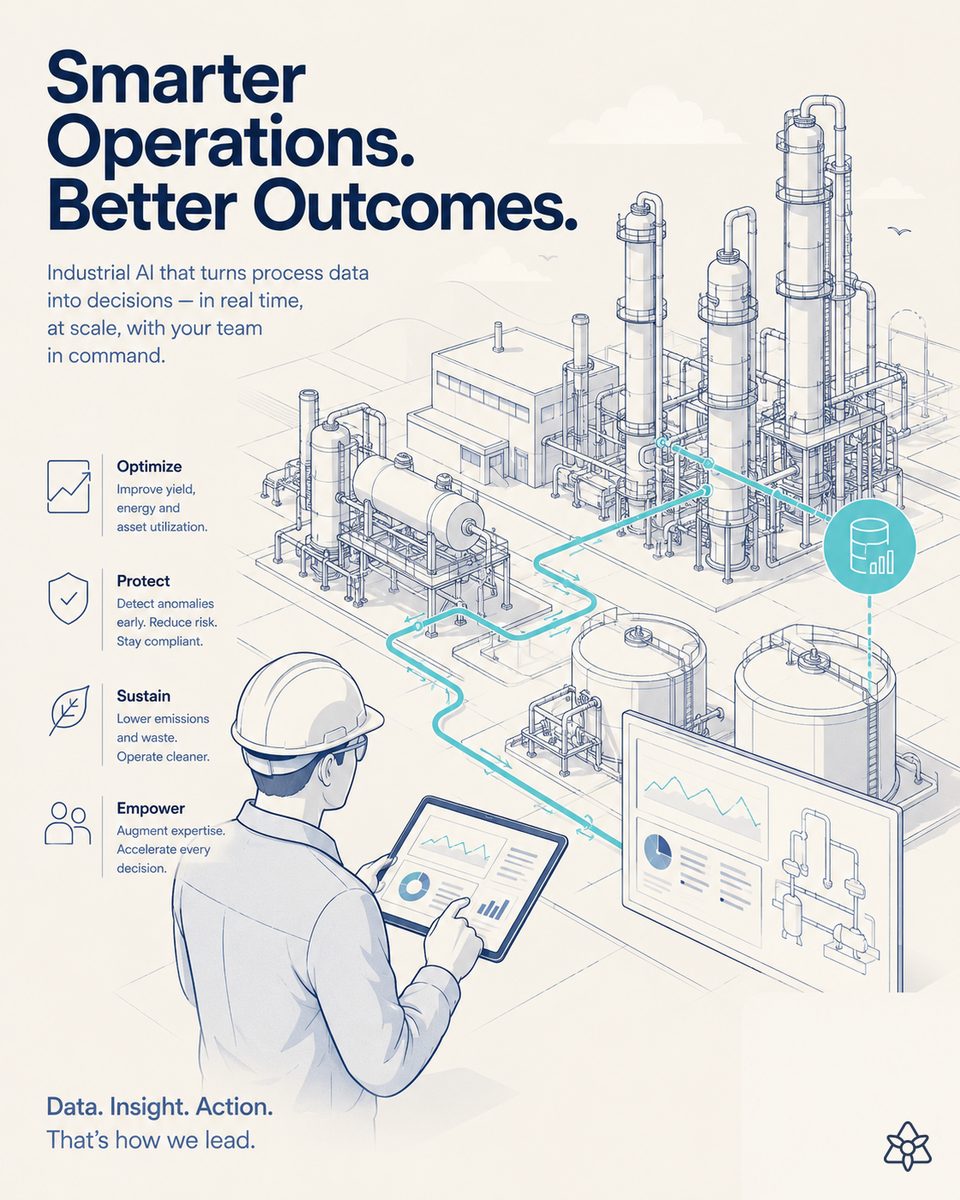
Three worlds that never talk to each other, and the margin slipping through the gap.
A green hydrogen plant is really three businesses wedged into one — and each has its own system, its own owner and its own rhythm:
- The electrochemical one — the real degradation of each stack, cell by cell, as a function of how many hours at which load, what DI water quality, what differential pressure. The manufacturer's SCADA sees something. The veteran operator's eye sees what the SCADA has not detected yet.
- The energy one — the hourly price of electricity, the PPA constraints, the actual output of the renewable asset. It lives in the market, in the trader's spreadsheets and in the energy manager's inbox.
- The commercial one — the offtaker's real demand (what pressure, what purity, what flow rate and at what time of day), the penalties for non-delivery and the schedule of certified tests. It lives in the ERP and in the contract.
The operations director knows it, but cannot be in all three places at once. The operator regulates stacks against a screen and hopes tomorrow's market price does not shift too far. Every badly matched hour is margin lost without anyone booking it as a loss — because no single system, on its own, can account for it.
iLEAN does not replace the electrolyzer's SCADA — it seals the cracks between your three worlds.
The problem with green hydrogen is not a lack of technology: it is information living on islands. The clue to degradation is in the stack; the decision about when to produce is in the market; the real demand is in an email from the offtaker. iLEAN acts as the putty that fills the gaps between those three systems, without asking you to change electrolyzer vendor, EMS or ERP.
Edge sees the stacks the way a veteran operator does. Connect captures the hourly price, the PPA and the offtaker's email. The agent cross-references all three and proposes the set point to the person. The person signs — the stack does not reconfigure itself.
The three iLEAN pieces applied to green hydrogen electrolysis:
- Edge — a terminal with vision and analog inputs on the electrolyzer rack itself. It reads per-cell voltage, H2/O2 differential pressure, bipolar plate temperature, DI water conductivity and analog gauges that no modern PLC integrates. It detects the characteristic drift of membrane degradation before it affects purity. It works with no network. If the plant goes offline, Edge keeps logging and holding critical events.
- Connect — captures the hourly market price, the availability of the renewable PPA, the offtaker's demand and constraints whether they arrive by email, WhatsApp or EDI, and the parameters living in the O&M manager's spreadsheets. When the trader revises the expected price curve at 6 p.m., the agents are already replanning the next day without anyone calling a meeting.
- Agent — cross-references real degradation, the power market and offtaker demand. It proposes the set point per stack hour by hour, anticipates the next optimal window for membrane maintenance and prepares the faradaic efficiency file for audit. If a purity reading drifts, it does not send an email at 10 p.m.: it holds the delivery and alerts the shift lead. The person validates and signs.
Electrolysis run from the SCADA vs. electrolysis run with iLEAN
| Aspect | Vendor SCADA + spreadsheets + emails | With iLEAN Edge + Connect + Agent |
|---|---|---|
| Stack degradation | Scheduled periodic inspection | Continuous detection of per-cell voltage drift |
| Load regime decision | Daily curve, adjusted by hand | Set point hour by hour with price + demand + stack health |
| Offtaker demand | Forwarded email, planning done in a meeting | Captured at second zero, replanning proposed automatically |
| H2 purity out of spec | Detected at the outlet, batch already produced | Anticipated from the V-I curve; held before loading |
| Operation with no network | n/a | Edge keeps reading and logging on panel power alone |
| File for the auditor / financier | Hours and efficiencies rebuilt by hand | Automatic efficiency and per-batch traceability dossier |
Impact estimate for your plant — to be validated with your numbers.
The block below is an estimate to be validated with your plant's real data. We put it forward so the committee has an order of magnitude; we refine it during the diagnostic.
- A 5–20 MW PEM or alkaline plant, with a renewable PPA and an industrial offtaker (refinery, chemicals or mobility).
- Pilot with Edge over one electrolyzer rack + Connect over the price feed and the offtaker's email + one agent proposing the hourly set point. First value expected within a few weeks.
- Indicative payback between 4 and 9 months, depending on the gap between your current operating efficiency and the theoretical one, how often the offtaker's demand changes, and the incremental stack life gained by anticipating maintenance.
- The hard lever is threefold: power savings from better-matched hours, extended stack life and fewer missed commitments to the offtaker. The project's financier appreciates having an AI layer that hands over the efficiency file without anyone rebuilding it by hand.
Why now, why this capital
The two biggest AI houses on the planet (OpenAI and Anthropic) have just closed joint ventures with Goldman Sachs, Blackstone, TPG, Brookfield and Bain Capital — billions to deploy AI inside companies, embracing the embedded-engineer model that industrial AI has used for three decades [1]. Industrial AI was not born with ChatGPT; the world has simply just validated, with a mountain of money, what the industrial sector already knew. For a green H2 plant, that means the capital about to finance the transition is already pricing in this layer.
[1] Source: Bloomberg, TechCrunch, Fortune — OpenAI/Anthropic joint ventures with funds (Goldman Sachs, Blackstone, Hellman & Friedman, TPG, Brookfield, Bain Capital) under Palantir's “forward deployed engineer” model.
What people ask about green hydrogen by electrolysis with AI
Why does a green hydrogen plant need more than the electrolyzer's SCADA?
Because the green hydrogen business is not decided inside the stack — it is decided where three realities meet, and they are almost never in the same place: the hourly price of electricity, the real degradation of each cell, and your offtaker's hydrogen demand. The SCADA sees the stack; the ERP sees the PPA contract; the power market lives in another world. iLEAN seals those cracks and the agents optimize the set point hour by hour with the person in the loop.
What can iLEAN Edge detect in a PEM or alkaline electrolyzer?
Edge is a terminal with machine vision (CNN) and analog inputs that sees the reality of the stack the way a veteran operator sees it: cell voltage anomalies, thermal drift in the bipolar plates, small leaks that have not yet tripped the ESD, analog readings from gauges and flowmeters that were never integrated. And it logs every event with a timestamp so the agent can anticipate membrane degradation or catalyst poisoning before the cost becomes irreversible.
How do you anticipate membrane or catalyst degradation?
By cross-referencing the per-cell voltage curve, H2/O2 differential pressure, DI water conductivity, stack temperature and operating hours at each load regime. The agents detect the characteristic drift (a V-I curve that shifts, faradaic efficiency dropping a few points) before it affects H2 purity. The operator gets a concrete proposal: “drop stack 3 to 70% load, schedule a membrane wash in the next low-power-price window” — and signs. The decision remains the person's.
Does iLEAN compromise the cybersecurity of my control system?
Quite the opposite: it formalizes it. iLEAN is built on a three-ring architecture (a sacred inner OT ring, an intermediate validation ring, an outer power ring) that isolates the electrolysis control system from the outside world. The inner ring accepts no inbound connections: it only picks up cryptographically signed data from a passive mailbox. It fits IEC 62443 and the requirements of the operators financing these projects. Automating the OT network and opening up to AI stop being mutually exclusive.
When do you see a return on a green hydrogen project with iLEAN?
In these projects the margin is electrical: every point of faradaic efficiency and every hour well matched to the hourly market price counts. Estimate to be validated: first value within a few weeks (a unified reading of stacks + hourly price + offtaker demand), indicative payback between 4 and 9 months on power savings and extended stack life. We ask for your plant's real data and send you the estimated ROI in 48h.
More cases in petrochemical
- Hazardous waste traceability in the chemical industry — a broken manifest is a penalty, a bad classification is a premium rate.iLEAN traces hazardous waste from the plant to the licensed contractor. EPA/EU compliance with no paper.
- Heat exchangers with AI — fouling is invisible, but it bills you every month.iLEAN models heat exchanger fouling and proposes the optimal cleaning window between turnarounds. No…
- Hot rolled steel control with AI — the window is narrow and the defect shows up with the coil already cold.How iLEAN cross-references heat, mill curve and surface vision on the strip to catch defects and…
- Industrial adhesive control with AI — one drum with out-of-range viscosity means the customer's line is down.How iLEAN cross-references in-line viscosity, tack and open time of industrial adhesive with the batch…
- Industrial paint manufacturing with AI — when delta-E is decided by a spectrophotometer reading that comes too late.How iLEAN cross-references dispersion, color, viscosity and pigment traceability to hold the formula…
- ISO 14001/50001 in a chemical plant with AI — evidence you live day to day, not something you rebuild the night before the auditor arrives.iLEAN keeps environmental and energy KPIs live for ISO 14001/50001, with audit evidence ready at any…
Tell us your case and in 48h we'll send you the estimated ROI of this AI project for your green hydrogen plant.
We work on your plant's real data, not ours. Diagnostic with no commitment.
Request estimated ROI in 48h See petrochemical