Industrial adhesive control with AI — one drum with out-of-range viscosity means the customer's line is down.
A correct industrial adhesive is the intersection of three realities — recipe and raw material, mixer and line parameters and customer spec (viscosity, tack, open time). iLEAN cross-references those three with vision and in-line sensors + integration with your ERP/MES, and holds the batch before packing when something does not add up. The person signs.
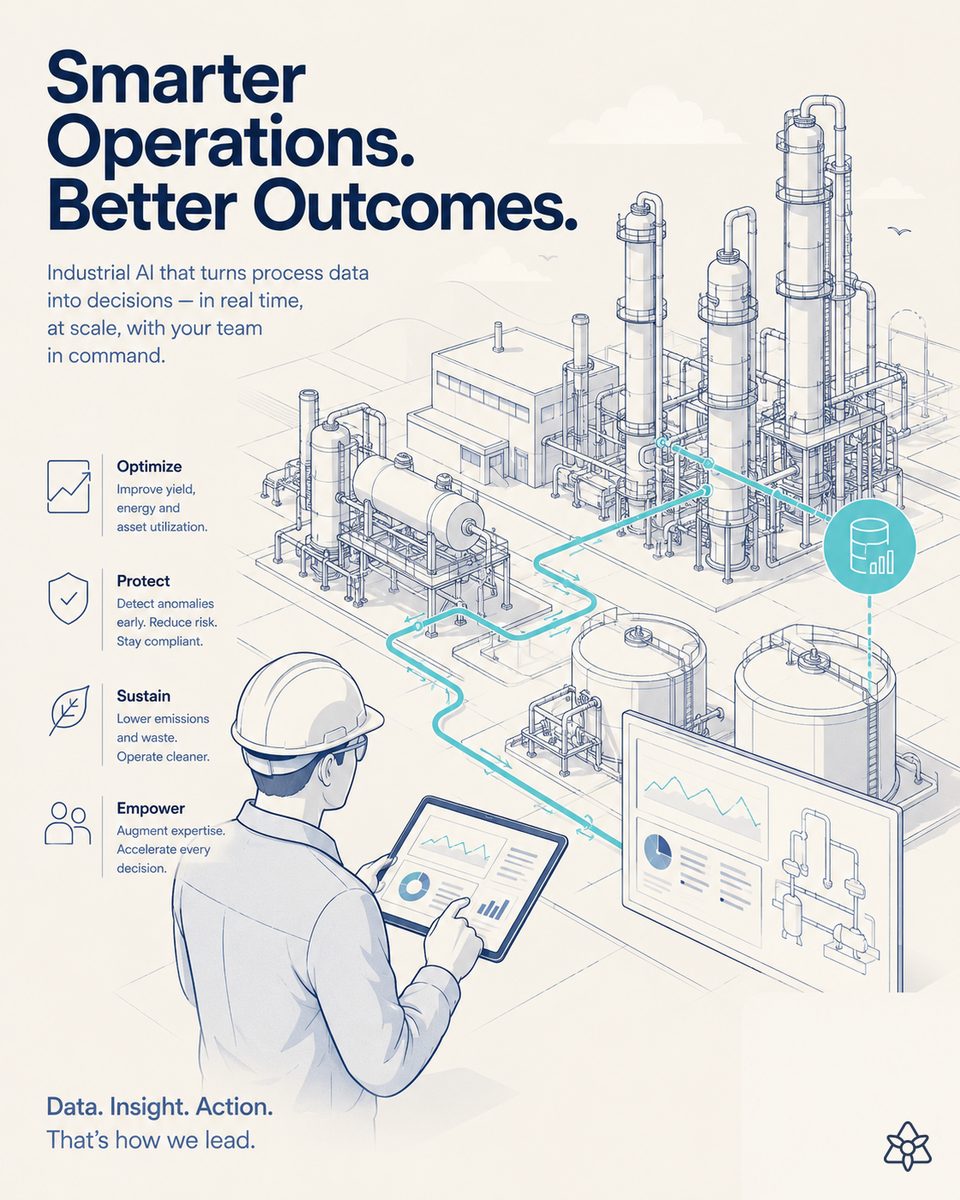
The recipe is stable, but nobody told the batch.
Any adhesives plant manager knows it: the nominal recipe has been in the ERP for years, but the real batch depends on things the recipe does not capture.
- Raw material changes from supplier to supplier — the base polymer may come with a slightly different molecular weight, the plasticizer with more moisture than expected, the tackifying resin with a softening point half a degree low. The supplier's analysis is in the LIMS or in a PDF that arrived by email, but it is rarely cross-referenced with the recipe before charging the mixer.
- The mixer performs differently every day — a worn agitator, a heating jacket losing a couple of degrees, a miscalibrated temperature sensor, a dosing pump that has lost accuracy. Today's viscosity curve is not exactly the one from six months ago, even though the SCADA setpoint has not changed.
- The customer spec takes no excuses — a drum of EVA hot melt that reaches the customer with viscosity outside the agreed Brookfield range for the application, a reel of laminated paper where the adhesive does not open in time, a PSA that fights back on someone else's thermoformer. Every complaint has a name, a surname and a return-freight cost.
The lab measures at the end of the batch or by sampling the drum, and returns the figure hours later. By then the batch is packed and, with luck, goes to a less demanding customer; with less luck, it comes back. The problem is not the recipe, it is that the classic system is always late — and every complaint from a repeat customer shows up in the whole year's numbers.
iLEAN does not change your mixer — it puts the missing intelligence on top of the data you are already generating.
The problem in industrial adhesive control is not a lack of information: it is information living on separate islands — the LIMS knows how the raw material came in, the mixer's SCADA knows what is happening in the jacket right now, the ERP knows which customer is waiting for that drum and at what viscosity, but none of them talks to the next at packing speed. iLEAN acts as the putty that fills those gaps, without asking you to change SCADA, ERP or the packing line.
Edge sees viscosity and temperature in line. Connect reads the LIMS analysis and the customer spec wherever they come from. The agent cross-references them with the expected curve and, if something does not add up, holds the drum before the pallet. The person signs — never the other way round.
The three iLEAN pieces applied to industrial adhesive control:
- Edge — a computer-vision terminal (CNN) with in-line signal capture: in-line Brookfield viscometer, temperature probe, camera over the filling head to read the label and detect bubbles or visual variation in the product. If viscosity moves outside the range accepted for that spec, it triggers a stack light and notifies the operator before the drum is closed. It works with no network.
- Connect — captures the raw-material analysis whether it comes from a modern LIMS, from the lab's spreadsheet or from the R&D manager's own sheet. And it also captures what comes in from outside (a customer spec PDF, an email from the supplier flagging the new resin batch, a WhatsApp message from the logistics supervisor about the shipment) at second zero, with nobody having to forward anything.
- Agent — cross-references the batch recipe, the raw-material analysis, the mixer's actual curve and the customer spec. If there is a deviation, it does not send an email at 10 p.m.: it holds the drum and alerts the quality manager through whatever channel they use. It also generates the traceability dossier — which raw material, how long the mix ran, which shift — ready for an audit or a complaint. The person validates and signs; the pallet never leaves on its own.
Manual control vs. cross-referenced control with iLEAN
| Aspect | Manual control + LIMS by sampling | With iLEAN Edge + Connect + Agent |
|---|---|---|
| Detection of viscosity deviation | When the lab returns the figure (hours) | In line, during packing |
| Cross-reference with supplier raw material | The operator checks the LIMS if there is time | Connect brings it to the mixer panel automatically |
| Drum / IBC labeling | Operator reads the label before the pallet | Edge verifies label vs. ERP batch, holds it if it does not match |
| Traceability for a complaint | Rebuilt by hand from the ERP and from paper | Per-batch dossier, automatic, with a photo of the line |
| Multi-customer spec (hot melt, PSA, solvent) | Same threshold for every SKU | Model trained per family and per customer |
| Operation without a network | n/a | Edge keeps running with its own light |
Impact estimate for your plant — to be validated with your numbers.
The block below is an estimate to be validated with the specific data of your plant. We put it forward so the committee has an order of magnitude; we refine it during the diagnostic.
- Mid-sized adhesives plant (a mix of hot melt, acrylic PSA and solvent-based), 2-3 mixers and a multi-SKU drum/IBC packing line.
- Edge pilot on one packing line (in-line viscometer + camera over the filling head + integration with the batch recipe in the ERP/MES). First value expected within a few weeks.
- Indicative payback between 4 and 9 months, depending on the frequency of customer complaints and of batches sent for rework documented over recent years.
- The hard lever is a single complaint avoided from a repeat customer: returned drum, return freight, rework, damage to the commercial relationship. The expected reduction in in-line rejects is ≥ 30% against your current baseline.
And the quality director's reasonable doubt
“What if the AI gets it wrong and holds a drum that was fine?” — hallucination is a problem of free generation, not of anchored tasks. In tasks where the AI merely compares a real measurement against a spec window trained on your own batches, the best models brought error below 1.5% [1]. And even so, what is critical is never decided alone: iLEAN holds and the person signs. The three safety rings are there for exactly this.
[1] OpenAI paper “Why Language Models Hallucinate”, 2025 — on the reliability of AI in anchored tasks.
What people ask about industrial adhesive control with AI
Which critical properties of industrial adhesive does AI control in line?
The four that decide whether the batch is good or not: viscosity (in-line Brookfield or Haake), initial tack, open time and solids or VOC content. iLEAN Edge captures the first three with in-line sensors and vision over the packing line, Connect cross-references them with the lab analysis and the batch recipe in the ERP, and the Agents anticipate the deviation before the drum leaves for the customer.
Does it work equally well for hot melt and solvent-based adhesives?
Yes. What changes between an EVA hot melt, a one-component polyurethane, an acrylic PSA and a rubber solvent-based adhesive is the recipe and the mixer kinetics — not the control pattern. Edge adapts to each chemistry with the product's trained model: extruder temperature for the hot melt, agitator profile for the solvent-based, polymerization curve for the reactive. The iLEAN architecture is the same; the model is trained on site during the immersion phase.
How does it control drum/IBC labeling and traceability?
iLEAN Edge reads the drum label at closing (batch, date, customer code, GHS H/P statements where applicable). If the label does not match the batch the ERP says is being packed, the system holds the drum before it goes onto the pallet. The Agents prepare the traceability dossier — which raw material, which mixer, how long, which shift — for an ISO 9001 audit or a customer requirement.
Does it work if the mixer is old and has no modern SCADA?
Yes. iLEAN Connect has three levels of capture: direct integration when the machine has a modern interface, reading the local computer when it is legacy and standalone, and manual capture (a photo of the panel) when all there is is analog. An old mixer comes in through the second or third level — Connect reads the data without touching the original electronics and without scrapping the mixer. Edge adds the external viscosity and temperature sensors that were missing.
How much does an AI pilot cost for an industrial adhesives plant?
The order of magnitude of an Edge pilot on an industrial adhesive line is in line with any Edge pilot in a chemical plant: an initial investment covering a vision terminal + in-line sensors (viscometer, temperature probe) + integration with the ERP/MES, plus an annual license. A reasonable payback to present to the committee is a matter of a few months — the hard lever is one batch rejected for out-of-range viscosity or one customer complaint from the packaging chain. We ask for your plant's data and send you the estimated ROI in 48h.
More cases in petrochemical
- Heat exchangers with AI — fouling is invisible, but it bills you every month.iLEAN models heat exchanger fouling and proposes the optimal cleaning window between turnarounds. No…
- Hot rolled steel control with AI — the window is narrow and the defect shows up with the coil already cold.How iLEAN cross-references heat, mill curve and surface vision on the strip to catch defects and…
- Green hydrogen by electrolysis with AI — when every kWh decides whether the project pays off.How iLEAN cross-references electrolyzer stacks, balance of plant and the power grid to anticipate…
- Industrial paint manufacturing with AI — when delta-E is decided by a spectrophotometer reading that comes too late.How iLEAN cross-references dispersion, color, viscosity and pigment traceability to hold the formula…
- ISO 14001/50001 in a chemical plant with AI — evidence you live day to day, not something you rebuild the night before the auditor arrives.iLEAN keeps environmental and energy KPIs live for ISO 14001/50001, with audit evidence ready at any…
- LNG plant control with AI — without touching the cryogenic SCADA, without losing the human signature.How iLEAN joins Connect, Agents and the three rings to see boil-off, liquefaction ratio and LNG quality…
Tell us your case and in 48h we'll send you the estimated ROI of this AI project for your adhesives plant.
We work on your plant's real data, not ours. Diagnostic with no commitment.
Request estimated ROI in 48h See petrochemical