Hot rolled steel control with AI — the window is narrow and the defect shows up with the coil already cold.
In hot rolling, quality is decided inside a very narrow window — temperature, speed and reduction per pass — yet surface defects and dimensional deviation are found late, when the coil is already cooled, packed or at the customer. iLEAN reads the mill panels without touching the control system, classifies the surface on the strip and cross-references heat, curve and coil in the central memory. The person decides where the coil goes — it is not the AI that downgrades it.
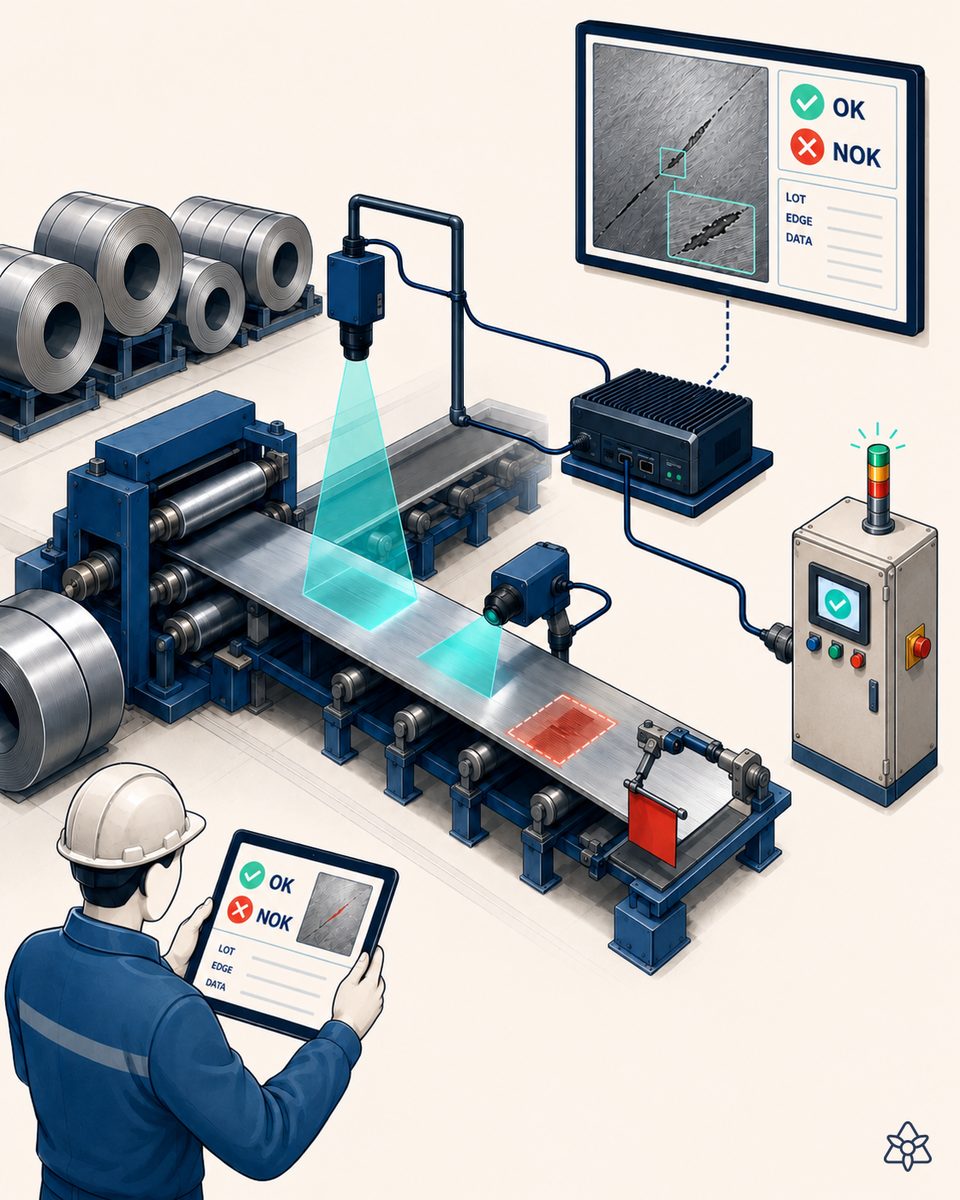
The deviation happens on the mill in seconds — but you pay for it in the coil yard or at the customer.
The quality of a hot rolled coil is the intersection of four pieces of data that are almost never on the same screen:
- Which steel went in — composition and heat certificate of the slab. In the melt shop system, delayed and in another building.
- How it went through the mill — entry and finishing temperature, speed, reduction per pass, roll loads. On the pulpit panels, in front of the operator and nowhere else.
- How it cooled — cooling on the run-out table and coiling temperature, which set the microstructure and the final flatness.
- What the strip looks like coming out — rolled-in scale, periodic roll marks, scratches, edge laps. A glance from the operator at the moving strip and little more.
The quality manager knows this, but most defects only get confirmed once the coil has cooled (and then you have to decide whether to downgrade the whole thing, cut it or reassign it to a lesser destination) or at the customer (when the strip is pickled, formed or painted and the mark comes out). By then the next heat has already been rolled with the same parameters. And the data that would explain what happened lives on a panel nobody logged and in a handwritten shift report. The classic system works 99% of the time. That 1% is what the monthly committee pays for.
iLEAN does not replace the mill's control system — it seals the cracks between heat, curve and coil.
The problem on a hot strip mill is not a lack of information: it is information living on separate islands — the panel, the shift report and the heat certificate — that never reaches, cross-referenced, the person who decides where the coil goes. iLEAN acts as the putty that fills those gaps, without asking you to change the mill control system, to open the loop, or to negotiate an integration with the line builder.
Connect reads the mill panels without touching the control system. Edge classifies the surface on the hot strip. The agent cross-references heat, curve and coil in the central memory and builds the dossier. The person decides where the coil goes.
The three iLEAN pieces applied to hot rolling:
- Edge — a computer-vision terminal (CNN) over the moving strip, with a camera and lighting adapted to the radiation of the hot strip. It classifies rolled-in scale, periodic roll marks, longitudinal scratches and edge laps, and flags the questionable stretch with its position in meters of coil. It works with no network.
- Connect — non-invasive reading of the mill panels: a camera aimed at the pulpit display or the mimic panel transcribes temperatures, speeds and loads into the central memory, without touching the PLC. And it captures everything else: heat certificate, rolling schedule, shift report, roll change, a heads-up from a customer with a tighter spec.
- Agent — cross-references heat ↔ mill curve ↔ coil in the central memory: it links the surface signature to the actual temperature and reduction window each stretch was rolled in, alerts the quality manager through whatever channel they use when the curve approaches the edge of the window, and builds the per-coil dossier automatically. The person decides and signs; no coil is downgraded on its own.
Panels and shift reports vs. cross-referenced control with iLEAN
| Aspect | Mill panels + shift report | With iLEAN Edge + Connect + Agent |
|---|---|---|
| Mill curve (temperature, speed, reduction) | On the pulpit panel, with no cross-referenced record | Read off the panel without touching the control, attached to each coil |
| Heat certificate | In the melt shop system, in another building | Cross-referenced with the curve and with the strip surface |
| Surface defect | A glance at the strip and confirmation once the coil is cold | Classified on the strip, with its position in meters of coil |
| Dimensional deviation | Discovered on cooling, already in the coil yard | Alert when the curve approaches the edge of the window |
| Operation without a network | n/a | Edge keeps classifying with its own light |
| File for the customer | Rebuilt by hand after a complaint, from shift memory | Per-coil dossier, automatic, with heat + curve + image |
Impact estimate for your plant — to be validated with your numbers.
The block below is an estimate to be validated with the specific data of your plant. We put it forward so the committee has an order of magnitude; we refine it during the diagnostic.
- Hot strip mill supplying sheet processors: automotive, white goods, tube, structural steel or slitting services.
- Edge pilot on the run-out table (surface camera with optics for hot strip + non-invasive reading of the mill panels + integration with the heat certificate). First value expected within a few weeks.
- Reduction of downgraded coils and of customer complaints against the historical baseline ≥ 25% — a conservative estimate.
- Indicative payback between 5 and 10 months, depending on the average value of a downgraded coil and the number of surface or flatness complaints over the last year.
- The hard lever is cutting out the bad stretch instead of downgrading the whole coil, and coming to the complaint with a dossier rather than with a hand-made reconstruction.
And the quality manager's reasonable doubt
“What if the AI flags a stretch as defective when it was fine?” — hallucination is a problem of free generation, not of anchored tasks. In tasks where the AI merely cross-references surface signature + mill curve + heat composition, the best models brought error below 1.5% [1]. And even so, the flagged stretch goes to a second review on the cold coil, not straight to a downgrade. The person decides; no coil is downgraded on its own. The three safety rings are there for exactly this.
[1] OpenAI paper “Why Language Models Hallucinate”, 2025 — on the reliability of AI in anchored tasks.
What people ask about steel control in hot rolling
What goes out of control on a hot strip mill?
The window is narrow: entry and finishing temperature, pass speed, reduction per pass and cooling on the run-out table. When one of those four drifts by a few tenths, you get thickness or flatness deviation and surface defects — rolled-in scale, periodic roll marks, edge laps. The problem is not that nobody knows: it is that it gets confirmed late, with the coil already cooled, packed or at the customer.
Why does the mill data never reach the decision-maker cross-referenced?
Because it lives in three places that do not talk to each other: the mill panels (temperatures, loads, speeds) in front of the operator, the shift report on paper or in a spreadsheet, and the heat certificate in the melt shop system. Nobody has, coil by coil, the complete curve alongside the composition and alongside what was seen on the strip. When the complaint arrives, all of that gets rebuilt by hand and from shift memory.
How does iLEAN read an old mill without touching the control system?
With non-invasive panel reading: a camera aimed at the pulpit display or at the mimic panel, and a model that transcribes those values into the central memory. The PLC is not touched, the control loop is not opened, and there is no need for the mill builder to authorize an integration. It is the usual route when the line is decades old and the control system is closed — and the mill data starts existing in digital form from day one.
What does Edge vision see on the hot strip?
Edge classifies surface defects on the moving strip — rolled-in scale, periodic roll marks, longitudinal scratches, edge laps — with a camera and lighting adapted to the radiation of the hot strip. It flags the questionable stretch with its position in meters of coil, so that the decision to downgrade or to cut is taken on a specific zone and not on the whole coil. It works with no network: if the plant loses WiFi, Edge keeps classifying and flagging.
How much does a hot rolling pilot cost and how fast does it pay back?
The order of magnitude is that of any Edge pilot on a continuous line: an initial investment covering terminals, a surface camera with optics for hot strip, panel reading from the mill and integration with the heat certificate, plus an annual license. A reasonable payback to present to the committee is between 5 and 10 months, through fewer downgraded coils and fewer customer complaints. It is an estimate to be validated with your numbers: we ask for your plant's data and send you the estimated ROI in 48h.
More cases in petrochemical
- Steel galvanizing with AI — zinc is expensive; what leaves through excessive drainage never comes back.How iLEAN combines in-line vision, zinc bath capture and agents to anticipate hot-dip galvanizing…
- Hazardous waste traceability in the chemical industry — a broken manifest is a penalty, a bad classification is a premium rate.iLEAN traces hazardous waste from the plant to the licensed contractor. EPA/EU compliance with no paper.
- Heat exchangers with AI — fouling is invisible, but it bills you every month.iLEAN models heat exchanger fouling and proposes the optimal cleaning window between turnarounds. No…
- Green hydrogen by electrolysis with AI — when every kWh decides whether the project pays off.How iLEAN cross-references electrolyzer stacks, balance of plant and the power grid to anticipate…
- Industrial adhesive control with AI — one drum with out-of-range viscosity means the customer's line is down.How iLEAN cross-references in-line viscosity, tack and open time of industrial adhesive with the batch…
- Industrial paint manufacturing with AI — when delta-E is decided by a spectrophotometer reading that comes too late.How iLEAN cross-references dispersion, color, viscosity and pigment traceability to hold the formula…
Tell us your case and in 48h we'll send you the estimated ROI of this AI project for your rolling mill.
We work on your plant's real data, not ours. Diagnostic with no commitment.
Request estimated ROI in 48h See petrochemical and materials