Hazardous waste traceability in the chemical industry — a broken manifest is a penalty, a bad classification is a premium rate.
Badly traced hazardous waste means a regulatory penalty and hidden cost. iLEAN covers cradle-to-grave — from the point of generation in the plant to the licensed contractor — with contractor integration, cross-referencing against SDS and EWC/EPA codes, and a living file. The person validates every critical step.
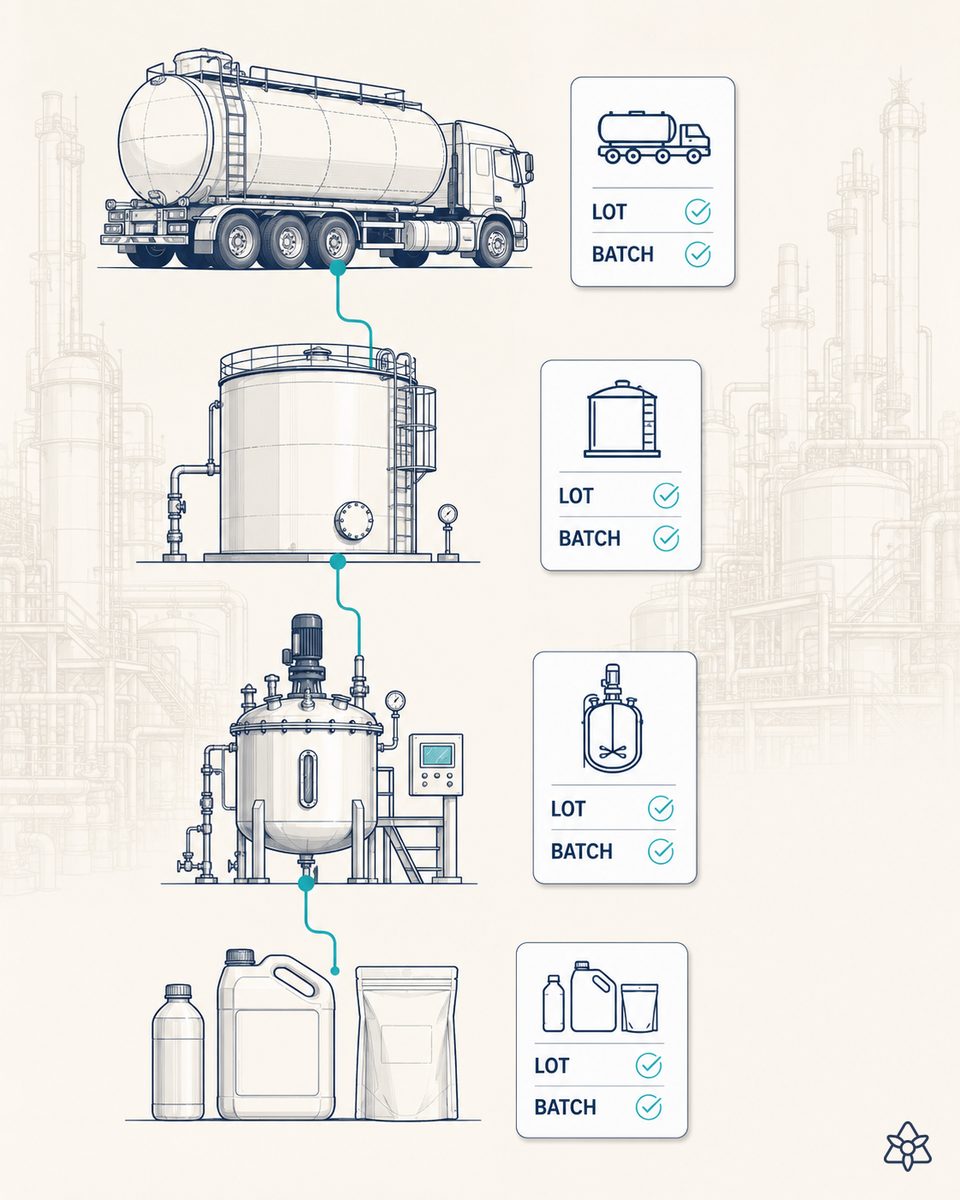
Hazardous waste is managed across three systems that do not talk to each other.
The environmental/HSE manager of a chemical plant lives with the same friction every week:
- The point of generation. A purge stream, a sludge, a spent solvent, a contaminated container. The composition depends on the batch recipe, on the yield of that shift and sometimes on an incident — and it is almost always assumed, not measured.
- The licensed contractor. Every contractor has its own portal, its own manifest format, its own collection calendar, its own rates tiered by EWC/EPA code. Every collection is an email, a phone call, a spreadsheet updated by hand.
- The cradle-to-grave file for the regulator. At inspection you have to demonstrate: how much was generated, which EWC code was assigned, which carrier collected it, what intermediate treatment, what final destination. All of it rebuilt by hand from emails, paper manifests and treatment certificates that arrive weeks later.
The classic system works almost every time. But the day the inspector asks for the cradle-to-grave record of last month's EWC 070104* batch and the treatment certificates cannot be found, the penalty is serious and the responsibility still sits with the generator. It is not a people problem — it is a problem of information living on islands between plant, contractor and authority.
iLEAN does not add a fourth system — it seals the cracks between the plant, the contractor and the regulator.
The plant already has a waste management system (sometimes an ERP module, sometimes a vertical tool, sometimes a spreadsheet). The contractors already have their portals. The regulator already has its formats. Each one does its own job well. The problem lives in the joints — between the point of generation and the manifest, between the manifest and the treatment certificate, between the certificate and the file for the inspector. iLEAN acts as the putty that fills those gaps, without asking you to change contractor or ERP.
Tracer records the waste at source, with its real composition. Writer assembles the manifest. Connect closes the loop with the contractor and captures the treatment certificate. The person validates; the cycle never closes on its own.
The three iLEAN pieces applied to hazardous waste traceability:
- Tracer — records the waste at the point of generation: which stream, which process batch it came from, real volume/mass (scale, meter or validated estimate), probable composition cross-referencing recipe + SDS + lab analysis where there is one. It assigns an EWC or EPA code with a reasoned proposal — the person validates or reclassifies. The waste stops being a drum in a yard: it is an object with an identity from second one.
- Writer — generates the manifests (EPA e-Manifest, EU transfer identification document, national equivalents) already filled in with generator, carrier, contractor, code, mass and hazard properties. It asks the person to review and sign; it never issues on its own.
- Connect — integrates with the portals/APIs of the licensed contractors, captures the intermediate and final treatment certificates as they come in (sometimes email, sometimes portal, sometimes a photographed paper), and attaches them to the waste batch file. When the cradle-to-grave cycle is complete, the dossier is signed and ready for the regulator — with no later reconstruction.
Waste management in spreadsheets vs. cradle-to-grave with iLEAN
| Aspect | Classic management + spreadsheets + contractor portals | With iLEAN Tracer + Writer + Connect |
|---|---|---|
| Identifying the waste at source | Label written by hand at the end of the shift | Recorded in the plant with probable composition and EWC/EPA code |
| EWC/EPA classification | Historical default, sometimes over-classified | Cross-reference of SDS + recipe + lab analysis; the person validates |
| Transfer manifest | Filled in by hand, paper copy | Draft generated, signed by the manager |
| Treatment certificate | Arrives by email weeks later, filed by hand | Captured automatically, attached to the file |
| Cradle-to-grave file | Rebuilt for the inspector | Living dossier, signed step by step |
| Waste KPI per unit of product | Calculated once a year | Live by shift, by batch, by SKU |
Impact estimate for your plant — to be validated with your numbers.
The block below is an estimate to be validated with the specific data of your plant. We put it forward so the committee has an order of magnitude; we refine it during the diagnostic.
- Chemical plant with 4-10 different hazardous waste streams, 2-5 licensed contractors, a waste module in the ERP or a vertical tool plus a parallel spreadsheet, and periodic regional/national inspections.
- Pilot on one priority stream (the highest-volume one, or the one the contractor reclassifies most often), integrated with SDS + ERP + one contractor. First value expected within a few weeks.
- Expected reduction in administrative management hours of over 30% in the first months.
- Expected reduction in waste over-classification (which triggers the contractor's premium rate) of between 10% and 25% depending on the stream.
- Indicative payback between 4 and 9 months, counting administrative savings + less over-classification + avoiding a non-conformity at inspection.
And the environmental manager's reasonable doubt
"What if the agent classifies a waste stream wrong and we end up with a worse regulatory problem?" — hallucination is a problem of free generation, not of anchored tasks. Assigning an EWC/EPA code is exactly an anchored task: the composition comes from the recipe + SDS + lab analysis; the agent proposes the code from the codified list. In this kind of task, the best models brought error below 1.5% [1]. And even so, what is critical is never decided alone: iLEAN proposes; the environmental manager validates and signs before the manifest is issued. The three safety rings exist precisely for this.
[1] OpenAI paper "Why Language Models Hallucinate", 2025 — on the reliability of AI in anchored tasks.
What people ask about hazardous waste traceability with AI
What does cradle-to-grave traceability require?
Cradle-to-grave makes the generator of hazardous waste answerable for it from its origin (the plant where it is produced) all the way to its final treatment, even if the waste changes hands along the way. In the US this is formalized by RCRA through the hazardous waste manifest (paper or EPA e-Manifest). In the EU, Directive 2008/98/EC plus the EWC codes and the national regimes (NIMA, the transfer identification document, e-SIR) cover the same principle. The generator remains responsible even while the waste is in the hands of the carrier or the contractor — a broken manifest does not release you, it only shows where the chain broke.
How is it cross-referenced with the waste SDS / safety data sheet?
iLEAN Connect reads the SDS (safety data sheets) of the process chemicals and, together with the batch recipe, infers the probable composition of the waste generated (purge streams, distillation heads and tails, neutralization sludges, spent solvent). It cross-references EWC codes in the EU or EPA codes in the US and assigns the right code before generating the manifest. If the real composition measured in the outlet analysis deviates from the expected one, the agent reopens the code assignment and alerts the environmental manager — the person decides whether the waste is reclassified.
What about integration with licensed waste contractors?
iLEAN Connect integrates with the portals and APIs of the licensed contractors your plant works with (collection, transport, intermediate treatment, recovery, final disposal). When a collection is closed out, the digital manifest is signed by both parties, the treatment certificates flow automatically into the waste batch file, and the agent closes the cradle-to-grave cycle without anyone rekeying anything. For contractors still working on paper, Connect captures the photographed or scanned manifest and digitizes it at second zero.
Does it comply with EPA RCRA and EU regulations?
Yes. The system keeps the manifest in the format of the applicable regime (EPA e-Manifest for the US, the transfer identification document and NIMA for Spain, national equivalents in other EU Member States) and preserves the chain of custody signed cryptographically — the iLEAN safety rings guarantee the trace is not altered afterwards. The cradle-to-grave file is ready for inspection at any moment; it is not compiled the night before the auditor arrives.
Is there a reduction in waste management costs?
This is an estimate to be validated with your plant. Chemical plants that close the waste traceability loop with AI typically see reductions of over 30% in administrative hours, with first value within a few weeks. The hard lever goes further: classifying the waste correctly at source avoids paying premium contractor rates after a reclassification; a living dossier avoids penalties at inspection; and the reduction in liters/kg handled becomes measurable once you see it by shift instead of by quarter — what gets seen gets improved. Indicative payback between 4 and 9 months.
More cases in petrochemical
- Epoxy resin control with AI — a batch out of spec is not an incident, it is a customer lost.How iLEAN cross-references bisphenol-A/epichlorohydrin stoichiometry, the exotherm curve and in-line…
- Float glass with AI — catching the bath drift half an hour before the ribbon falls from prime to B.How iLEAN cross-references ribbon vision, tin bath and annealing lehr to anticipate float glass…
- Steel galvanizing with AI — zinc is expensive; what leaves through excessive drainage never comes back.How iLEAN combines in-line vision, zinc bath capture and agents to anticipate hot-dip galvanizing…
- Heat exchangers with AI — fouling is invisible, but it bills you every month.iLEAN models heat exchanger fouling and proposes the optimal cleaning window between turnarounds. No…
- Hot rolled steel control with AI — the window is narrow and the defect shows up with the coil already cold.How iLEAN cross-references heat, mill curve and surface vision on the strip to catch defects and…
- Green hydrogen by electrolysis with AI — when every kWh decides whether the project pays off.How iLEAN cross-references electrolyzer stacks, balance of plant and the power grid to anticipate…
Tell us about your case and in 48h we'll send you the estimated ROI of this AI hazardous waste traceability project for your plant.
We work on your plant's real data, not ours. Diagnostic with no commitment.
Request estimated ROI in 48h See petrochemical and chemical