Float glass with AI — catching the bath drift half an hour before the ribbon falls from prime to B.
The quality of a float ribbon is the crossing of four realities — tin bath composition and temperature, melting furnace curve, defect pattern at high speed and annealing in the lehr. iLEAN cross-references defect vision with process sensors to anticipate the distortion, instead of cataloguing it once it is already scrap. The person signs.
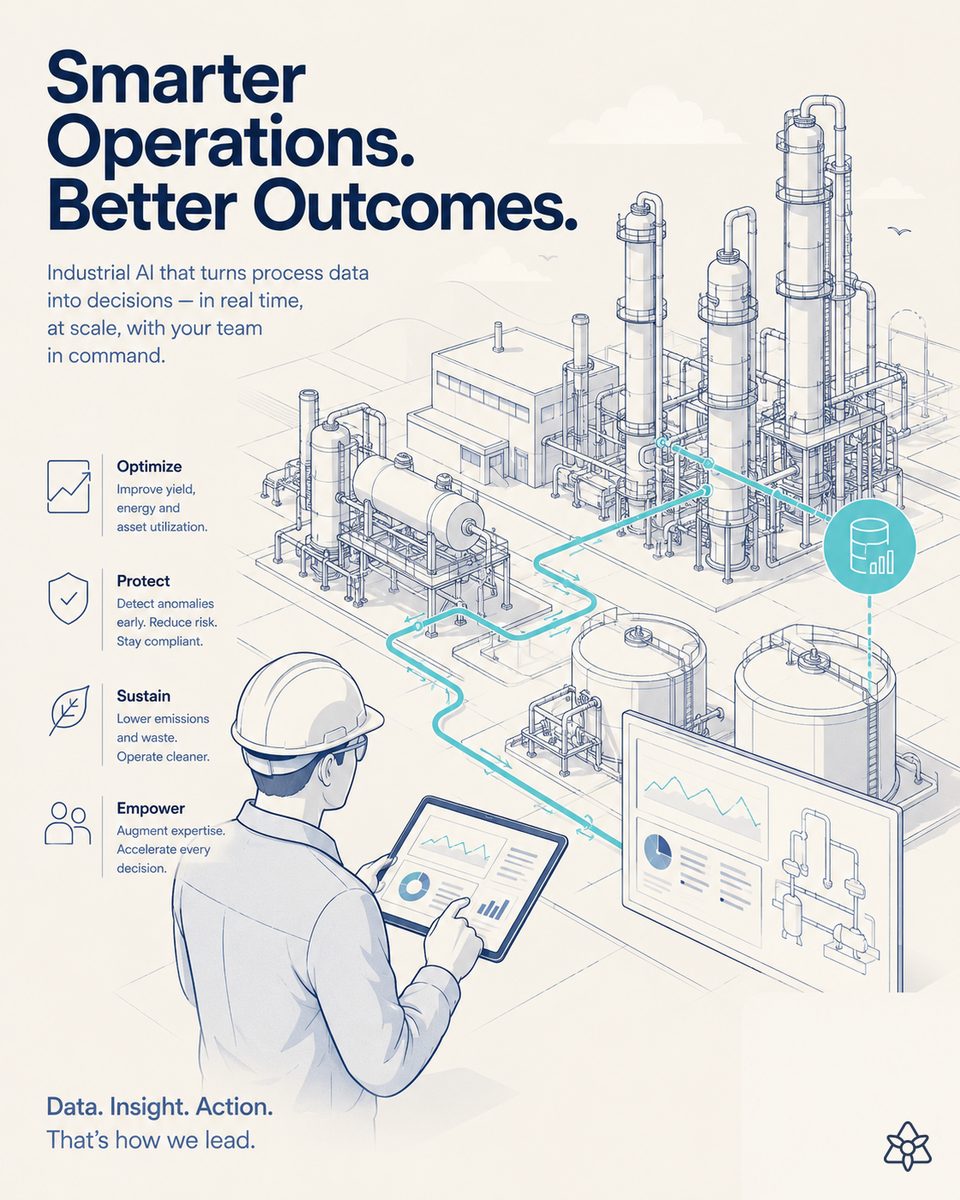
The ribbon never stops — and by the time you see the defect, you already have hundreds of meters of it.
A float glass line is one of the most demanding continuous processes in the industry. Ribbon quality is the crossing of four realities that live in different systems:
- What happens in the melting furnace — composition, zone temperatures, charging cycles. SCADA data that almost nobody cross-references in real time with the inspection camera.
- What happens in the tin bath — thermocouples by zone, reducing atmosphere, ribbon speed. Small drifts the operator spots too late.
- What the ribbon shows — optical defects (bubbles, inclusions, distortion, roller marks). Classic optical inspection detects them, but with the defect already fully formed.
- How the lehr anneals — cooling gradient, residual stress. Anneal it badly and the sheet breaks spontaneously at the cutting line or on site.
The line manager knows all this, but cannot hold four systems in one head. The ribbon keeps coming out, and by the time it is confirmed that it is falling from prime to B you have lost 20-30 minutes at thousands of euros an hour of margin — not a minor incident. The classic system works 99% of the time. That 1% is where the month's margin goes.
iLEAN does not replace the bath SCADA — it seals the cracks between bath, camera and lehr.
The problem in float is not a lack of information: it is information living on islands that, at the critical moment (the bath drift, the bubble forming in one specific band), does not reach the decision-maker cross-referenced. iLEAN acts as the putty that fills those gaps, without asking you to change the SCADA, the optical inspection system or the annealing lehr.
Edge watches the ribbon with deep vision at real speed. Connect reads the bath, the furnace and the lehr wherever they live. The agent cross-references the defect pattern with the process signature and flags the drift — 20-30 minutes early — to the shift lead, who decides.
The three iLEAN pieces applied to float glass:
- Edge — a machine-vision terminal (CNN) on the line. Cameras at the lehr entrance or at the bath exit, with coherent lighting to classify bubbles, inclusions, distortion and roller marks at ribbon speed. It tags the zone and sends the trace to the agent. It works without a network.
- Connect — captures bath parameters (thermocouples, atmosphere, speed), furnace parameters (curve and charging) and lehr parameters (gradient), whether they come from a modern SCADA, a local data logger or the lab spreadsheet. And it captures what arrives from outside: a change of soda ash from the supplier, a new specification from a glass processor.
- Agent — cross-references the defect pattern on camera with the thermal/chemical signature of the process and anticipates the drift. It does not send an email at 10 pm: it alerts the shift lead through whatever channel they use, with the probable root cause and the suggested actions. The person decides what to adjust; the line does not correct itself.
Classic optical inspection vs. cross-referenced inspection with iLEAN
| Aspect | Optical inspection + standalone SCADA | With iLEAN Edge + Connect + Agent |
|---|---|---|
| Defect detection | At the cutting line, defect already formed | On the ribbon at high speed, classified in line |
| Root cause | Investigated afterwards; the bath data is in another system | Automatic cross-reference with bath, furnace and lehr at second zero |
| Anticipating the drift | n/a — you see it once it is already scrap | 20-30 minutes early, from defect pattern + thermal signature |
| Fall from prime to B | Discovered at the end of the shift | Alert to the shift lead with the probable root cause |
| Operation without a network | n/a | Edge keeps classifying on cabinet power |
| File for the glass processor | Rebuilt by hand when a claim comes in | Per-coil/batch dossier, with a photo of the zone |
Impact estimate for your plant — to be validated with your numbers.
The block below is an estimate to be validated with the specific data of your plant. We put it forward so the committee has an order of magnitude; we refine it during the diagnostic.
- Continuous float line running several formats, multi-thickness, supplying glaziers and glass processors.
- Edge pilot at the lehr entrance (cameras + lighting + integration with the bath and furnace SCADA). First value expected within a few weeks.
- Reduction of ribbon-hours downgraded to B against the historical baseline ≥ 30% — a conservative estimate; that is the order of leverage of predictive jidoka.
- Indicative payback between 4 and 9 months, depending on the prime-to-B margin gap and the frequency of drifts documented over the last few months.
- The hard lever is every hour gained in prime grade and the root cause closed for the next shift.
And the line manager's reasonable doubt
“What if the AI flags false positives and makes me touch the bath when I shouldn't?” — hallucination is a problem of free generation, not of anchored tasks. In tasks where the AI simply cross-references a defect pattern with a process signature, the best models brought error below 1.5% [1]. And even so, what is critical is never decided alone: iLEAN alerts and the person decides what to adjust. The three safety rings exist precisely for this.
[1] OpenAI paper “Why Language Models Hallucinate”, 2025 — on the reliability of AI in anchored tasks.
What people ask about quality control in float glass
Which typical defects ruin a float glass ribbon?
The classics of the float process are bubbles and gaseous inclusions (from the melting furnace), tin bath contamination (SnO2 spots, top/bottom defects), optical distortion caused by a thermal gradient in the bath, roller marks on the way into the lehr and spontaneous breakage from badly annealed residual stress. Each one has its own visual signature and each one points to an upstream process parameter — but the pattern only becomes visible if the camera, the furnace, the bath and the lehr are seen together in the same view.
Why does classic optical inspection fail to catch a bath drift in time?
Because classic optical inspection looks at the sheet at the cutting line, with the defect already fully formed: by then you have generated tens of linear meters with the defect developing. The early signal that warns of the drift lives in the cross-reference — bath composition + zone temperatures + ribbon speed + defect pattern on the camera. When the agent sees that small bubbles are starting to drift toward one specific band of the ribbon and that thermocouple 7 in the bath dropped two degrees 40 minutes ago, it anticipates distortion that has not happened yet, instead of cataloguing it once it is already scrap.
What is one hour of out-of-spec float ribbon worth?
A continuous float line produces hundreds of tonnes of glass a day and almost never stops — stopping it is off the table, going out of spec is very expensive. One hour producing ribbon at lower quality than planned (downgraded from prime to B, from B to scrap) translates into thousands of euros an hour of lost margin, plus the cost of the ribbon that goes back as cullet. The hard lever is not cutting scrap from 2% to 1.9% — it is anticipating the drift 20-30 minutes earlier and giving operations room to correct.
Can iLEAN Edge work in line on a ribbon at production speed?
Yes. Edge is a machine-vision terminal (CNN) on the line itself — high-resolution cameras at the lehr entrance or at the bath exit, with coherent lighting to detect bubbles, inclusions, distortion and roller marks at real ribbon speed. It classifies the defect, tags the zone and sends the trace to the agent, which cross-references it with bath and furnace parameters. It works without a network: if the plant loses WiFi, Edge keeps classifying and recording.
How much does an AI quality pilot cost on a float glass line?
The order of magnitude of an Edge pilot on a float line is that of any Edge pilot in a critical continuous process: an initial investment covering terminals, cameras, lighting and integration with the bath/furnace/lehr parameters, plus an annual license. A reasonable payback to present to the committee is between 4 and 9 months: the hard lever is every hour gained with the ribbon in prime grade instead of B. We ask for your plant's data and send you the estimated ROI in 48h, with your numbers, not ours.
More cases in petrochemical
- Detergent formulation with AI — the batch that separates in the warehouse never showed its face in the reactor.How iLEAN cross-references surfactants, enzymes, viscosity, foam and batch traceability to keep the…
- Energy optimization with an AI digital twin — a badly tuned plant burns steam and electricity every single shift.iLEAN runs a digital twin of your chemical plant and proposes optimal setpoints every shift to cut…
- Epoxy resin control with AI — a batch out of spec is not an incident, it is a customer lost.How iLEAN cross-references bisphenol-A/epichlorohydrin stoichiometry, the exotherm curve and in-line…
- Steel galvanizing with AI — zinc is expensive; what leaves through excessive drainage never comes back.How iLEAN combines in-line vision, zinc bath capture and agents to anticipate hot-dip galvanizing…
- Hazardous waste traceability in the chemical industry — a broken manifest is a penalty, a bad classification is a premium rate.iLEAN traces hazardous waste from the plant to the licensed contractor. EPA/EU compliance with no paper.
- Heat exchangers with AI — fouling is invisible, but it bills you every month.iLEAN models heat exchanger fouling and proposes the optimal cleaning window between turnarounds. No…
Tell us about your case and in 48h we'll send you the estimated ROI of this AI project for your float line.
We work on your plant's real data, not ours. Diagnostic with no commitment.
Request estimated ROI in 48h See petrochemicals and materials