Energy optimization with an AI digital twin — a badly tuned plant burns steam and electricity every single shift.
A badly tuned chemical plant burns steam and electricity without the operator knowing until next month's bill. iLEAN runs a digital twin of the plant on top of your real DCS, proposes optimal setpoints shift by shift and measures the saving against the baseline, in kWh and in m³. The operator signs off every change.
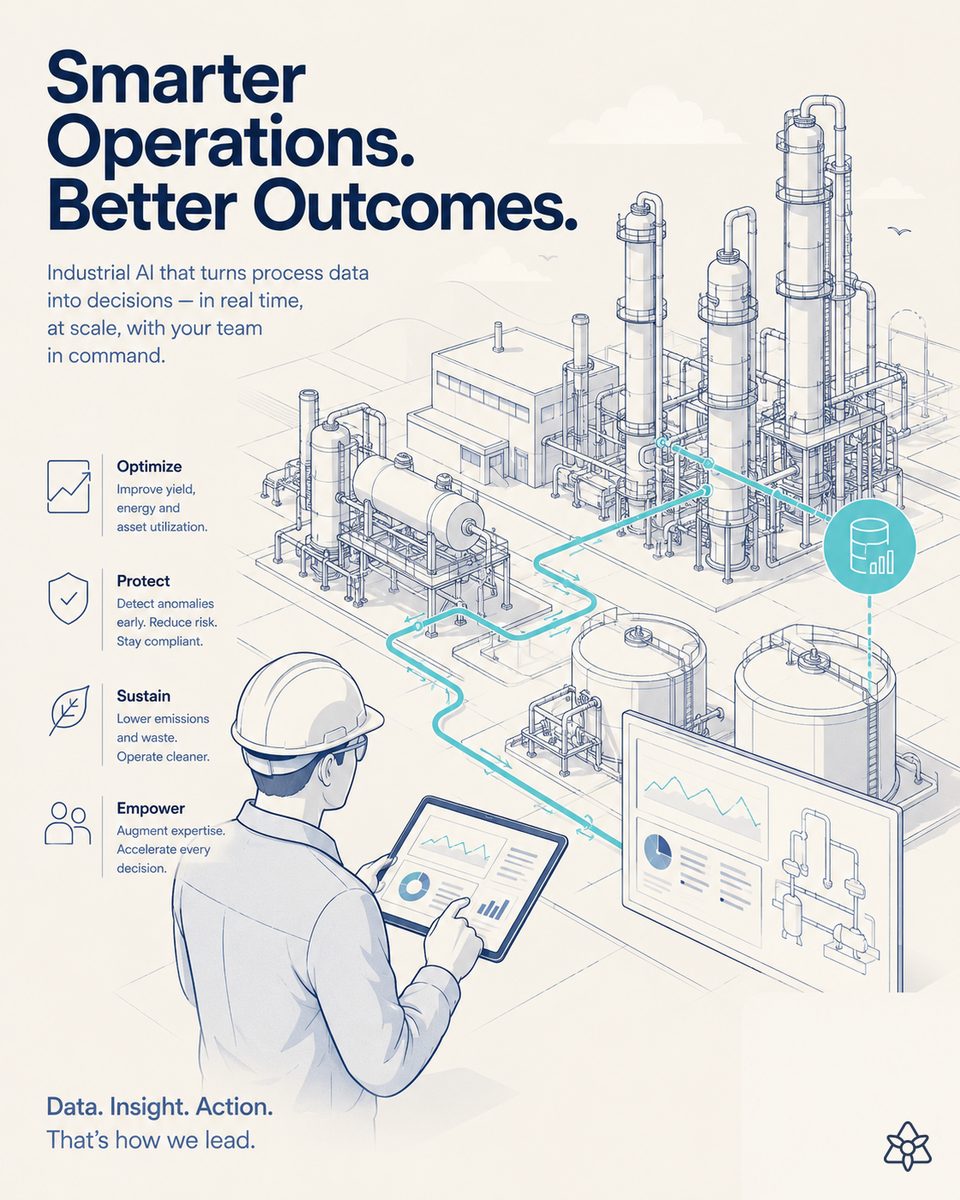
The plant has a thousand setpoints; only a few of them are genuinely optimal.
The operations / energy manager of a chemical plant lives with the same friction every week:
- The DCS is tuned to the design, not to today. The original setpoints were calculated for a given recipe, a given capacity and a given energy cost. The plant has evolved — the mix changed, raw materials change with the supplier, electricity prices move every hour — and the setpoints are still the ones from commissioning.
- The veteran's intuition is the best tool available. The operator with the most years knows that “if we drop 3 °C in reactor 2 when we switch to recipe B, the steam header gets a rest”, but that knowledge is not in any system. The day they retire, it leaves with them.
- Trying to optimize on the live plant is frightening. Moving a setpoint without knowing the effect on quality or safety is a gamble. And simulating it in an external proprietary model is expensive and takes months to calibrate.
- The energy bill arrives late. Specific consumption per unit of product shows up at month-end; the operator gets no real-time feedback on how much each shift is costing.
The classic system works — the plant operates and produces. But it operates far from the energy optimum most of the time, and nobody in the plant has a way to prove it. This is not a people problem — it is a problem of information (what is happening) and simulation (what could happen) living on separate islands.
iLEAN does not add a fourth system — it seals the cracks between the DCS, the veteran's knowledge and the energy bill.
The plant already has a DCS, meters, quality analyses and an MES or an APC. Each one does its own job well. The problem lives in the joints — between real-time operational data and the question “what would happen if…?”, between plant knowledge and the energy bill, between the improvement proposal and the operations approval. iLEAN acts as the putty that fills those gaps, without asking you to change your DCS or your APC.
Edge captures what the DCS does not see. Brain keeps the digital twin calibrated against history. The agent proposes setpoints. The operator signs — the system never touches the DCS without a validated envelope.
The three iLEAN pieces applied to energy optimization with a digital twin:
- Brain (digital twin) — a model of the sub-process trained on the real DCS history and calibrated against live data. It answers questions like “if I raise the feed flow by 8% and drop pressure by 2%, how much steam do I save and how far does quality move?”. It is not a monolithic proprietary simulator: it is a living model that learns with every shift and also captures the veteran's knowledge when the agent cross-references it with real data (what the veteran knew becomes formalized).
- Edge + Tracer — they capture what the DCS does not integrate: the local panel of an old valve by vision, the electricity meter of the utilities, the analysis that is still written down on paper. Without complete capture, the digital twin has gaps; with complete capture, the twin can be trusted.
- Agent — every shift, it proposes optimal setpoints to the operator on their screen — not in an email at 10pm. It cites the source of the calculation (the history, the recipe, the conditions), the expected saving in kWh/t and the effect on quality. The operator accepts, modifies or ignores. The system measures the result against the baseline. What worked gets formalized in the twin for next time.
Operating on inherited setpoints vs. the iLEAN digital twin
| Aspect | Classic operation with a DCS + a monthly bill | With iLEAN Brain + Edge + Agent (digital twin) |
|---|---|---|
| Where the setpoints come from | Commissioning + the veteran's intuition | A twin calibrated on real history + the conditions of the shift |
| Capturing the veteran's knowledge | In their head, gone on the day they retire | Formalized in the twin when the agent cross-references it with data |
| Feedback to the operator | Monthly energy bill | Savings in kWh per accepted change, on their screen |
| Simulating changes | Try it on the live plant or use an expensive external tool | The twin answers in seconds, without touching the plant |
| Energy baseline | Approximate annual calculation | Live EnPI, per shift, adjusted for conditions |
| CSRD / customer reporting | Duplicated work, a separate template | The same twin data feeds the reporting |
Impact estimate for your plant — to be validated with your numbers.
The block below is an estimate to be validated with the specific data of your plant. We put it forward so the committee has an order of magnitude; we refine it during the diagnostic.
- Mid-sized chemical plant with a DCS in place, a steam header + electrical supply + one energy-intensive sub-process (reactor, distillation column, pumping train), and at least 12 months of operating history available in the DCS or the historian.
- Digital twin pilot on a priority sub-process (the one with the highest energy cost or the highest consumption variability). First value expected within a few weeks.
- Expected energy savings in the pilot sub-process between 5% and 15% in the first months, depending on the baseline and the initial variability.
- Indicative payback between 4 and 9 months, depending on the energy cost of the pilot sub-process.
- The hard lever adds up: the energy bill + a reportable footprint reduction + a basis for future decarbonization investments + retaining the veteran's knowledge.
- Context data point: the most digitalized sectors raised productivity by up to 40% compared with the least digitalized ones[2]. Serious digitalization is not a cost — it is a lever.
And the operations manager's reasonable doubt
“What if the twin gets it wrong and proposes a setpoint that affects quality or safety?” — hallucination is a problem of free generation, not of anchored tasks. Proposing an optimal setpoint is an anchored task: the twin is calibrated against real history and proposes within the known operating range. In this kind of task, the best models brought error below 1.5% [1]. And even so, what is critical is never decided alone: iLEAN proposes to the operator and never writes to the DCS without a human signature. The three safety rings exist precisely for this: the OT network only accepts validated changes.
[1] OpenAI paper “Why Language Models Hallucinate”, 2025 — on the reliability of AI in anchored tasks.
[2] Fundación BBVA / Ivie — productivity of the most digitalized sectors vs. the least digitalized ones (2000-2021).
What people ask about energy optimization with an AI digital twin
What is a digital twin of a chemical plant?
A digital twin is a model of the plant that reproduces its real behavior well enough to simulate what would happen if you changed a setpoint, a mix or a condition. It is not a pretty drawing and it is not a BI dashboard: it is a model that learns from the operating history, is calibrated against real DCS data and is used to answer questions like “if I lower the inlet of reactor X by 5 °C, how much steam do I save and how far does quality drift?”. At iLEAN the twin does not live in a CAD tool: it lives in Brain, fed by the continuous data from Tracer + Edge, and it proposes optimal setpoints shift by shift.
How much does it cost to build the digital twin?
Far less than it cost five years ago, and for the same reason that integration in general came down in price: AI is exceptionally good at the work of homogenizing heterogeneous data, calibrating models against history and learning from real operation. It does not require replacing the DCS or installing a monolithic proprietary simulator. iLEAN builds the twin on the plant's live data (DCS, meters, lab analyses), iterating sub-process by sub-process starting with the low-hanging fruit — the sub-process with the highest consumption and the highest variability — and moving on to the rest. The initial investment covers integration + training of the sub-process twin + the license; indicative payback between 4 and 9 months.
Does it work with a legacy DCS?
Yes. iLEAN Connect integrates with classic DCS platforms (Honeywell, Emerson, Yokogawa, ABB, Siemens) through their standard interfaces (OPC UA, OPC DA, historians such as PI, the DCS's own SQL database). Where there is no better way, Edge reads the local panel screen by vision. The critical part: the digital twin reads from the DCS but does not write to the DCS without a signature. The optimal setpoints the agent proposes are applied by the operator, not by the system. The three iLEAN safety rings guarantee that the OT network accepts nothing without a validated envelope signed by a person.
Are the energy savings really measurable?
Yes, and this is the heart of the approach's honesty. iLEAN keeps the sub-process's energy baseline from before the pilot (specific consumption per unit of product, per mix, per external conditions) and compares real consumption against the baseline adjusted for conditions. Savings are reported in kWh, in m³ of gas, in tons of steam — with the same logic ISO 50001 requires for EnPIs. It is not “we think we saved” — it is “here are the kWh saved per shift, this is the baseline, this is the calculation method”.
What about decarbonization and footprint reporting?
The same digital twin that optimizes energy today is the best instrument for decarbonizing tomorrow. It lets you evaluate the impact of a fuel switch, a partial electrification, a heat recovery project — before investing a single euro. And the verified energy savings feed straight into CSRD/ESRS and CDP reporting, and into the data your end customer asks for about the footprint of the product you sell them. One single piece of information, several legitimate consumers — with no duplicated sources.
More cases in petrochemical
- Crop protection control with AI — a mislabeled drum is not an incident, it is a recall and a penalty.How iLEAN cross-checks active ingredient dosing, GHS labeling and EFSA/MAPA registration in a crop…
- Barrel and derivative traceability with AI — from incoming crude to the customer's diesel, with no gaps in the genealogy.iLEAN links incoming crude, refining unit and finished product by batch and by tank. Complete genealogy.
- Detergent formulation with AI — the batch that separates in the warehouse never showed its face in the reactor.How iLEAN cross-references surfactants, enzymes, viscosity, foam and batch traceability to keep the…
- Epoxy resin control with AI — a batch out of spec is not an incident, it is a customer lost.How iLEAN cross-references bisphenol-A/epichlorohydrin stoichiometry, the exotherm curve and in-line…
- Float glass with AI — catching the bath drift half an hour before the ribbon falls from prime to B.How iLEAN cross-references ribbon vision, tin bath and annealing lehr to anticipate float glass…
- Steel galvanizing with AI — zinc is expensive; what leaves through excessive drainage never comes back.How iLEAN combines in-line vision, zinc bath capture and agents to anticipate hot-dip galvanizing…
Tell us your case and in 48h we'll send you the estimated ROI of this energy digital twin project for your chemical plant.
We work on your plant's real data, not ours. Diagnostic with no commitment.
Request estimated ROI in 48h See oil and chemical