Crop protection control with AI — a mislabeled drum is not an incident, it is a recall and a penalty.
A correct crop protection product is the intersection of three realities — active ingredient and adjuvant dosing, GHS labeling and EFSA/MAPA registration by destination country and CIP cleaning between campaigns to prevent cross-contamination. iLEAN cross-checks those three with in-line vision and sensors plus integration with your ERP/MES and registries, and holds the batch before filling when something does not add up. The person signs.
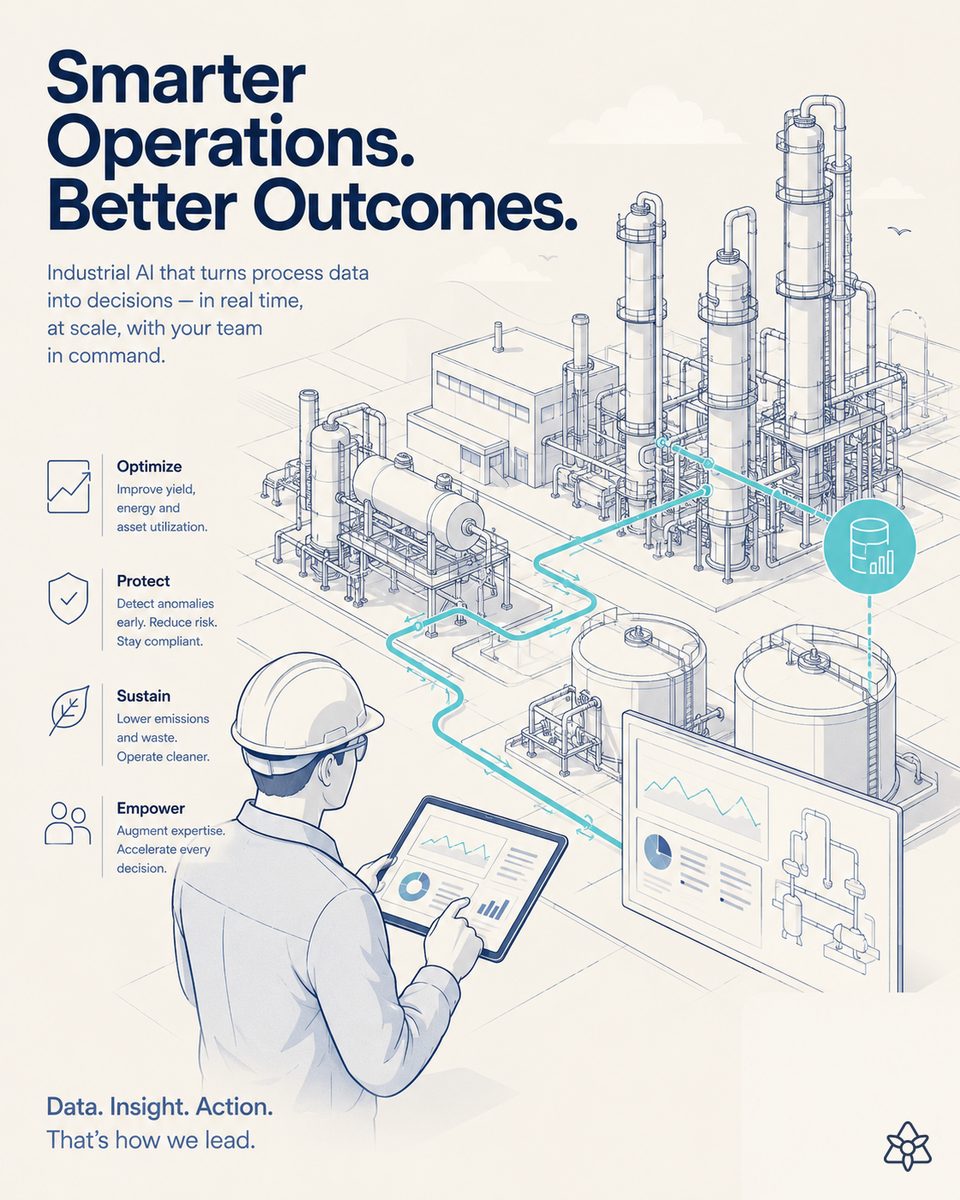
Three realities that are almost never in the same place.
A correct drum of crop protection product is the intersection of three pieces of data that, in most plants, each live on their own island:
- What the batch contains — the recipe for the active ingredient and the adjuvants. It usually sits in the ERP, in a vertical MES, or in a spreadsheet kept by the R&D manager and updated every season.
- Which authorization covers the SKU in each destination country — the MAPA registration number in Spain, DGAV in Portugal, SENASA in Argentina, ANVISA in Brazil, the new EUDR registration for products with deforestation risk. Every country, its own H/P statements, its own pictogram, its own language. The label matrices live in PDFs and in the regulatory manager's head.
- What happened on the line before — the production order and the CIP cleaning between campaigns. A trace of glyphosate in the next campaign's fungicide is cross-contamination — and a crop lost in the field.
The quality manager knows it, but cannot be in all three places at once. The operator has three screens and two checklists, and the changeover between campaigns is precisely the most vulnerable moment. The classic system works 99% of the time. That other 1% is what reaches the inspector — and every time it means a recall, a penalty and a distributor rethinking the next order.
iLEAN does not add a fourth system — it seals the cracks between the three you already have.
The problem in crop protection control is not a lack of information: it is information living on islands that, at the critical moment (the SKU changeover, the campaign changeover, the EUDR registration update), does not reach the decision-maker in time. iLEAN acts as the putty that fills those gaps, without asking you to change your ERP, your MES or the filling line.
Edge sees the label and the filling operation in line. Connect reads the recipe, the LIMS and the registration matrix wherever they live. The agent cross-checks against the authorization in force and, if something does not add up, holds the drum before the pallet. The person signs — never the other way round.
The three iLEAN pieces applied to crop protection control:
- Edge — a terminal with machine vision (CNN) over the filling line: it reads the label printed on the drum (H/P statements, registration number, language) and cross-checks it against the pallet's destination. It also captures the active ingredient weighing, the fill level and the VOC reading in the booth. If something does not add up, it triggers a status light and a rejecter before close. It works with no network.
- Connect — captures the batch recipe whether it comes from the ERP, the vertical MES or the regulatory manager's spreadsheet. And it also captures what arrives from outside (a MAPA authorization update, a new CLP H/P statement, an email from the Argentinian distributor requesting a labeling change, an EFSA alert about an active ingredient) at second zero, with nobody forwarding anything.
- Agent — cross-checks the batch recipe, the active ingredient analysis, the CIP cleaning between campaigns, the printed label and the authorization in force for each destination country. If there is a deviation, it does not send an email at 10 p.m.: it holds the drum and alerts the quality manager through whatever channel they use. It also generates the per-batch conformity dossier, ready for inspection or for the distributor. The person validates and signs; the line does not restart on its own.
Manual control vs. cross-checked control with iLEAN
| Aspect | Manual control + checklist per campaign | With iLEAN Edge + Connect + Agent |
|---|---|---|
| GHS labeling by destination country | Label matrix in PDF, manual review | Automatic cross-check on every drum before close |
| Verifying the EFSA/MAPA registration number | The operator looks up the current list | Edge reads the label and cross-checks it against the registry in a second |
| CIP cleaning between campaigns | Paper checklist, signed by the shift lead | CIP traceability cross-checked with the production order |
| Detecting cross-contamination | Lab analysis after the changeover (hours) | Predictive alert if the cleaning has not been closed out |
| Dossier for a 1107/2009 inspection | Rebuilt by hand, weeks | Per-batch dossier, automatic, with a photo of the filling |
| Operation with no network | n/a | Edge keeps running on the panel's own light |
Impact estimate for your plant — to be validated with your numbers.
The block below is an estimate to be validated with the specific data of your plant. We put it forward so the committee has an order of magnitude; we refine it during the diagnostic.
- Mid-sized multi-country crop protection plant (herbicides, fungicides, insecticides), 2 drum/jerrican filling lines running multi-SKU and multi-registration, seasonal campaigns.
- Edge pilot on one line (camera over the label + active ingredient weighing sensor + VOC sensor in the booth + integration with ERP/MES and the registration matrix). First value expected in a few weeks.
- Indicative payback between 4 and 9 months, depending on the frequency of recalls over wrong labeling, 1107/2009 inspection non-conformities and distributor claims documented in recent years.
- The hard lever is a single recall avoided in one country: drums collected from the distributor, reverse logistics, destruction of the regulated active ingredient, brand damage and a review of the registration. One recall pays for the pilot. The expected reduction in in-line rejects is ≥ 30% over the current baseline.
And the regulatory manager's reasonable doubt
“What if the AI misreads the H/P statement and lets a mislabeled drum through?” — hallucination is a problem of free generation, not of anchored tasks. In tasks where the AI merely reads a label and compares it against a registration in force, the best models brought error below 1.5% [1]. And even so, what is critical is never decided alone: iLEAN holds the drum and the person signs. The three safety rings exist precisely for this.
[1] OpenAI paper “Why Language Models Hallucinate”, 2025 — on the reliability of AI in anchored tasks.
What people ask about crop protection control with AI
What does AI control in a crop protection plant?
The four variables that decide whether the drum complies with its authorization: active ingredient dosing (glyphosate, mancozeb, deltamethrin, etc., each with its declared percentage), adjuvant formulation (wetting agent, dispersant, antifoam), multi-country GHS labeling (H/P statements, pictograms, the destination country's language) and the EFSA/MAPA registration number printed on the pack. iLEAN Edge captures the in-line measurements and reads the label at close, Connect cross-checks against the LIMS and the registration in force, and the Agents anticipate any deviation before the drum moves to the pallet.
How do you manage multi-country labeling (Spain, Portugal, Latin America, Africa)?
Every country has its own authorization, its own registration number (MAPA in Spain, DGAV in Portugal, SENASA, ANVISA, and so on) and its own translated H/P statements. iLEAN Connect maintains the matrix of labels in force by country and by SKU, and the Agents cross-check it against the filling order. Edge reads the label printed on the drum and, if it does not match the pallet's destination country, holds the batch before close. The traceability is left ready for the inspector and for the distributor.
What about active ingredient dosing when the plant runs seasonal campaigns?
Crop protection plants work by season — herbicide in spring, fungicide in summer, insecticide in fall. Every campaign reuses tanks and mixers with cleaning in between. iLEAN Edge captures the active ingredient weighing and the mixer curve, Connect reads the batch analysis and the documented CIP cleaning, and the Agents detect both an out-of-dosing condition and cross-contamination between campaigns. The person signs — the line does not restart on its own.
How does it fit REACH, EU Regulation 1107/2009 and operator safety?
EU Regulation 1107/2009 and the Sustainable Use Directive 2009/128 set the product authorization and the declared quantity. Connect reads the registrations in force and the distributor's spec, the Agents generate the per-batch conformity dossier and, where applicable, feed EUDR and SISLOG traceability. For operator safety, Edge captures VOC and spill monitoring in the filling booth and alerts the shift lead through whatever channel they use, before it turns into an incident.
How much does an AI pilot cost in a crop protection plant?
The order of magnitude of an Edge pilot in a crop protection plant is in line with any Edge pilot in a chemical formulation plant: an initial investment covering a vision-equipped terminal (label reading + filling control) + in-line sensors (weighing, VOC, viscosity) + integration with ERP/MES and the authorization registry, plus an annual license. A reasonable payback to put in front of the committee is a few months — the hard lever is one recall avoided over a wrong label or out-of-spec dosing. We ask for your plant's data and send you the estimated ROI in 48h.
More cases in petrochemical
- Tank management at a chemical terminal with AI — the stock you have and the stock the system reports should be the same.iLEAN manages per-tank stock, transfers with ATEX compliance and batch-to-customer traceability from the…
- Cosmetics manufacturing with AI — the emulsion that split, the batch that passed GMP by hand and the audit that started over.How iLEAN cross-checks emulsion, color, filling and the GMP batch record to hold cosmetics manufacturing…
- Cracking control (FCC / steam cracker) with AI — severity, feedstock and margin on the same screen.How iLEAN cross-checks severity, feedstock, catalyst and margins in an FCC / steam cracker to anticipate…
- Barrel and derivative traceability with AI — from incoming crude to the customer's diesel, with no gaps in the genealogy.iLEAN links incoming crude, refining unit and finished product by batch and by tank. Complete genealogy.
- Detergent formulation with AI — the batch that separates in the warehouse never showed its face in the reactor.How iLEAN cross-references surfactants, enzymes, viscosity, foam and batch traceability to keep the…
- Energy optimization with an AI digital twin — a badly tuned plant burns steam and electricity every single shift.iLEAN runs a digital twin of your chemical plant and proposes optimal setpoints every shift to cut…
Tell us your case and in 48h we'll send you the estimated ROI of this AI project for your crop protection plant.
We work on your plant's real data, not ours. Diagnostic with no commitment.
Request estimated ROI in 48h See petrochemical