Tank management at a chemical terminal with AI — the stock you have and the stock the system reports should be the same.
A chemical terminal moves thousands of m³/day through a constellation of tanks, racks and tankers. iLEAN traces every transfer with ATEX compliance and closes the batch-to-customer link without re-keying anything into Excel. The person signs every outbound shipment — the system hands them the file already assembled.
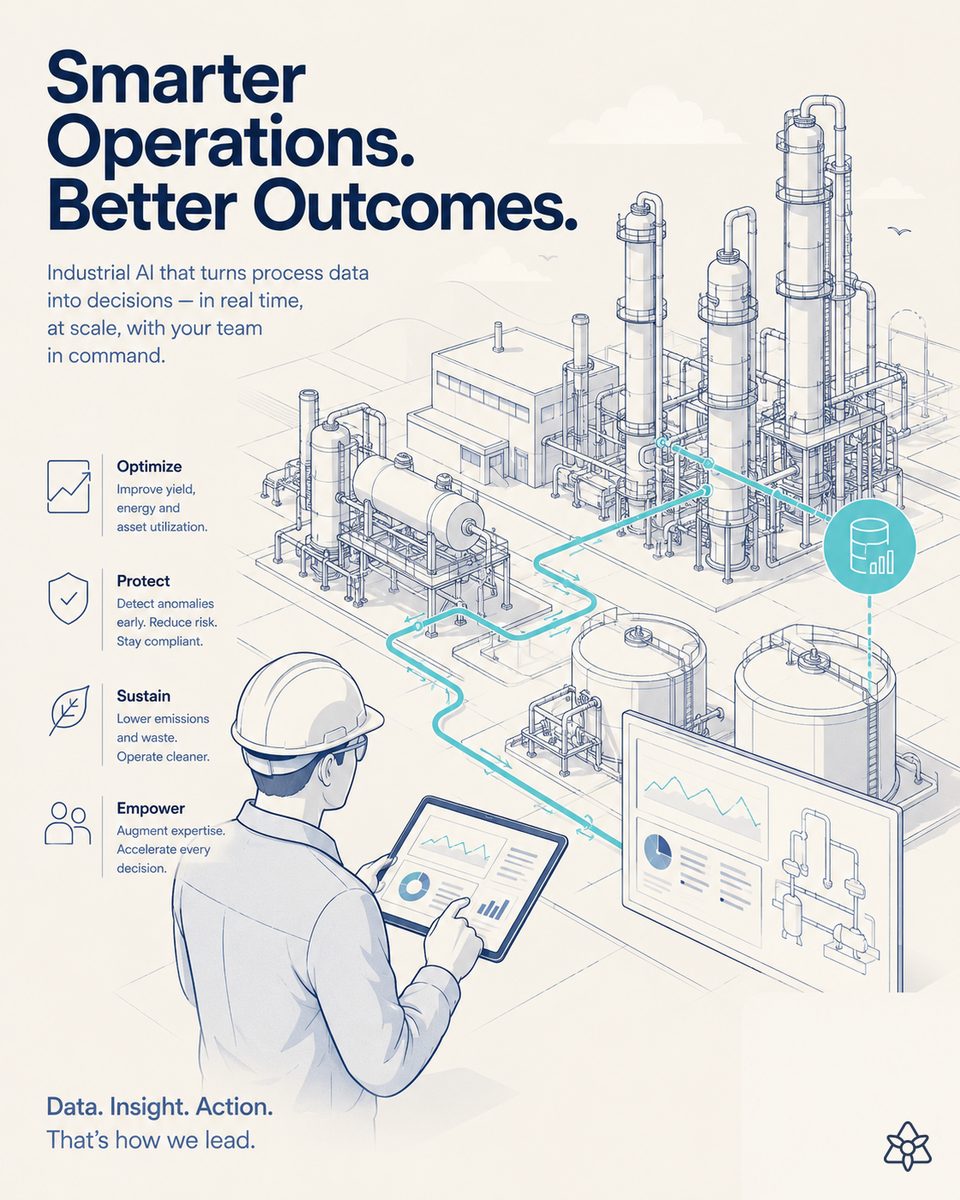
Three terminal realities that almost never match to the millimeter.
The manager of a chemical terminal lives with the same friction every day: the physical stock, the SCADA stock and the stock the customer sees in SAP are rarely the exact same number at the exact same time. The causes are familiar and boring, not malicious:
- Probes and radars living on their own island. The tank farm's SCADA holds the most critical data, but it was such an effort to get it down to the plant that the older tanks are still read off the local panel — a person, a notebook, a transcription.
- Transfers arriving through human channels. The supplier writes "the truck leaves at 7 with product X" over WhatsApp, the bay adjusts the slot by radio, the paper delivery note travels in the tanker's cab and gets digitized hours later.
- ATEX and batch-to-customer traceability as a manual check. The zone check, the grounding, the opening sequence — all correct 99% of the time, all reconstructed by hand for the auditor.
The classic system works almost always. That "almost" is the cross-mix, the mislabeled tanker, the inventory that shows up in the quarterly adjustment with an unexplained −0.7%. It is not a people problem — it is a problem of information living in islands that the terminal has to reconcile by hand every night.
iLEAN does not add a fourth system — it seals the cracks between the three you already have.
The terminal already has SCADA, TMS and SAP. Each does its job well. The problem lives in the joints — between the old tank's local panel and the modern SCADA, between the carrier's WhatsApp and the TMS, between the ATEX check and the audit file. iLEAN acts as the putty that fills those gaps, without asking you to change anything that already works.
Edge sees the local panel. Connect reads the delivery note through whatever channel it arrives. The agent reconciles against SCADA + TMS + SAP and, if something does not add up, holds the transfer. The person signs — never the other way around.
The three iLEAN pieces applied to tank management at a chemical terminal:
- Edge — a computer-vision terminal (CNN) over the old tank's local panel and over the loading bay. It reads the level off the analog panel, reads the license plate and label of the tanker entering the bay, and triggers an actuator (signal light, dry contact) when the tank–tanker–product combination does not match the order. It works without a network: if the terminal loses WiFi, Edge keeps reading and stopping the operation inline, because what is critical cannot depend on connectivity.
- Connect — captures the carrier's delivery note whether it comes by email, WhatsApp or a photo from the bay operator. Captures the supplier's notice ("the truck is leaving with product X and CoA Y") at second zero. And it also captures, inward, the data from the tank's local panel that the SCADA does not integrate. Bidirectional: it confirms to the customer and the carrier through the same channel when the transfer finishes.
- Agent (Tracer) — reconciles physical level, SCADA, TMS and SAP in real time. It maintains the transfer file with its signed ATEX check (zone, grounding, sequence), the delivery note, the CoA and the control analysis. When there is a deviation, it holds the operation and alerts the shift lead through their channel. The person validates; the transfer does not resume on its own.
Terminal with checklists and a notebook vs. terminal with iLEAN
| Aspect | Manual management + isolated SCADA | With iLEAN Edge + Agent + Tracer |
|---|---|---|
| Old tank's level | Operator, notebook, transcription into the system | Edge reads the local panel, reconciles with SCADA inline |
| Carrier's delivery note | Paper in the cab, digitized hours later | Connect captures it from whatever channel, at second zero |
| Transfer's ATEX check | Checkbox sheet, signed afterwards | File signed in real time: zone, grounding, sequence |
| Stock reconciliation | Quarterly inventory adjustment, with a gap | Continuous reconciliation physical level ↔ SCADA ↔ TMS ↔ SAP |
| Batch → customer trace | Excel reconstruction after the fact for a complaint | Per-batch dossier with CoA, conditions and transfers |
| Operation without a network | n/a | Edge keeps running on the panel's own light |
Impact estimate for your plant — to be validated with your numbers.
The block below is an estimate to be validated with the specific data of your terminal. We put it forward so the committee has an order of magnitude; we refine it during the diagnostic.
- Terminal with 30-60 tanks, several ATEX-classified products, 50-150 transfers/day between rack and tanker, a mix of modern tanks integrated into the SCADA and old tanks with a local panel.
- Pilot on one loading bay and 4-6 tanks (Edge on the local panel + license plate/tanker label camera + Connect to SAP/TMS). First value expected within a few weeks.
- Indicative payback between 4 and 9 months, depending on the documented frequency of cross-mixes, inventory adjustments and customer complaints over the last year.
- The hard lever is avoiding a single serious incident: a cross-mix in a tanker, an ATEX penalty or a full return from a premium customer pays for the pilot.
And the terminal manager's reasonable doubt
“What if the AI makes up a reading from the local panel?” — hallucination is a problem of free generation, not of anchored tasks. In tasks where the AI merely recontextualizes a piece of data from one system to another (reading the panel and comparing it with the SCADA), the best models brought error below 1.5% [1]. And even so, what is critical is never decided alone: iLEAN holds the transfer and the person signs. The three safety rings are there precisely for this: the terminal's OT network accepts nothing that has not been validated and signed.
[1] OpenAI paper “Why Language Models Hallucinate”, 2025 — on the reliability of AI in anchored tasks.
What people ask about chemical tank and terminal management with AI
How is the real level in each tank measured?
By cross-referencing what already exists — level probes, radar, hydrostatic pressure and transfer flow meters — with what is missing: vision-based reading of the tank's own local panel (even on old tanks without modern telemetry) and reconciliation against the loading/unloading delivery note. iLEAN Edge reads the local display when there is no better way; Connect captures the carrier's delivery note (PDF, email, WhatsApp); the agent reconciles and leaves a single auditable level. The operational gap between “what the SCADA says” and “what you actually have” stops being a hallway debate.
What about the quality of the product inside the tank?
Quality is sampling + history + context. iLEAN Tracer stores, per tank and per batch: the inbound analyses (supplier's CoA), the in-storage control analyses (density, water, color), the conditions (temperature, agitation, days in stock) and the events (inflows, outflows, recirculations). When an analysis drifts, the agent cross-references the history and proposes a probable cause — insufficient recirculation, mixing with a different batch, condensation. The person validates whether the batch ships, gets reprocessed or gets blocked.
Does it comply with ATEX in classified zones?
Yes. In ATEX zones, iLEAN Edge is deployed with equipment certified for the applicable zone (Zone 0/1/2 depending on the product and location) and, most importantly, the system documents every transfer with its ATEX check: correct valve, tanker grounding, absence of vapors, opening/closing sequence. The transfer file ends up signed and audit-ready without anyone writing it up afterwards.
Does it integrate with the terminal's TMS and SAP?
Yes. iLEAN Connect hooks into the terminal's TMS (loading order, tanker slot, bay manager) and into SAP (sales order, batch, end customer). The agent closes the loop: when the transfer finishes, it confirms the actual quantity to SAP, releases the slot in the TMS and delivers the signed delivery note to the end customer through their preferred channel. Nothing gets re-keyed into Excel.
What incident reduction can be expected?
This is an estimate to be validated with your terminal: at terminals where the typical incident is a cross-mix, a mislabeled tanker or a physical-vs-system stock discrepancy, plants that have closed the vision + integration loop usually see reductions above 30% in the first months, with first value in a few weeks. The hard lever is avoiding a single serious incident — a full customer return, an ATEX penalty or product lost to a wrong transfer pays for the pilot.
More cases in petrochemical
- Chemical batch traceability (lot genealogy) — a complaint six months later should not be a two-week project.iLEAN rebuilds the chemical batch genealogy from raw material to dispatch. REACH/CLP covered.
- Chemical customer specs and CoA with AI — the spec stays live, the certificate is automatic, the complaint never arrives.iLEAN keeps every customer spec live and auto-generates the CoA for each batch. No outdated specs, no…
- Chemical recipe optimization with AI — the raw material changes, so the recipe should change with it.iLEAN adjusts the recipe batch by batch to the real quality of the incoming raw material. Consistent…
- Cosmetics manufacturing with AI — the emulsion that split, the batch that passed GMP by hand and the audit that started over.How iLEAN cross-checks emulsion, color, filling and the GMP batch record to hold cosmetics manufacturing…
- Cracking control (FCC / steam cracker) with AI — severity, feedstock and margin on the same screen.How iLEAN cross-checks severity, feedstock, catalyst and margins in an FCC / steam cracker to anticipate…
- Crop protection control with AI — a mislabeled drum is not an incident, it is a recall and a penalty.How iLEAN cross-checks active ingredient dosing, GHS labeling and EFSA/MAPA registration in a crop…
Tell us your case and in 48h we'll send you the estimated ROI of this AI project for your chemical terminal.
We work on your terminal's real data, not ours. Diagnostic with no commitment.
Request estimated ROI in 48h See petrochemical