Chemical batch traceability (lot genealogy) — a complaint six months later should not be a two-week project.
A chemical complaint lands half a year after the batch shipped and demands a full genealogy: which raw material went in, which recipe was applied, which process conditions, which SDS was delivered, which customer received it. iLEAN stores that genealogy automatically while the batch is being produced, and leaves it queryable for REACH/CLP, for the auditor or for the customer. When the complaint comes in, the dossier is already built.
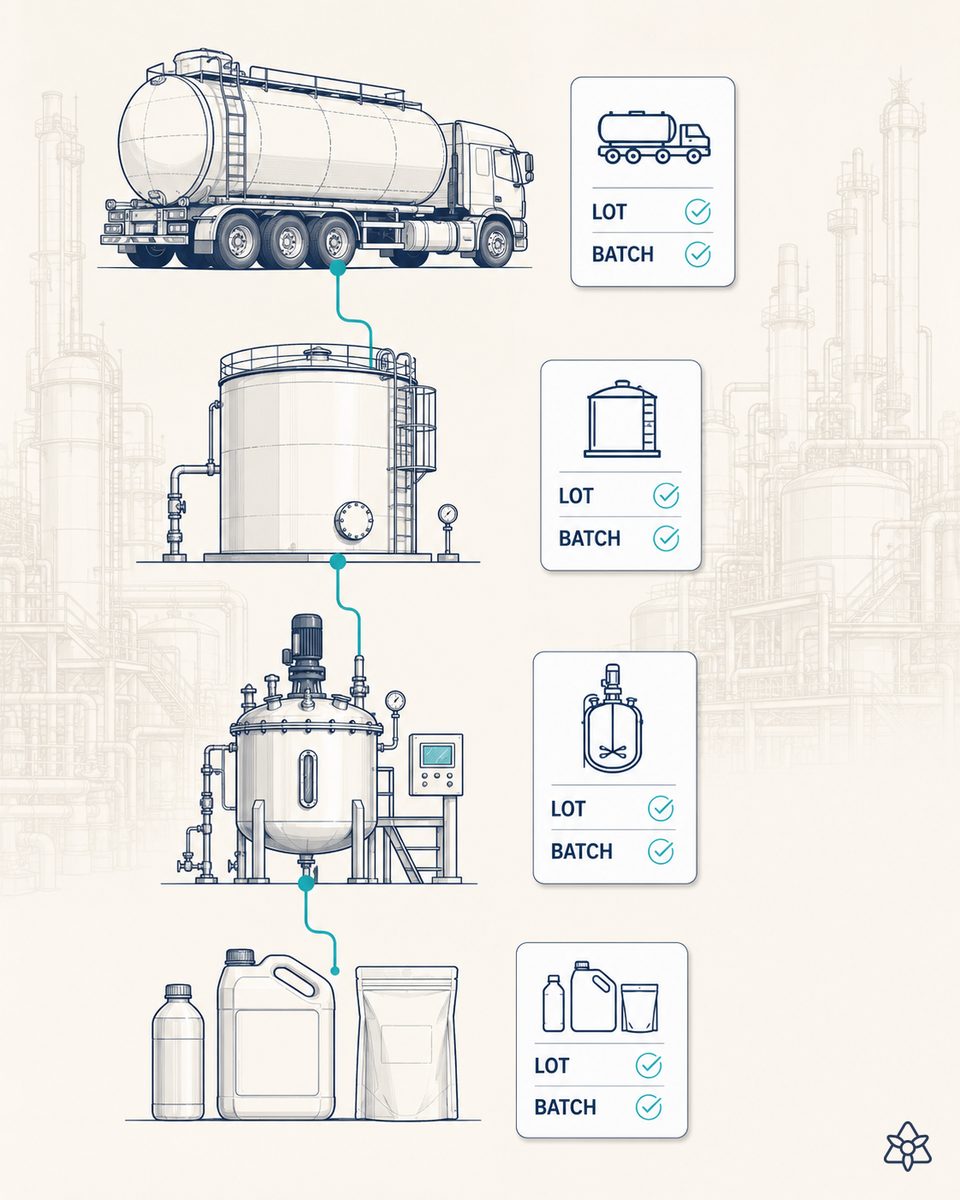
The genealogy exists — spread across five systems that do not talk to each other.
In any serious chemical plant, the data needed to rebuild a batch genealogy exists. The problem is that it lives in five different places and nobody joined it up:
- The ERP/MES holds the batch header, the nominal recipe and the supplier's delivery note — without the real process conditions or the SDS.
- The DCS/historian holds the real batch curve (temperature, pressure, dosing, agitation) — without linking it to the MES batch through a clean identifier.
- The LIMS holds the product analysis and sometimes the raw-material analysis — without a link to the DCS batch if the timestamps never lined up.
- The REACH/CLP manager keeps the SDS in force in their own file, and the per-customer version in another folder — without knowing which exact SDS traveled with which batch.
- Warehouse and logistics have the dispatch delivery note, the certificate and the tanker — on paper or in a third system.
When a complaint or a REACH query arrives six months later, somebody spends a week cross-referencing the five systems by hand to rebuild what had technically already been recorded. Traceability exists in pieces; what is missing is the genealogy as a living, queryable object. And every hour it takes to answer the customer is damage to the brand.
iLEAN does not add a sixth system — it seals the cracks between the five you already have.
The problem is not a lack of data: it is data living on islands and a genealogy that gets assembled by hand every time somebody asks. iLEAN acts as the putty that fills the gaps between ERP, DCS, LIMS, the REACH file and logistics, without asking you to throw anything away.
Connect reads the five systems — including the REACH manager's spreadsheet and the photographed delivery note. Tracer links by batch. Writer assembles the queryable dossier. The person validates what they sign.
The iLEAN pieces applied to chemical batch traceability:
- Connect — capture in its three modes: native integration with the ERP (SAP, Oracle), MES and DCS over OPC UA/Modbus; an intermediate mode for the LIMS that only has an old isolated PC; capture by photo or voice when the delivery note is on paper or when the SDS is on a printed sheet. It also captures what arrives through external channels at second zero: the supplier's email with the raw-material certificate of analysis, the carrier's WhatsApp message with the tanker at destination. Nothing is left out because "it wasn't in a system".
- Tracer — links every batch to its full tree: upstream raw-material batches (with certificates of analysis and suppliers), the recipe actually executed, the DCS curve, LIMS results, the SDS in force at that moment, the intermediate tank/silo, transfers, the dispatch batch, the end customer. The structure is built from the bottom up — reality first, reports afterwards.
- Writer + agent — the agent watches the thresholds (real batch composition vs. declared SDS, raw material out of spec, a customer with a complaint history) and raises alerts. When a complaint or a query arrives, Writer assembles the per-batch dossier in seconds, with everything linked: upstream genealogy, process conditions, SDS-for-that-batch, dispatch delivery note. The quality/REACH manager reads it, signs it and sends it. What used to be a week is now a morning.
Rebuilding by hand vs. a living genealogy with a queryable dossier
| Aspect | 5 systems + spreadsheets + paper | With iLEAN Tracer + Writer |
|---|---|---|
| Rebuilding the genealogy | Manual, cross-referencing 5 systems | Automatic, while the batch is being produced |
| SDS per batch | The SDS "in force", with no trace of which batch it traveled with | SDS-for-that-batch linked to the customer dispatch |
| Incoming raw material | Certificate buried in the supplier's email | Certificate captured and linked into the tree |
| Complaint six months later | A week of work by several people | Dossier assembled in seconds, signed within hours |
| REACH/CLP query | A sprint whenever the query arrives | Live data all year, ready when it is asked for |
| Continuous production | Does not fit the concept of a "batch" | Virtual batch by time window, same structure |
Impact estimate for your plant — to be validated with your numbers.
The block below is an estimate to be validated with the specific data of your plant. We put it forward so the committee has an order of magnitude; we refine it during the diagnostic.
- Batch or continuous chemical plant with an ERP (SAP/Oracle), a DCS (Honeywell/Yokogawa/ABB), a LIMS and a REACH/CLP file. Volume in the order of 1,000-10,000 batches/year, dozens of customer complaints/year.
- Tracer + Writer pilot on the Pareto family: the product/customer that concentrates the largest number of complaints or the one most sensitive under REACH. First value expected within a few weeks: a per-batch dossier available for that family.
- Reduction in complaint response time of ≥ 30%. On complaints where rebuilding by hand takes a week, a living dossier lets you answer in a morning — the hard lever is not the hours saved, it is the different conversation with the customer.
- Indicative payback between 4 and 9 months. The big lever is one REACH/CLP finding avoided or one large complaint resolved fast — either of them usually covers several pilots.
And the REACH/CLP manager's reasonable doubt
"What if the agent links things wrong and attributes a data point to the wrong batch?" — hallucination is a problem of free generation, not of anchored tasks. When the AI merely extracts and links data that already exists in the systems (which raw material went into this batch, which SDS was in force when it shipped), the best models brought error below 1.5% [1]. And the three-ring architecture guarantees that no dossier goes out signed without a person having read and validated it — the agent prepares, the person signs.
[1] OpenAI paper "Why Language Models Hallucinate", 2025 — on the reliability of AI in anchored tasks.
What people ask about chemical batch traceability with AI
How far does the chemical batch genealogy go?
In both directions. Upstream: finished batch → the batches of every raw material used → the supplier's certificate of analysis → the goods-receipt delivery note → storage warehouse/silo → internal transfer → reactor → batch recipe → the real DCS conditions batch by batch. Downstream: finished batch → storage tank → transfer → packing/tanker → dispatch delivery note → end customer → SDS delivered. It is multi-tier genealogy (as many levels as your sector demands) in a single queryable structure.
How is it cross-referenced with the SDS (safety data sheet)?
The SDS is not static: when the real composition of a batch changes (because the raw material carried a different impurity, or because the recipe was adjusted), the agent automatically compares it against the SDS in force and warns if the real batch composition falls outside the declared thresholds. The SDS and the batch stop traveling separately — they travel together to the customer who ordered that specific batch. If the customer raises a complaint six months later, the dossier already holds the SDS-for-that-batch, the raw-material certificate, the process conditions, a photo of the packing and the manager's signature.
Does it comply with REACH and CLP?
REACH requires traceability of every substance from the actor that places it on the EU market through to the end user, and record retention for 10 years after the last batch. CLP requires classification and labeling consistent with the real composition, and that any change is reflected in the SDS and on the label. iLEAN covers the operational side of both: immediate reconstruction of the multi-tier genealogy when an authority query or a complaint arrives, and automatic composition-batch-SDS-label cross-checking to catch deviations before the product ships. It does not replace the company's REACH/CLP manager — it takes the dumb work off their desk and leaves them the work of judgment.
Does it work for continuous production, not just batch?
Yes. In continuous production the concept of a "batch" is virtual — defined by a time window, by a change of incoming raw material, by a process inflection point. Tracer applies the same genealogy: every cubic meter of product dispatched is associated with the production time range, the process conditions in that range and the raw-material batches active at that moment. The structure of the dossier is the same; what changes is where the "batch" comes from.
How much does complaint handling effort go down?
An estimate to be validated with your numbers: in chemical plants that today rebuild the genealogy by hand whenever a complaint arrives (mixing ERP + DCS + spreadsheets + paper delivery notes), response time to a customer complaint or an authority query typically drops from several days to hours, with effort cut by at least 30%. The hard lever is not that saving — it is answering fast and with a complete dossier, which changes the conversation with the customer and with the inspector. We refine it with your real complaint volume.
More cases in petrochemical
- Biofuel control with AI — chemistry, the standard and traceability cross-referenced in one place.How iLEAN combines Edge, Connect and Agents to control transesterification, free glycerin and RED III…
- Cement and clinker control with AI — the kiln drives the whole plant, and every kcal counts.How iLEAN combines Edge, Connect and Agents to control LSF, clinker moduli, fineness and kiln energy use…
- CEMS stack emissions with AI — an analyzer in drift is not an incident, it is the quarter's reporting invalidated.iLEAN validates analyzers, predicts failures and generates BREF/CORINAIR emissions reporting with no…
- Chemical customer specs and CoA with AI — the spec stays live, the certificate is automatic, the complaint never arrives.iLEAN keeps every customer spec live and auto-generates the CoA for each batch. No outdated specs, no…
- Chemical recipe optimization with AI — the raw material changes, so the recipe should change with it.iLEAN adjusts the recipe batch by batch to the real quality of the incoming raw material. Consistent…
- Tank management at a chemical terminal with AI — the stock you have and the stock the system reports should be the same.iLEAN manages per-tank stock, transfers with ATEX compliance and batch-to-customer traceability from the…
Tell us about your case and in 48h we'll send you the estimated ROI of batch traceability for your chemical plant.
We work on your real batch and complaint volumes, not on generic ones. Diagnostic with no commitment.
Request estimated ROI in 48h See petrochemical