Cement and clinker control with AI — the kiln drives the whole plant, and every kcal counts.
Controlling a cement plant means cross-checking raw meal chemistry (LSF, MS, MA), kiln burning (free lime, burning-zone temperature, alternative fuels), final quality (Blaine fineness, EN 197) and energy use. iLEAN joins all four with Edge over the clinker conveyor, Connect over the DCS/APC and Agents that anticipate the deviation. The person signs.
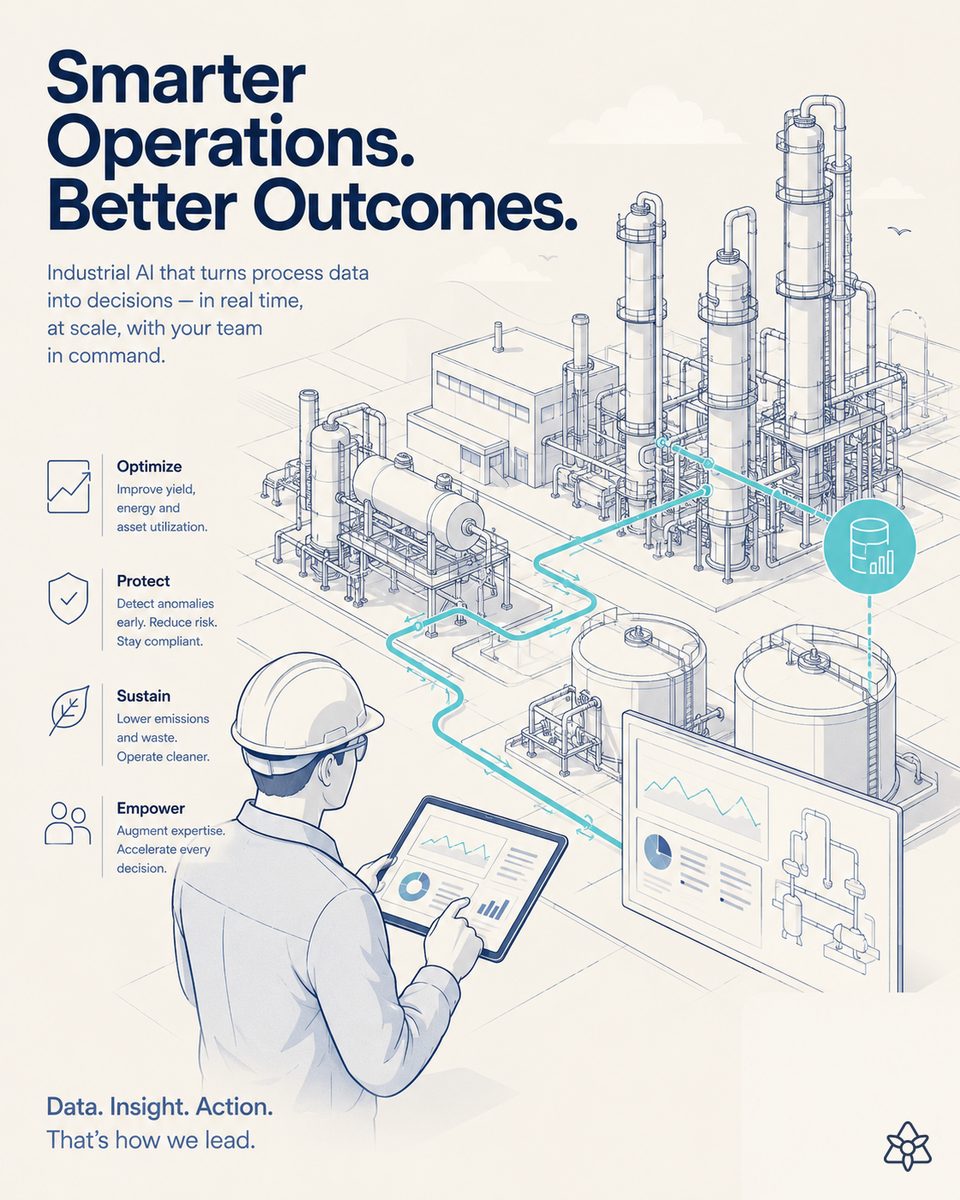
Three planes of the kiln — and the lab arrives afterwards.
A cement plant runs four parallel flows that rarely meet in time:
- Raw meal chemistry — the LSF, MS and MA moduli. They define optimal burning. Raw material varies from one quarry face to another and from one batch of corrective additives to the next.
- Kiln burning — burning-zone temperature, fuel flow (fossil + alternative: RDF, biomass, tires), free lime in the clinker. It lives in the DCS and, in modern plants, in an APC (Picasso, OptimizeIT) that closes local loops.
- Final cement quality — Blaine fineness, particle size distribution, 2- and 28-day strengths under EN 197. It lives in the LIMS, in one-off tests.
- Energy use and emissions — kcal/kg clinker, kWh/t cement, alternative fuel substitution rate, CEMS data for the environmental audit.
The kiln supervisor knows it — the kiln drives everything. An LSF deviation at the inlet costs hours further downstream in lost strength or excess fuel. Out-of-range free lime (>2%) lowers 28-day strength and is discovered in the lab hours later. The classic system works — and when it fails, it costs tons of fuel and downgraded batches.
iLEAN does not replace the APC or the DCS — it sits on top and cross-checks what the APC never looks at.
The problem with cement control is not a lack of measurements: it is measurements the APC watches inside its own loop, but that nobody cross-checks with the LIMS, the quarry and the fuel mix at the same time. iLEAN acts as the putty that seals those cracks — without replacing the APC, without touching the DCS, respecting OT isolation with the three rings.
Edge sees the clinker on the conveyor. Connect reads the DCS, APC, LIMS and CEMS wherever they are. The Agents cross-check against the quarry and the fuel mix. The person signs — never the other way round.
The three iLEAN pieces applied to cement and clinker control:
- Edge — a vision-equipped terminal (CNN) over the clinker conveyor. It reads color, apparent particle size and texture — capturing the veteran's eye that spots excess free lime or under-burning at a glance. It turns that into a continuous 24/7 signal. It works with no network.
- Connect — reads raw meal proportioning, the kiln curve and fuel flow from the DCS. Reads current setpoints from the APC. Reads strengths and Blaine fineness from the LIMS. Reads stack emissions from the CEMS. And it captures what comes from outside: analysis of the active quarry face, the supplier's RDF certificate, the hourly energy bill. At second zero.
- Agents — they live in ring 3. They cross-check raw meal chemistry against burning, against final quality and against energy use. They identify energy optimization windows the APC cannot see because it only watches its own loop. They keep the CEMS dossier and the fuel mix dossier up to date for the environmental audit.
Control with APC + LIMS + spreadsheets vs. cross-checked control with iLEAN
| Aspect | Control with DCS + APC + LIMS | With iLEAN Edge + Connect + Agents |
|---|---|---|
| Reading the clinker on the conveyor | The veteran's eye when they walk past | Edge with vision 24/7, continuous signal |
| Detecting out-of-range free lime | LIMS, hours later | Anticipated hours ahead by cross-checking raw meal + burning |
| Change of quarry face | Phone call to the kiln supervisor | In the system at second zero, linked to the batch |
| Fuel mix (RDF, biomass) | Spreadsheet kept by the calciner operator | Cross-checked against LSF and expected quality |
| Energy optimization | The APC watches its own loop | The Agent sees the whole plant and proposes windows |
| CEMS dossier for the audit | Assembled by hand at month-end | Kept automatically, ready for the auditor |
Impact estimate for your plant — to be validated with your numbers.
The block below is an estimate to be validated with the specific data of your plant. We put it forward so the committee has an order of magnitude; we refine it during the diagnostic.
- Cement plant with a dry-process kiln, cyclone preheater, calciner running alternative fuel substitution (RDF, biomass), CEM I and CEM II.
- Edge pilot over the clinker conveyor + Connect + an Agent cross-checking LSF/free lime/energy use. First value in a few weeks.
- Indicative payback between 4 and 9 months, depending on current energy use (kcal/kg clinker) and the percentage of downgraded batches in recent years.
- Expected fuel consumption reduction of ≥ 3-5% in the optimization windows detected by the agent (conservative estimate, to be validated).
- The hard lever: a kiln burning tens of tons per hour saves hundreds of thousands of euros a year for every percentage point of fuel. The pilot pays for itself in the first quarter.
And the kiln supervisor's reasonable doubt
“What if the AI proposes cutting fuel and my kiln goes out?” — the Agents do not execute in the DCS or in the APC. They propose optimization windows to the kiln supervisor, who decides. The APC keeps closing its loops exactly as it does today. Reliability in anchored tasks (cross-checking DCS, LIMS and quarry data) sits below 1.5%[1]. The AI here does not invent a new setpoint — it proposes an adjustment based on the raw meal history, the fuel mix and final quality. The person sees the why and signs.
[1] OpenAI paper “Why Language Models Hallucinate”, 2025 — on the reliability of AI in anchored tasks.
Related topics you may find useful: asphalt and bitumen control · prestressed concrete control · float glass control.
What people ask about cement and clinker control with AI
What does a cement plant control, and why does the kiln drive the whole plant?
A cement plant controls, all at once, raw meal chemistry (the LSF — lime saturation factor, MS — silica modulus and MA — alumina modulus), kiln burning (burning-zone temperature, alternative and fossil fuel flow, free lime CaO in the clinker), final cement quality (Blaine fineness, particle size distribution, 2- and 28-day strengths under EN 197) and energy use (kcal/kg clinker, kWh/t cement). And the kiln drives everything: a small LSF deviation at the inlet costs hours further downstream in lost strength and in excess fuel. iLEAN cross-checks those planes without touching the DCS.
How do you anticipate an LSF, Blaine fineness or free lime deviation with AI?
Out-of-range free lime (typically 1-2%) signals badly proportioned raw meal or insufficient burning — and it is measured in the lab hours later. iLEAN Connect reads limestone/clay/marl proportioning, the kiln temperature curve and fuel flow from the DCS. The Agents cross-check them against the history of batches from the same quarry face (raw material varies from face to face) and against recent LIMS tests. They detect within the hour that LSF is going to drift off target, and the kiln supervisor adjusts proportioning before the raw meal reaches the preheater.
How does iLEAN Edge help control the clinker conveyor and kiln coloring?
Clinker coming out of the kiln has a texture and a color that the veteran operator reads at a glance — excess free lime shows up as white nodules, under-burning as a dull tone. iLEAN Edge with vision (CNN) over the clinker conveyor captures that veteran know-how and turns it into a continuous signal, 24/7. It detects anomalies in color and apparent particle size and raises an alert on the kiln panel. It works with no network. The veteran's eye no longer retires with them — it stays captured as a permanent capability of the plant.
Can iLEAN cut kiln energy use without replacing the advanced process control (APC) system?
Yes. iLEAN does not compete with a modern APC (Picasso, OptimizeIT) — it sits on top of it. iLEAN Connect captures energy data from the DCS and the APC, and the Agents cross-check it against the alternative fuel mix (RDF, biomass, shredded tires), against the LSF of the raw meal and against clinker quality. They identify optimization windows the APC cannot see because it only looks at its own loop. And they keep the CEMS emissions dossier up to date for the audit — without doubling the environmental manager's workload.
How much does an AI control pilot cost in a cement plant?
The typical cement plant pilot starts with the combination of Edge over the clinker conveyor + Connect over the DCS/APC + one Agent on one of the three critical planes (LSF/free lime, Blaine fineness or energy use). First value in a few weeks — a dashboard that cross-checks kiln and lab. Indicative payback between 4 and 9 months, depending on current kiln energy use (kcal/kg clinker) and the frequency of downgraded batches. The hard lever: saving a small percentage of fuel on a kiln that burns tons per hour is hundreds of thousands of euros a year. We ask for your data and send you the estimated ROI in 48h.
More cases in petrochemical
- Base oil control with AI — an off-spec batch is several m³ that get downgraded.How iLEAN joins Edge, Connect and Agents to control viscosity, viscosity index and the blending of Group…
- AI control for batch chemical reactors — the reactor depends on the recipe and on the operator's eye, and that eye walks out the day they retire.iLEAN learns the golden batch of every product and suggests real-time corrections to the reactor…
- Biofuel control with AI — chemistry, the standard and traceability cross-referenced in one place.How iLEAN combines Edge, Connect and Agents to control transesterification, free glycerin and RED III…
- CEMS stack emissions with AI — an analyzer in drift is not an incident, it is the quarter's reporting invalidated.iLEAN validates analyzers, predicts failures and generates BREF/CORINAIR emissions reporting with no…
- Chemical batch traceability (lot genealogy) — a complaint six months later should not be a two-week project.iLEAN rebuilds the chemical batch genealogy from raw material to dispatch. REACH/CLP covered.
- Chemical customer specs and CoA with AI — the spec stays live, the certificate is automatic, the complaint never arrives.iLEAN keeps every customer spec live and auto-generates the CoA for each batch. No outdated specs, no…
Tell us your case and in 48h we'll send you the estimated ROI of this AI project for your cement plant.
We work on your plant's real data, not ours. Diagnostic with no commitment.
Request estimated ROI in 48h See petrochemical