Asphalt and bitumen control with AI — the tank temperature rules, and the standard does not wait.
Control in a bitumen plant crosses physics (penetration, softening point, ductility), composition (SARA fractions) and, in PMB, polymer blending (SBS, SBR). iLEAN brings the three together with Edge on dispersion, Connect on DCS/LIMS and Agents that anticipate a batch falling outside EN 12591 / EN 14023. The person signs.
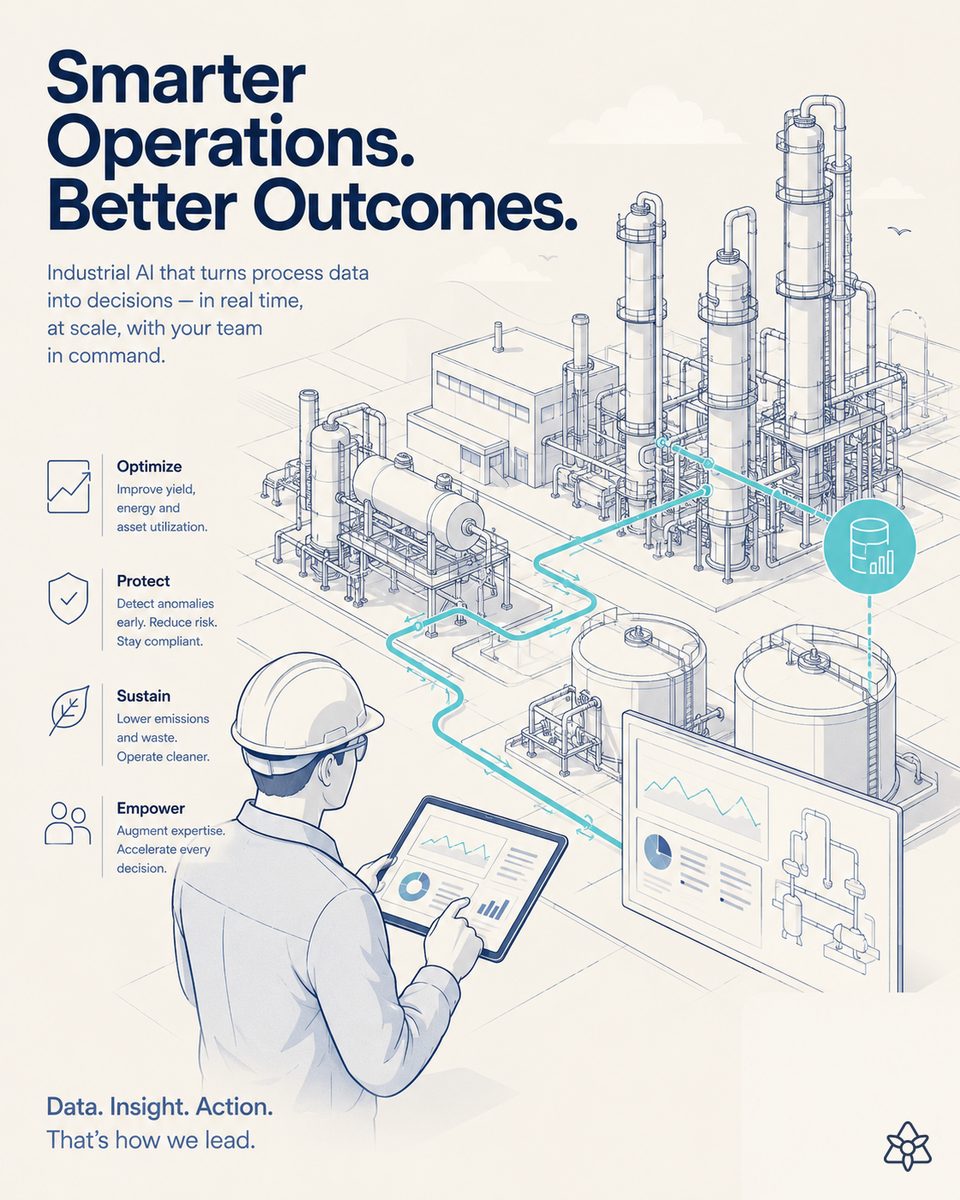
Bitumen does not forgive — and the lab arrives late.
Control in a bitumen and PMB plant lives in three realities that the lab only closes hours after the batch is closed:
- Product physics — penetration at 25 ºC (EN 1426), ring-and-ball softening point (EN 1427), ductility, dynamic viscosity. It defines the grade (35/50, 50/70, 70/100 under EN 12591). If penetration goes over the top of the range, the grade is downgraded.
- SARA composition — asphaltene, saturate, resin and aromatic fractions. It determines polymer compatibility and aging. It lives in the LIMS, with spot tests per upstream crude.
- Polymer blending (PMB) — SBS, SBR, EVA dispersed in the base bitumen. Sensitive to blending time and temperature; a poorly dispersed SBS fails the Tube Test (EN 13399, storage stability) and EN 14023 does not forgive.
The production manager knows it — tank temperature is the variable that drives everything. Overheated, the bitumen oxidizes and the softening point drifts away; underheated, it does not homogenize with the polymer. And the lab delivers results hours after the batch. The classic system works — and when it fails, the truck is already loaded.
iLEAN does not replace the DCS or the LIMS — it seals the cracks between tank temperature and the standard.
The problem in bitumen control is not a lack of measurements: it is measurements that arrive late and get cross-referenced by hand when everything is already closed. iLEAN acts as the putty that seals those cracks, without touching the DCS or the blending equipment, and respecting OT isolation with the three rings.
Edge sees polymer dispersion before the Tube Test. Connect reads the DCS, the LIMS and the SBS certificates wherever they are. The Agents anticipate a batch falling outside the EN standard. The person signs — never the other way round.
The three iLEAN pieces applied to asphalt and bitumen control:
- Edge — a vision terminal over the shear mill outlet (PMB) or over the sampling belt. A CNN trained to detect SBS dispersion quality from visual texture, triggering a stack light if the dispersion is going to fail the Tube Test. It works with no network. The person validates.
- Connect — reads the tank temperature curve and the polymer dosing from the DCS through a passive mailbox (without touching the PLC). Reads penetration and softening point tests from the LIMS. And it captures what comes from outside: the supplier's SBS batch certificate (email, a photo of the delivery note), the customer's PMB spec. At second zero.
- Agents — they live in ring 3. They cross-reference the DCS curve with the upstream crude history, the LIMS tests with the EN 12591/EN 14023 window, and the polymer certificate with previous Tube Test results. They detect within hours that the batch is heading out of range. They keep the per-batch CoA up to date, ready for the customer.
Manual control + a slow LIMS vs. cross-referenced control with iLEAN
| Aspect | Control with DCS + LIMS + spreadsheets | With iLEAN Edge + Connect + Agents |
|---|---|---|
| Penetration / softening point | LIMS result hours after the batch | Anticipated within hours by cross-referencing the DCS curve + history |
| SBS dispersion in PMB | Tube Test 3 days later | Edge detects dispersion by vision, in line |
| Critical tank temperature | In the SCADA, never cross-referenced with the test | Cross-referenced with the expected LIMS result |
| Polymer (SBS) certificate | A PDF in the purchasing manager's inbox | In the system at second zero, linked to the batch |
| Per-batch CoA for the customer | Assembled by hand before shipping | Maintained automatically, signed by the person |
| Batch outside EN 12591 / EN 14023 | Discovered after shipping | Anticipated and adjusted before closing |
Impact estimate for your plant — to be validated with your numbers.
The block below is an estimate to be validated with the specific data of your plant. We put it forward so the committee has an order of magnitude; we refine it during the diagnostic.
- Bitumen plant producing 35/50, 50/70 and SBS-modified PMB, supplying road works and hot-mix asphalt plants.
- Connect + Agent pilot on the DCS/LIMS cross-reference for penetration and softening point, plus Edge over the shear mill for PMB. First value within a few weeks.
- Indicative payback between 4 and 9 months, depending on how often batches fell outside EN 12591/EN 14023 in recent years and on the cost of rework or downgrade.
- Expected reduction in out-of-spec batches ≥ 30% (a conservative estimate, to be validated).
- The hard lever: a single batch of several hundred tonnes rescued from a downgrade pays for the pilot.
And the production manager's reasonable doubt
“What if the AI proposes raising the tank temperature and oxidizes the bitumen?” — the Agents do not execute anything in the DCS. They propose. Signing off the adjustment is still the production manager's call. Reliability in anchored tasks (cross-referencing the DCS curve, the LIMS test and the EN standard) is below 1.5%[1]. The AI here does not invent a temperature — it proposes an adjustment based on the crude's history and on what has already worked. The person sees the reasoning and decides.
[1] OpenAI paper “Why Language Models Hallucinate”, 2025 — on the reliability of AI in anchored tasks.
Related topics you may find useful: base lubricant control · cement clinker control · epoxy resin control.
What people ask about asphalt and bitumen control with AI
What is controlled in a bitumen plant, and why does it break the standard AI mold?
A bitumen plant controls, all at once, the key physical parameters (penetration at 25 ºC, ring-and-ball softening point, ductility, dynamic viscosity), the composition (asphaltenes, saturates, resins, aromatics — the SARA fractions), and, when there is polymer-modified bitumen (SBS, SBR, EVA), the blending with the polymer, which is where things become sensitive to detail. The reference standard varies: EN 12591 for straight-run bitumen and EN 14023 for PMB. Control breaks the mold because tank temperature is the variable that drives everything — overheated bitumen oxidizes and drifts off the softening point; underheated, it does not homogenize with the polymer. iLEAN cross-references those planes without touching the DCS.
How do you anticipate a penetration or softening point deviation with AI?
Penetration and softening point are measured in the lab hours after the batch is closed — when it is already too late to correct. iLEAN Connect reads the tank temperature curve, the polymer blending times and the dosing from the DCS. The Agents cross-reference them with the history of batches from the same upstream crude and with previous LIMS tests, and detect within hours that the batch is heading outside the EN 12591/EN 14023 window. The production manager sees the alert before shipping to the customer — and decides whether to adjust the blend, extend homogenization time or redirect it to another grade.
How do you control polymer blending (SBS, SBR) and dispersion with AI?
PMB (polymer-modified bitumen) is very sensitive to blending time and temperature — a poorly dispersed SBS forms separate phases that show up in the storage stability test (Tube Test). iLEAN Edge can read the camera over the outlet of the shear mill and detect dispersion quality by vision (a CNN trained on good and bad samples). Connect logs the blending curve. The Agents cross-reference with the history of the supplier's SBS (captured from the batch certificate) and warn if the dispersion is going to fail the Tube Test. The person validates — the line never shuts itself down.
Can iLEAN integrate the DCS, the LIMS and the polymer certificates without touching them?
Yes. iLEAN Connect reads from the DCS through a passive mailbox (ring 1 never accepts incoming connections), reads the lab tests from the LIMS, and captures the supplier's polymer certificates (a photo of the delivery note, a PDF from an email, a weighbridge ticket). Nothing is modified. The Agents live in ring 3 and do the cross-referencing; only what has been signed by ring 2 and by a person enters ring 1. Plant equipment is not replaced; it is connected to the putty that cross-references it with EN 12591/EN 14023 and with the customer.
How much does an AI control pilot cost in an asphalt/bitumen plant?
The typical pilot starts with the combination of Connect over DCS/LIMS + one Agent on one of the two critical planes (penetration/softening point, or SBS dispersion in PMB). First value within a few weeks — a dashboard that cross-references tank temperature with LIMS history. If the plant produces PMB, we add Edge over the shear mill. Indicative payback between 4 and 9 months, depending on how often batches fall outside EN 12591/EN 14023 and on the cost of rework. The hard lever: a single batch of several hundred tonnes rescued from a downgrade pays for the pilot. We ask for your data and send you the estimated ROI in 48h.
More cases in petrochemical
- Refinery turnaround with AI — scope creep is not bad luck, it is information that reaches the office late.iLEAN plans, executes and cuts scope creep in refinery turnarounds. Measurable ROI on every TA.
- AI wastewater treatment — a discharge breach is seen two hours too late; with iLEAN, two hours early.How iLEAN cross-references LIMS, probes and SCADA to anticipate discharge breaches, prevent sludge…
- Anodized aluminum with AI — one shade out of range and the profile comes back from the customer.How iLEAN cross-checks part appearance, anodizing baths and the customer specification to guarantee…
- Base oil control with AI — an off-spec batch is several m³ that get downgraded.How iLEAN joins Edge, Connect and Agents to control viscosity, viscosity index and the blending of Group…
- AI control for batch chemical reactors — the reactor depends on the recipe and on the operator's eye, and that eye walks out the day they retire.iLEAN learns the golden batch of every product and suggests real-time corrections to the reactor…
- Biofuel control with AI — chemistry, the standard and traceability cross-referenced in one place.How iLEAN combines Edge, Connect and Agents to control transesterification, free glycerin and RED III…
Tell us your case and in 48h we'll send you the estimated ROI of this AI project for your bitumen plant.
We work on your plant's real data, not ours. Diagnostic with no commitment.
Request estimated ROI in 48h See petrochemical