Anodized aluminum with AI — one shade out of range and the profile comes back from the customer.
Anodizing control is the crossing of three realities — the part's color appearance and coating, the chemistry of the bath and the rectifier, and the customer specification, which changes by email. iLEAN sees the part with Edge vision, reads the baths and the rectifier with Connect even when they are old, and an agent cross-checks against the current standard to issue the dossier before shipment. The person signs.
← See all solutions for petrochemical and process industries
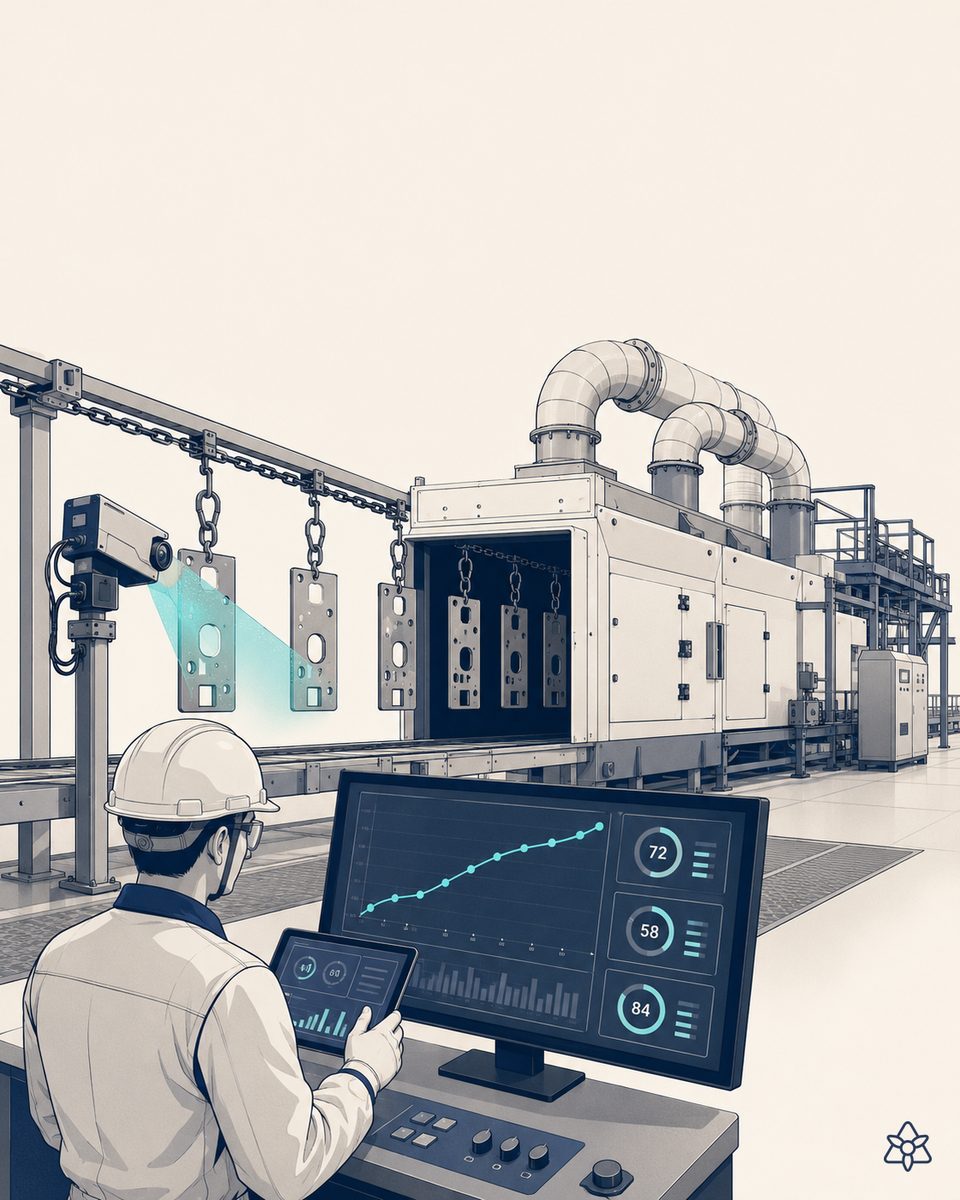
Three realities that are almost never in the same place.
A “correct” batch of anodized aluminum is the crossing of three pieces of data that in most plants each live on their own island:
- The part's appearance — shade uniformity, absence of burning/pitting, coating thickness to standard. Today it is validated by sampling: a part at the end of the rack, a flashlight, a color comparator, the shift lead's signature.
- The process parameters — bath H₂SO₄ concentration, temperature, voltage, current density, immersion time, incoming alloy. On the rectifier panel, in a probe, in the lab's LIMS, in a spreadsheet kept by the bath manager.
- The customer specification — Qualanod, AAMA 611, the profile manufacturer's own specification, changes by email from the customer saying “this week we run range X”. Almost always in a PDF, in a quality dossier and in the memory of whoever manages that account.
The quality manager can carry two of the three in their head, not all three at once. The operator has their panel and their instruction card, and at the end of the shift everything adds up — until the day the customer returns the profile because the shade does not match the facade that was already installed. A shade complaint is paid in rejected profile, freight and the awkward conversation with the builder.
iLEAN does not add a fourth system — it seals the cracks between the three you already have.
The problem with anodizing is not a lack of information: it is information living on islands that at the critical moment (the rack change, the customer change) does not reach the decision-maker in time. iLEAN acts as the putty that fills those gaps, without asking you to change your rectifier, baths or SCADA.
Edge sees every part on the way out. Connect reads the bath, the rectifier and the specification whether it arrives as a PDF or an email. The agent cross-checks against the current standard and, if something does not add up, holds the batch. The person signs.
The three iLEAN pieces applied to anodized aluminum control:
- Edge — terminal with computer vision (CNN) and colorimetry over the rack at the exit. It detects out-of-range shade, burning, pitting, marks and coating unevenness in milliseconds, and triggers a local actuator (light signal, logging, stopping the advance). It works without a network. As long as it has power, it keeps seeing and recording.
- Connect — captures the rectifier and bath parameters whether they come from the SCADA, from a rectifier panel with an isolated computer, or from the lab's spreadsheet. And it also captures the customer specification when it arrives by email or WhatsApp, at second zero — not when someone uploads it to the server on Friday.
- Agent — cross-references the Edge image, the process parameters, the incoming alloy and the customer's current standard. If a series drifts, it proposes the adjustment (correct the voltage, adjust the temperature, modify the time); if a part comes out of range, it holds the batch and prepares the dossier for quality. The person validates and signs.
Sampling-based anodizing vs. cross-checked anodizing with iLEAN
| Aspect | Classic anodizing + sampling | With iLEAN Edge + Connect + Agent |
|---|---|---|
| Shade inspection | Visual comparator at the end of the rack | 100% in-line, part by part, continuous colorimetry |
| Coating thickness | Spot-measured by sampling (eddy current) | Continuous estimate + cross-check with voltage and time |
| Customer specification change | PDF / email lost in a folder | Immediate capture, agent logs it and alerts |
| Defect root cause | Manual reconstruction of shifts | Per-rack dossier with cross-checked parameters |
| Compliance dossier (Qualanod / AAMA) | Assembled by hand when the audit asks for it | Generated automatically per load |
| Operation without a network | n/a | Edge keeps operating on power from the cabinet |
Impact estimate for your plant — to be validated with your numbers.
The block below is an estimate to be validated with the specific data of your plant. We put it forward so the committee has an order of magnitude; we refine it during the diagnostic.
- Architectural / industrial profile anodizing plant, one or two lines, multi-customer with several color ranges and different incoming alloys.
- Edge pilot at the bath exit + Connect reading of the rectifier and the LIMS. First value expected within a few weeks: out-of-range shade detection and automatic logging.
- Indicative payback between 4 and 9 months, depending on the current cost of profile reworked, returned or given away over color complaints.
- Reasonable reduction to expect: ≥30% in shade complaints and rework, once the model is calibrated to your plant's mix of alloys and color ranges.
The quality manager's reasonable doubt
“What if the AI mistakes normal alloy variation for a process failure?” — hallucination is a problem of free generation, not of anchored tasks. In tasks where the AI compares against a known reference (the good part from your own catalog) and a measured process value, the best models brought error below 1.5% [1]. And even so, what is critical is never decided alone: iLEAN holds the batch and the person signs. The three safety rings exist precisely for this.
[1] OpenAI paper “Why Language Models Hallucinate”, 2025 — on AI reliability in anchored tasks.
What people ask about anodizing control with AI
What defects does iLEAN detect in anodized aluminum?
The classic anodizing defects: uneven color between parts of the same batch, burning (areas scorched by local current density), pitting, a thin or uneven oxide layer, stains and haze from poor rinsing, and rack marks. iLEAN Edge with computer vision detects them on the part as it leaves the process, before packing, while you can still pull the part for rework or adjust the bath before the next batch repeats the failure.
Why does color vary from one batch to the next?
Anodizing color uniformity is the crossing of many variables — sulfuric acid concentration, bath temperature, voltage and current density, aluminum alloy, immersion time, and the chemistry of the subsequent coloring. All of them are measured, but they live in different systems: the rectifier panel, the bath probe, the LIMS sheet, the aluminum supplier's data sheet. iLEAN Connect crosses them at second zero, and an agent correlates them with the Edge image of the part — the root cause shows up on its own, not in a meeting the following week.
How do you meet the customer specification without rebuilding the control at every change?
Every architectural or automotive customer demands its own standard (Qualanod, AAMA 611, the profile manufacturer's own specification). Today the operator consults a paper dossier or a PDF lost in the quality folder. iLEAN Connect keeps the current version of every specification live in the system; the agent cross-checks it against the Edge image and the bath parameters on every batch, and issues the compliance dossier automatically. If the customer changes the tolerated color range by email, the agent logs it and alerts before the next load — not after the complaint.
Does it work without a network in an anodizing plant?
Yes. iLEAN Edge is a physical terminal with a trained CNN and a local actuator — if the plant loses Internet, WiFi and the ERP connection, as long as it has power it keeps seeing, recording and holding. In an environment of acid baths where connectivity is always fragile, that is not optional: the detection cycle cannot depend on a cable.
Does it integrate with the old rectifier and the bath SCADA?
Yes. iLEAN's strategy is not to throw out your rectifier or replace the SCADA — it is to read what they already have. iLEAN Connect captures the data directly if the machine has a modern interface, reads the local panel if the machine is old but has an isolated computer, or works from a manual photo of the analog panel if there is no other option. The gradation adapts to each machine; what is critical does not have to change.
More cases in petrochemical
- Leak detection with thermal vision and AI — the leak you can already smell arrived too late.iLEAN combines thermal cameras and AI models to detect leaks before they are visible. Continuous LDAR in…
- Refinery turnaround with AI — scope creep is not bad luck, it is information that reaches the office late.iLEAN plans, executes and cuts scope creep in refinery turnarounds. Measurable ROI on every TA.
- AI wastewater treatment — a discharge breach is seen two hours too late; with iLEAN, two hours early.How iLEAN cross-references LIMS, probes and SCADA to anticipate discharge breaches, prevent sludge…
- Asphalt and bitumen control with AI — the tank temperature rules, and the standard does not wait.How iLEAN combines Edge, Connect and Agents to control penetration, softening point and polymer blending…
- Base oil control with AI — an off-spec batch is several m³ that get downgraded.How iLEAN joins Edge, Connect and Agents to control viscosity, viscosity index and the blending of Group…
- AI control for batch chemical reactors — the reactor depends on the recipe and on the operator's eye, and that eye walks out the day they retire.iLEAN learns the golden batch of every product and suggests real-time corrections to the reactor…
Tell us your case and in 48h we'll send you the estimated ROI of this AI project for your anodizing plant.
We work on your plant's real data, not ours. Diagnostic with no commitment.
Request estimated ROI in 48h See petrochemical