Leak detection with thermal vision and AI — the leak you can already smell arrived too late.
Fugitive emissions are a regulatory obligation (EPA OOOOa in the US, the BREFs and the Industrial Emissions Directive in the EU). iLEAN combines thermal cameras and AI models to detect the plume before it is visible, audible or detectable by nose — and keeps the LDAR file live with no paper. The person validates the repair.
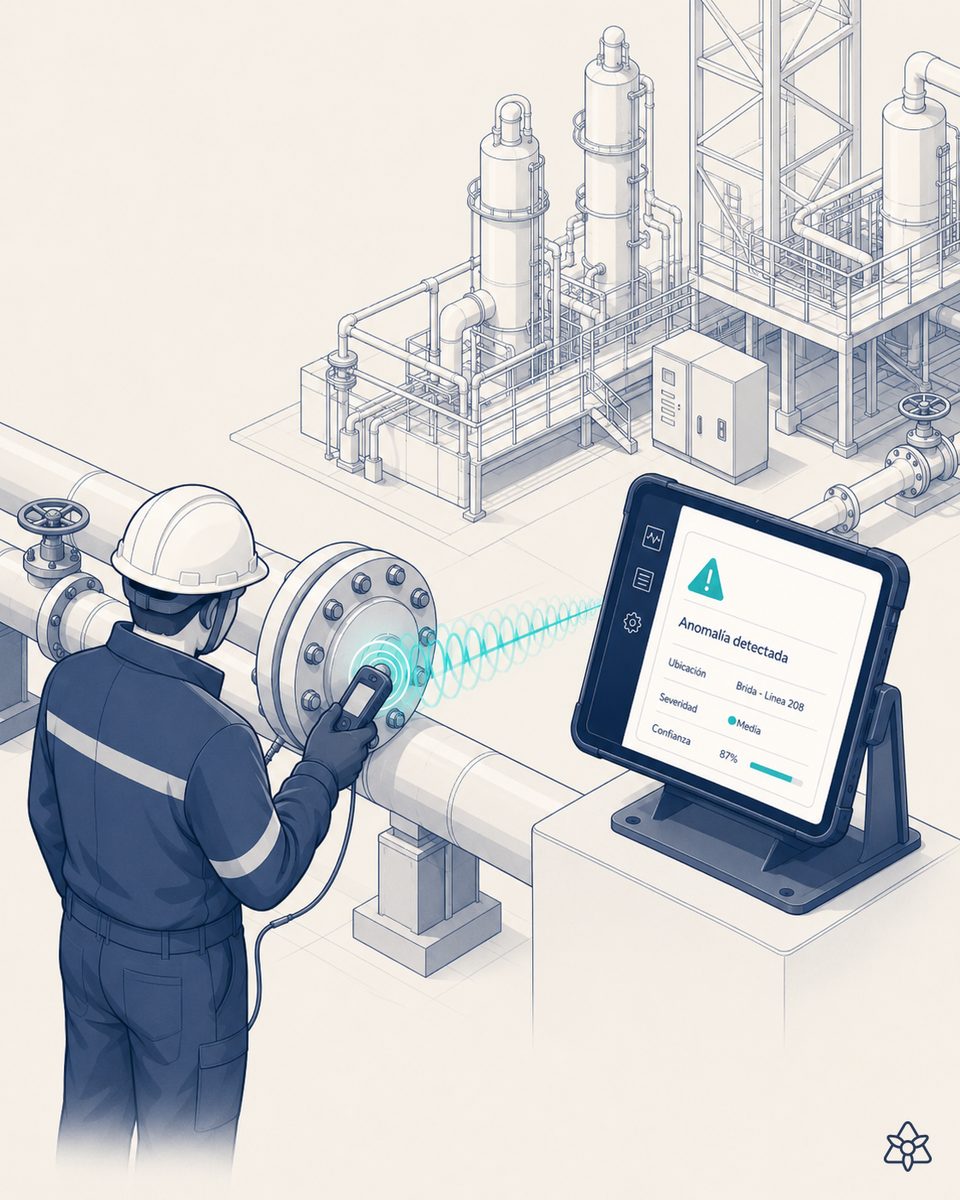
Classic LDAR finds what already escaped weeks ago.
The environmental / HSE lead of a chemical plant has lived with the same dilemma ever since LDAR rules have existed:
- The manual survey is a snapshot. A technician with an OGI camera or a handheld sniffer covers thousands of components in a quarterly or biannual campaign. The leak that appears on the Monday after the survey has been emitting for three months by the time it is detected.
- The smell arrives late and depends on the wind. By the time an operator “smells something”, the plume has been emitting for hours — sometimes days. Smell is an indicator, not a sensor.
- Earlier continuous OGI stumbled on false positives. The first fixed thermal camera deployments without AI triggered on water vapor, on sunlight reflecting off hot flanges, on vehicle exhaust plumes. They ended up muted or ignored.
- The regulator's file is paper. An EPA or competent-authority audit means rebuilding traceability, calibrations, events and repairs by hand — weeks of work per campaign.
The classic system works most of the time. But the serious leak is the one that escapes between surveys. This is not a people problem — it is a sampling frequency problem, and the answer is not hiring more technicians: it is having the plant see itself continuously.
iLEAN does not add one more standard — it seals the cracks between the camera, the regulator and the maintenance team.
The plant already has OGI cameras (sometimes), a documented LDAR program and an EAM/CMMS for maintenance orders. Each of them does its own job well. The problem lives in the joints — between what the camera sees and what the technician interprets, between what is detected and the repair order, between the repair and the file for the regulator. iLEAN acts as the putty that fills those gaps.
The thermal camera sees the plume. The AI model filters noise. The agent opens the order, follows the repair and signs off the file. The person validates; the system does not close it alone.
The three iLEAN pieces applied to leak detection in a chemical plant:
- Edge + thermal Vision — machine-vision terminals (CNN) on a fixed thermal camera watching the pipe rack, the critical units or the tank farm. The model learns to tell a gas plume from water vapor, from sun glare, from people moving through the frame. It raises an alert only when confidence is high. It works without a network: the basic detection loop keeps running on cabinet power.
- Connect — captures the operator's report that they “smell something” over the radio or WhatsApp, correlates it with the thermal image at that moment, and cross-references it with wind direction and line pressure. It also captures the reports from the last manual OGI inspection, the CoAs of the gaskets installed and the maintenance technician's work sheets.
- Agent — when there is a high-confidence detection, it opens an order in the EAM/CMMS, assigns the technician, follows the repair, schedules the post-repair verification with the same camera and keeps the LDAR dossier signed and ready for the auditor. It coordinates with sustainability to report the corrected leak in footprint KPIs. The person signs every critical step.
Survey-based LDAR vs. continuous LDAR with iLEAN
| Aspect | Manual survey LDAR | With iLEAN Vision + Edge + Agent |
|---|---|---|
| Inspection frequency | Quarterly or biannual | Continuous, 24/7, per component under camera |
| Average time leak → detection | Weeks to months between surveys | Hours, sometimes minutes |
| False positives on fixed OGI | Previous fixed camera muted in practice | AI model filters water vapor, sun, movement |
| Repair order | Manual, paper, days of delay | Agent opens the order in the EAM on the spot |
| Post-repair verification | At the next survey | Same camera, same shift |
| File for the auditor | Rebuild a spreadsheet, weeks | Live LDAR dossier, signed per component |
Impact estimate for your plant — to be validated with your numbers.
The block below is an estimate to be validated with the specific data of your plant. We put it forward so the committee has an order of magnitude; we refine it during the diagnostic.
- Mid-sized chemical plant or refinery with a formal quarterly LDAR, an OGI program with a handheld camera, 10-30 critical units and an EAM/CMMS in place.
- Thermal Vision + Edge pilot on 2-3 prioritized racks or units, integrated with the EAM and with LDAR reporting. First value expected within a few weeks.
- Indicative payback between 4 and 9 months, depending on the cost of a manual LDAR campaign, documented regulatory incidents and the internal valuation of penalty risk.
- The hard lever combines: product recovered because a leak was fixed in hours instead of months, a measurable reduction in reportable footprint, avoiding an unscheduled inspection by the regulator, and fewer hours spent on manual LDAR campaigns.
And the HSE lead's reasonable doubt
“What if the model invents a leak that does not exist and shuts down the unit?” — hallucination is a problem of free generation, not of anchored tasks. Leak detection is exactly an anchored task: the image is the source, the model segments and classifies. In this kind of task, the best models brought error below 1.5% [1]. And even so, what is critical is never decided alone: iLEAN alerts and proposes; the person validates and signs the shutdown or the repair. The three safety rings exist precisely for this.
[1] OpenAI paper “Why Language Models Hallucinate”, 2025 — on the reliability of AI in anchored tasks.
What people ask about leak detection with thermal AI vision
What does LDAR (Leak Detection And Repair) require?
LDAR requires a documented program of inspection, repair and verification of leaks on process components (flanges, valves, pump seals, connectors). Under EPA Method 21 / OOOOa in the US and the Industrial Emissions Directive plus the refinery and chemical BREFs in the EU, surveys are usually quarterly or biannual, with thresholds in ppm and an obligation to repair within a set deadline. The regulatory state of the art is moving toward continuous OGI (Optical Gas Imaging), which is exactly what thermal vision with AI makes possible without manual survey equipment.
Does it detect methane and volatile organic compounds (VOCs)?
Yes. MWIR (3-5 µm) and LWIR (8-14 µm) thermal cameras integrated with iLEAN Vision detect methane plumes and most VOC hydrocarbons through differential absorption — the gas appears as a dark cloud against the background. What is new about the AI approach is that the camera does not need an operator interpreting the image: the trained model segments the plume, discards water vapor, discards sunlight reflecting off a hot flange and only triggers when confidence is high. It cuts the false positives that killed earlier continuous OGI pilots.
Does it work in ATEX classified areas?
Yes. iLEAN Edge terminals in ATEX areas are deployed with enclosures and certifications for the corresponding zone (Zone 1 or 2 depending on the case). Thermal cameras often live on a pole mount with a view over the pipe rack, outside the critical area but with line of sight into it; when the equipment has to go inside the zone, it is specified with ATEX certification from the design stage. The base loop (detect + buffer + alert) keeps working even if the plant loses its network — because what is critical cannot depend on WiFi.
Does it speed up an EPA or competent-authority audit?
Yes, and this is one of the biggest invisible returns. iLEAN keeps the LDAR file live for each component: inspection history, detected events, repair orders, follow-up verifications, camera calibrations, identification of the operator who signed each step. When the auditor arrives, the dossier is already assembled — no weeks of spreadsheet reconstruction. The same data serves EPA Subpart OOOOa, the BREFs and internal sustainability reporting.
Is there a measurable reduction in emissions?
This is an estimate to be validated with your plant: refineries and chemical plants that move from manual survey LDAR to continuous OGI with AI usually see reductions above 30% in fugitive emissions within the first months, with first value in a few weeks. The reason is arithmetic: on average a leak takes less time to repair when it is detected in hours rather than in months. The hard lever adds up avoiding a regulatory penalty + recovered product + a reduction in the carbon footprint reported to the regulator and to shareholders.
More cases in petrochemical
- FCC zeolite catalyst — today's makeup rate is decided with an analysis from three days ago.How iLEAN cross-references E-cat, feed metals and FCC yields to anticipate the fresh-to-equilibrium…
- Steel casting with AI — the porosity you find at machining gets paid for three times.How iLEAN cross-checks melt, mold and shakeout to detect porosity and inclusions in steel castings…
- Textile adhesive control with AI — one badly formulated drum means an entire collection rejected.How iLEAN cross-references in-line viscosity, peel and tack of textile adhesive with the batch recipe…
- Refinery turnaround with AI — scope creep is not bad luck, it is information that reaches the office late.iLEAN plans, executes and cuts scope creep in refinery turnarounds. Measurable ROI on every TA.
- AI wastewater treatment — a discharge breach is seen two hours too late; with iLEAN, two hours early.How iLEAN cross-references LIMS, probes and SCADA to anticipate discharge breaches, prevent sludge…
- Anodized aluminum with AI — one shade out of range and the profile comes back from the customer.How iLEAN cross-checks part appearance, anodizing baths and the customer specification to guarantee…
Tell us about your case and in 48h we'll send you the estimated ROI of this AI leak detection project for your plant.
We work on your plant's real data, not ours. Diagnostic with no commitment.
Request estimated ROI in 48h See oil and chemicals