Steel casting with AI — the porosity you find at machining gets paid for three times.
The quality of a casting is the intersection of four realities — melt composition, mold parameters, thermal pattern at shakeout and surface vision. iLEAN cross-checks those four sources in real time and flags the borderline casting before shot blasting. The person decides where it goes — the AI is not the one scrapping the part.
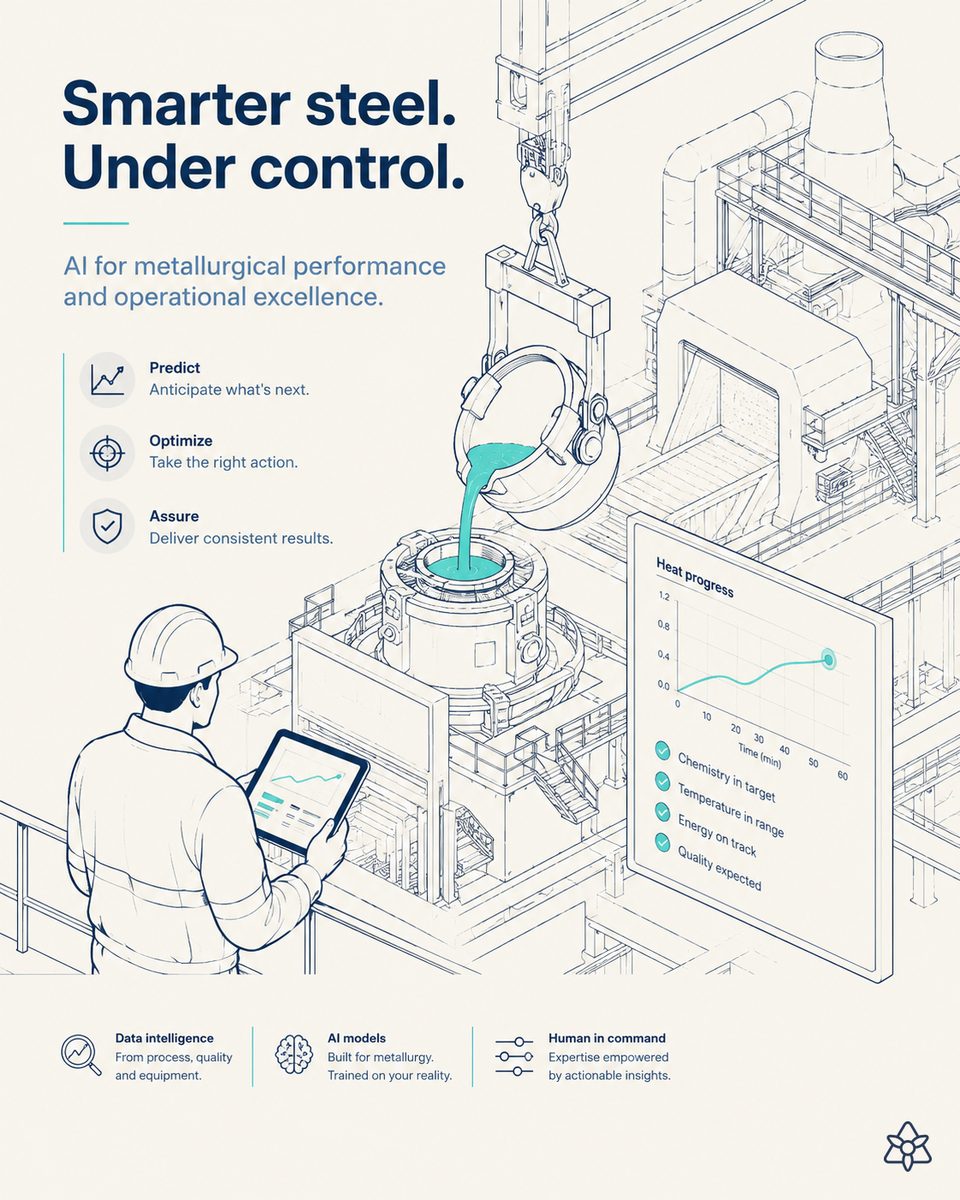
The defect gets into the casting at the pour — but it gets billed at machining or at the customer.
The quality of a casting is the intersection of four pieces of data that are almost never on the same screen:
- What was poured — the furnace's chemical composition (carbon, manganese, silicon, sulfur, phosphorus). In the spectrometer system, usually with a delay.
- How it was poured — pouring temperature, filling, mold parameters, atmosphere. In the molding plant's control system.
- How it cooled — the thermal pattern at shakeout, the gradients. Almost nobody records it casting by casting.
- What the casting looks like when it comes out — surface blowholes, veining, cold shuts, flash. The operator's visual inspection before shot blasting.
The quality manager knows it, but most defects are only confirmed at machining (when the internal porosity that wrecked a lathe operation shows up) or at the customer (when dye penetrant testing or ultrasound flags an inclusion). By then the cost is triple: the casting, the machining hours and the customer's trust. The classic system works 99% of the time. That other 1% is what the monthly committee pays for.
iLEAN does not add a fifth system — it seals the cracks between melt, mold, shakeout and appearance.
The problem in a foundry is not a lack of information: it is information living on islands that, between the pour and the final inspection, never reaches the decision-maker cross-checked. iLEAN acts as the putty that fills those gaps, without asking you to change your spectrometer, your molding system or your classic inspection.
Edge looks at the casting with a thermal + visible camera at shakeout. Connect reads the melt and the mold wherever they live. The agent cross-checks the signature against the composition and the parameters, and flags the borderline casting before shot blasting. The person decides where it goes.
The three iLEAN pieces applied to steel casting:
- Edge — a terminal with machine vision (CNN) at shakeout. A thermal camera for a per-casting temperature map and a visible camera with raking light to classify surface defects. It flags the borderline casting and triggers an actuator (status light, diverting lane). It works with no network.
- Connect — captures the spectrometer composition, the mold parameters and the melt recipe, whether they come from a modern system, from an old machine or from a spreadsheet kept by the metallurgical lab. And it captures what arrives from outside: a change in the supplier's scrap, a new customer specification tightening S and P.
- Agent — cross-checks the thermal and visual pattern against the composition and the mold parameters. It recommends where each borderline casting should go (radiography, testing, controlled scrap) to the quality manager through whatever channel they use. The person decides and signs; no casting is discarded on its own.
Classic inspection vs. cross-checked control with iLEAN
| Aspect | Classic inspection + standalone spectrometer | With iLEAN Edge + Connect + Agent |
|---|---|---|
| Melt composition | In the spectrometer, almost never cross-checked | Attached to the specific casting at second zero |
| Thermal pattern at shakeout | Almost nobody records it casting by casting | Thermal camera per casting, cross-checked with composition and mold |
| Surface defects | Operator's visual inspection before shot blasting | Vision classified under raking light, before shot blasting |
| Porosity detection | At machining or already at the customer | Casting flagged as borderline for radiography or testing |
| Operation with no network | n/a | Edge keeps classifying on the panel's own light |
| File for the customer | Rebuilt by hand when a claim comes in | Per-casting dossier, automatic, with composition + thermography + photo |
Impact estimate for your plant — to be validated with your numbers.
The block below is an estimate to be validated with the specific data of your plant. We put it forward so the committee has an order of magnitude; we refine it during the diagnostic.
- Carbon / stainless / alloy steel foundry, castings up to several hundred kg, supplying the mechanical, energy or rail sectors.
- Edge pilot at shakeout (thermal camera + visible camera + integration with the spectrometer and the mold system). First value expected in a few weeks.
- Reduction in castings whose defect is found at machining/at the customer, against your history: ≥ 30% — a conservative estimate.
- Indicative payback between 4 and 9 months, depending on the average cost per casting with machining hours wasted and the frequency of claims over the past year.
- The hard lever is every casting scrapped before machining (instead of finding it at the customer).
And the quality manager's reasonable doubt
“What if the AI flags a good casting as borderline?” — hallucination is a problem of free generation, not of anchored tasks. In tasks where the AI merely cross-checks thermal + visual signature + composition, the best models brought error below 1.5% [1]. And even so, the flagged casting goes to a second inspection (radiography, dye penetrant), not to the scrap bin. The person decides; no casting is discarded on its own. The three safety rings exist precisely for this.
[1] OpenAI paper “Why Language Models Hallucinate”, 2025 — on the reliability of AI in anchored tasks.
What people ask about quality control in steel casting
Which typical defects ruin a steel casting?
The foundry classics are gas or shrinkage porosity, non-metallic inclusions (slag, oxides, sand), cold shuts and misruns caused by insufficient pouring temperature, surface defects (excessive roughness, blowholes, veining) and dimensional deviations from abnormal shrinkage. Most of them are found late — at shot blasting, at machining or already in the customer's test — when the scrap cost includes machining hours thrown in the bin.
Why are chemical composition and thermal pattern never cross-checked in real time?
Because they live in different systems: the lab spectrometer gives the melt composition with some delay, the mold control system holds the pouring and cooling parameters, and shakeout thermography is a camera that almost nobody cross-checks against the other two. When an agent can read all three at once, the defect signature shows up — casting by casting — before shot blasting, not after final inspection.
How does iLEAN Edge work at the moment of shakeout?
Edge combines two cameras: a thermal one that records each casting's thermal pattern at shakeout (a temperature map by zone) and a visible one that classifies surface defects — blowholes, veining, flash, cold shuts — under raking light. The agent cross-checks those two signatures against the melt composition and the mold parameters, and flags the borderline casting for a second inspection instead of sending it straight to shot blasting. It works with no network: if the plant loses WiFi, Edge keeps classifying and flagging.
Does this work in investment casting or only in sand molding?
It works in both. The pattern changes (investment casting has its own defects — metal-mold soldering, decarburization, shell defects — while sand casting has the typical mix and binder issues), but the logic is the same: cross-check melt composition, mold parameters and the thermal/visual signature at shakeout. iLEAN adapts to the type of mold with a model trained on your plant during the immersion phase.
How much does an AI quality pilot cost in a steel foundry?
The order of magnitude of an Edge pilot in a foundry is that of any Edge pilot in a critical transformation process: an initial investment covering terminals, thermal + visible cameras, lighting, integration with the spectrometer and the mold system, plus an annual license. A reasonable payback to put in front of the committee is between 4 and 9 months: the hard lever is every casting scrapped before machining (instead of finding it at the customer). We ask for your plant's data and send you the estimated ROI in 48h, with your numbers, not ours.
More cases in petrochemical
- You change UV inkjet ink every shift — and the changeover eats the next customer's hour.iLEAN Connect orchestrates the fast changeover of UV inkjet ink: recipe, purge, printhead and QA in a…
- UV adhesive in flexible lamination — delamination doesn't show up today, it shows up at your customer's plant.iLEAN Edge correlates UV adhesive viscosity, coat weight and UV dose in film-film lamination: stops…
- FCC zeolite catalyst — today's makeup rate is decided with an analysis from three days ago.How iLEAN cross-references E-cat, feed metals and FCC yields to anticipate the fresh-to-equilibrium…
- Textile adhesive control with AI — one badly formulated drum means an entire collection rejected.How iLEAN cross-references in-line viscosity, peel and tack of textile adhesive with the batch recipe…
- Leak detection with thermal vision and AI — the leak you can already smell arrived too late.iLEAN combines thermal cameras and AI models to detect leaks before they are visible. Continuous LDAR in…
- Refinery turnaround with AI — scope creep is not bad luck, it is information that reaches the office late.iLEAN plans, executes and cuts scope creep in refinery turnarounds. Measurable ROI on every TA.
Tell us your case and in 48h we'll send you the estimated ROI of this AI project for your foundry.
We work on your plant's real data, not ours. Diagnostic with no commitment.
Request estimated ROI in 48h See petrochemical and materials