UV adhesive in flexible lamination — delamination doesn't show up today, it shows up at your customer's plant.
Delamination in a film-to-film laminate comes to light weeks later, in the customer's cold room, and takes whole orders with it. iLEAN Edge correlates UV adhesive viscosity, applied coat weight and UV dose in-line: if the cross-check falls outside the product window, it holds the roll before rewinding. The person signs — the line does not restart on its own.
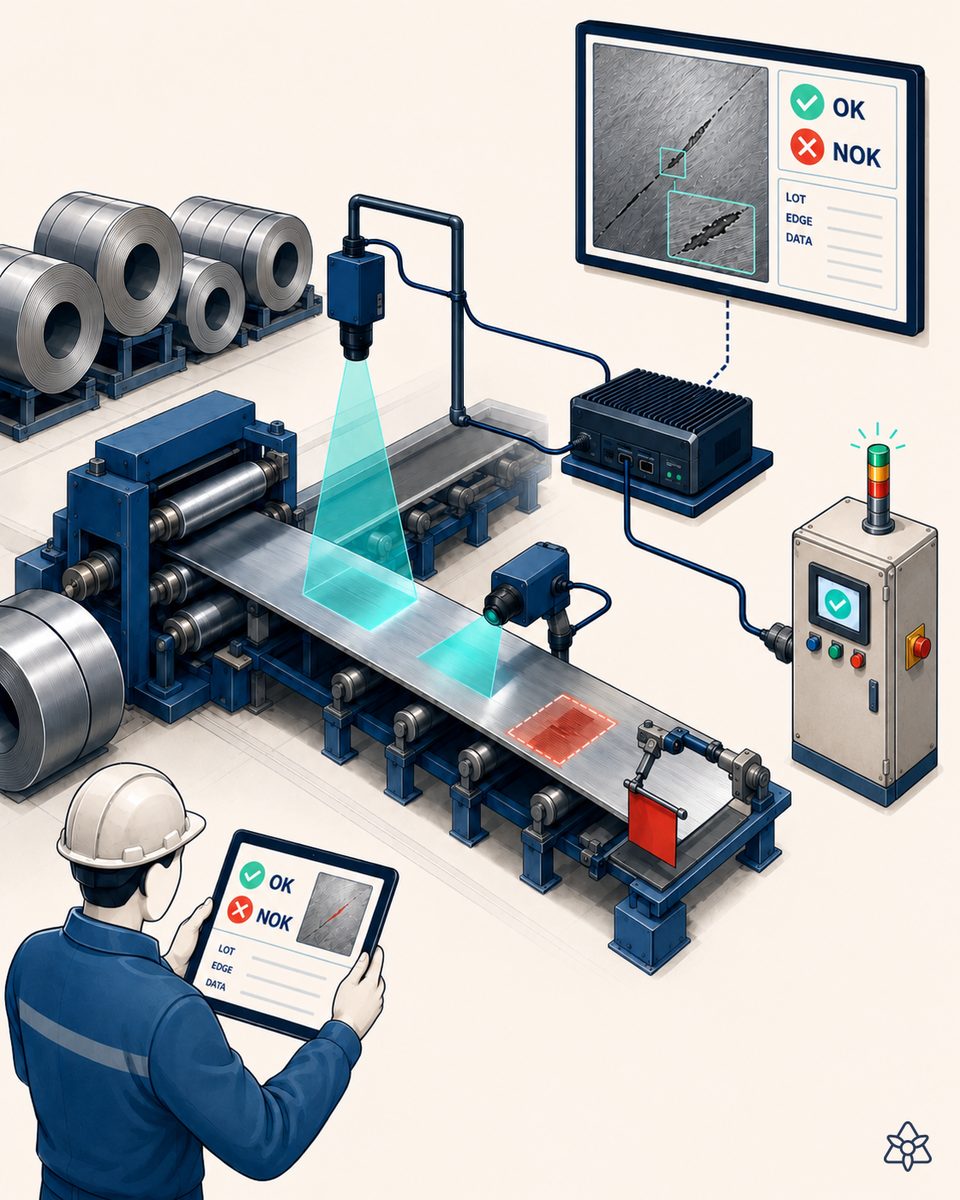
Three variables that have to line up — and a defect that shows up weeks later.
A sound film-to-film bond with UV adhesive is the intersection of three realities that most plants do not cross-check in-line, only after the fact:
- The adhesive viscosity at the dosing unit — it depends on temperature, on the supplier's batch and on the condition of the applicator. If it rises, the actual coat weight changes even though the setting has not been touched.
- The coat weight deposited on the film — the product target. Sometimes it is measured by weight difference, sometimes assumed from the recipe. Rarely is it measured in real time.
- The effective UV dose — the mJ/cm² the adhesive actually receives. It depends on lamp power, film speed, distance and bulb age. It is usually monitored at setup, not on every roll.
When all three are inside the window, the bond holds. When one drifts, the initial tack can pass the plant check and the laminate delaminate weeks later — when it enters the customer's cold room, goes through the packing cycle or gets stressed on the end-of-line equipment. Or worse: the roll comes out slightly yellowed from UV overdose and the customer rejects it as a cosmetic defect. The damage is to the brand, not just the roll.
iLEAN does not replace your control lab — it cross-checks the three curves you already have before rewinding.
The delamination problem is not a lack of measurement: it is that viscosity, coat weight and UV dose are never cross-checked in the same second against the product window. iLEAN acts as the putty that seals that crack, without asking you to change your laminator, your adhesive or your lamp.
Edge sees the roll and measures the dose. Connect reads the viscosity and the product recipe. The agent cross-checks the three curves against the target window and holds the roll if something does not add up. The person signs — the line does not restart on its own.
The three iLEAN pieces applied to UV adhesive control in flexible lamination:
- iLEAN Edge — a vision (CNN) terminal over the film at the UV lamp exit, reading color (yellowing), continuity of the adhesive layer and, with the right sensor, in-line UV dose. It works without a network: if the plant loses WiFi, Edge keeps reading and holding rolls before rewinding.
- iLEAN Connect — captures the adhesive viscosity from the in-line meter, the dosing-unit temperature and the product recipe whether it comes from the ERP, the MES or an Excel sheet where R&D logs the % solids of the supplier's latest batch. And it also captures the supplier's email announcing a batch change, at second zero, without anyone having to forward it.
- Agent — cross-checks viscosity, estimated coat weight, UV dose and product recipe against the signed window. If the cross-check falls outside it, it holds the roll and alerts the quality manager through whatever channel they use. At closeout, it leaves a per-roll dossier with the three curves for the BRC auditor or for the customer's claim.
Isolated control vs. cross-checked control with iLEAN
| Aspect | Classic control | With iLEAN Edge + Connect + Agent |
|---|---|---|
| Adhesive viscosity | Spot measurement, not always cross-checked | Continuous, against the product window |
| Actual coat weight | By weight difference or assumed | Estimated in-line from vision and dose |
| UV dose | Measured at setup, assumed afterward | Monitored every meter, alarm if it drops |
| Yellowing detection | Operator's eye — or the customer's | CNN camera before rewinding |
| Roll hold | After the fact, in the lab | In-line, before it leaves the plant |
| Dossier for the BRC auditor | Rebuilt by hand | Curves + recipe + signature, per roll |
Impact estimate for your plant — to be validated with your numbers.
The block below is an estimate to be validated with the specific data of your plant. We put it forward so the committee has an order of magnitude; we refine it during the diagnostic.
- Flexible packaging plant, one or several film-to-film laminators running UV adhesive, multi-product with frequent recipe and substrate changes.
- Edge pilot on one laminator (CNN camera at the UV lamp exit + integration with the viscometer and the lamp control). First value expected within a few weeks.
- Expected reduction in delamination / yellowing claims ≥ 30% against the documented frequency of recent months.
- Indicative payback between 4 and 9 months, depending on the average cost of a claim (product recovered, reverse logistics, brand damage) and the volume of multi-customer rolls.
- The hard lever is a single delamination claim avoided: over the medium term the brand cost outweighs the immediate hard cost. One claim pays for the pilot.
And the quality manager's reasonable doubt
“What if the AI holds a good roll and stops the line for no reason?” — hallucination is a problem of free generation, not of anchored tasks. In tasks where the AI merely recontextualizes a piece of data from one system to another (reading color, coat weight and dose and comparing them against the product window), the best models brought error below 1.5% [1]. And even so, what is critical is never decided alone: iLEAN holds and the person signs whether the roll goes to the customer, to rework or to scrap. The three safety rings exist precisely for this.
[1] OpenAI paper “Why Language Models Hallucinate”, 2025 — on the reliability of AI in anchored tasks.
What people ask about UV adhesive in flexible lamination
Why does film-to-film delamination show up weeks later?
Because the quality of the adhesive bond depends on the intersection of three variables — UV adhesive viscosity at the dosing unit, actual coat weight deposited on the film and effective UV dose per linear meter. If one drifts, the initial tack can be fine and the problem surface weeks later, when the laminate enters the customer's cold room or goes through the packing cycle. That latency is what makes the defect expensive: it is discovered on the retail shelf, not in the plant.
How does iLEAN detect a yellowed roll before rewinding?
With an Edge terminal carrying a CNN camera over the laminated film at the UV lamp exit. Yellowing is a sign of overdose (high UV + too little adhesive) or of adhesive degraded by temperature — iLEAN compares the color reading against the product's reference and, if it exceeds the threshold, holds the roll before rewinding. The person validates whether it goes to the customer, to rework or to scrap; the line does not decide on its own.
Does it work with cationic, free-radical and dual-cure UV adhesives?
Yes — the architecture is the same; what changes is the target window. Each UV chemistry has its admissible application-viscosity range, its recommended coat weight and its minimum UV cure dose (mJ/cm² measured with a radiometer or estimated from speed and power). The immersion team defines the window with your process manager and records it as a signed recipe per product; iLEAN does not blindly import curves from another plant.
What do you gain over manual coat weight + lamp checks?
What you gain is in-line correlation, not the isolated measurements. Today coat weight gets measured (sometimes), viscosity gets measured (sometimes) and the lamp gets looked at (always). What nobody does is cross-check all three on every linear meter against the product window, because no system allowed it. iLEAN closes that loop and leaves a per-roll dossier with the three curves, ready for the BRC auditor or for the customer when they file a claim.
How much does the pilot cost and when does the first value show?
The order of magnitude of an Edge pilot on a flexible laminator is close to that of any Edge pilot in flexible packaging: terminal + camera + in-line viscosity sensor + integration with the UV lamp control and the ERP/MES recipe, plus the annual license. The first value (holding out-of-window rolls before rewinding) shows within a few weeks. We ask for your plant's data and send you the estimated ROI in 48h.
More cases in petrochemical
- You want AI in the pyrophoric catalyst plant — without compromising the SIL or opening the OT to the outside.iLEAN's three rings uphold the SIS and human validation in pyrophoric catalyst activation and unloading,…
- A barrier roll with comets and craters sells as seconds — it shouldn't take two shifts to find out.iLEAN Vision detects comets, craters and uncoated areas on silicone/PVDC barrier coaters and…
- You change UV inkjet ink every shift — and the changeover eats the next customer's hour.iLEAN Connect orchestrates the fast changeover of UV inkjet ink: recipe, purge, printhead and QA in a…
- FCC zeolite catalyst — today's makeup rate is decided with an analysis from three days ago.How iLEAN cross-references E-cat, feed metals and FCC yields to anticipate the fresh-to-equilibrium…
- Steel casting with AI — the porosity you find at machining gets paid for three times.How iLEAN cross-checks melt, mold and shakeout to detect porosity and inclusions in steel castings…
- Textile adhesive control with AI — one badly formulated drum means an entire collection rejected.How iLEAN cross-references in-line viscosity, peel and tack of textile adhesive with the batch recipe…
Tell us your case and in 48h we'll send you the estimated ROI of this AI project for your flexible laminator.
We work on your plant's real data, not ours. Diagnostic with no commitment.
Request estimated ROI in 48h See specialty chemicals