You want AI in the pyrophoric catalyst plant — without compromising the SIL or opening the OT to the outside.
Activating, unloading and regenerating a pyrophoric catalyst demands an independent SIS and a human validation no AI can replace. iLEAN's three-ring architecture keeps the SIS and the safety PLC in the inner ring (no internet, no inbound connections) and lets the AI live in the outer ring at full power. The operator signs any action that touches ring 1.
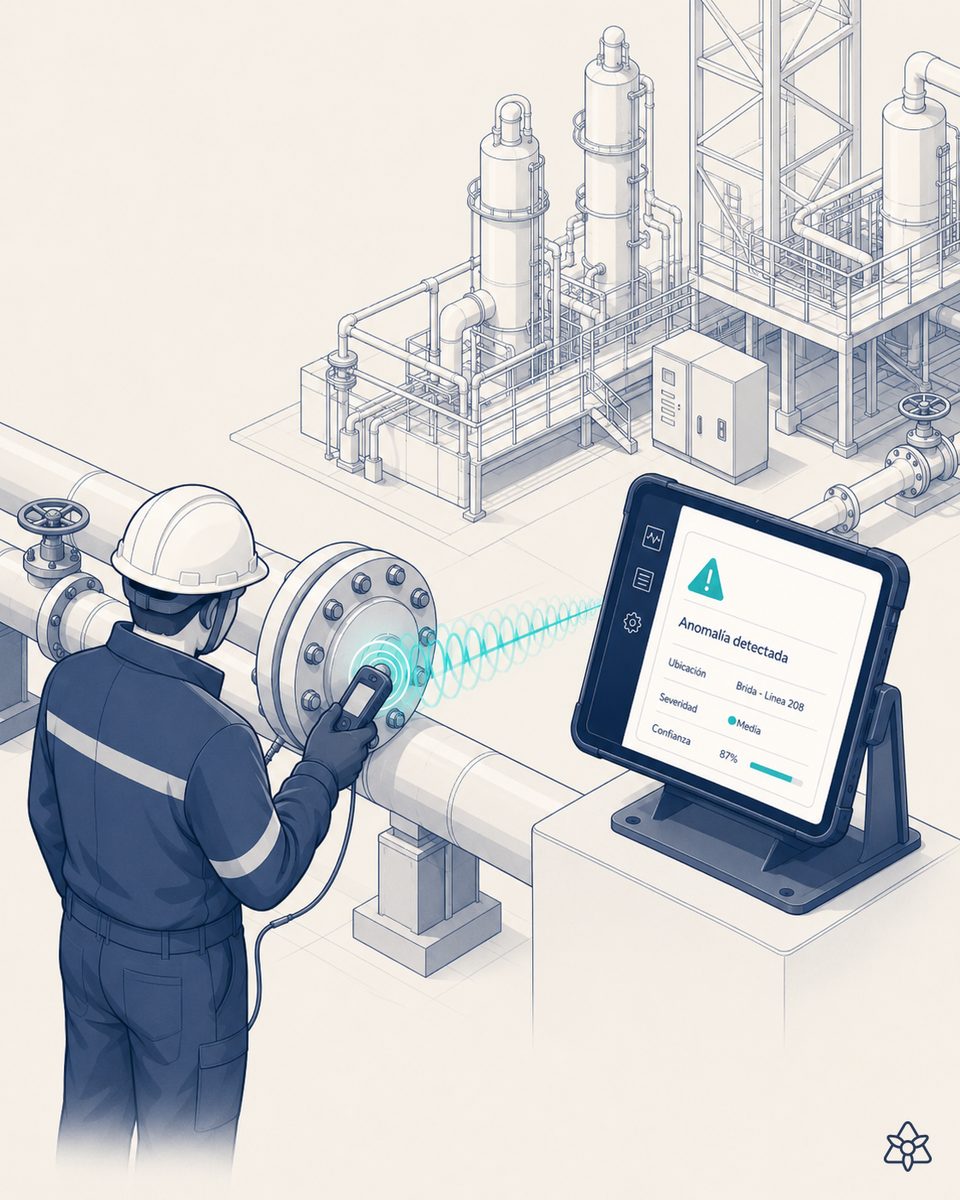
A pyrophoric catalyst is unforgiving — but modern AI cannot be ignored either.
In hydrotreating, isomerization and certain polymerizations, the catalyst in its active state reacts violently with air or moisture. The plant's HAZOP has already identified the critical safety functions, and the SIS, independent of the BPCS, upholds SIL-2 or SIL-3 under IEC 61511. The operation works — and at the same time, two pressures are not going away:
- The operations manager wants to anticipate the moment of leaving the envelope before the SIS has to close the loop. Every SIS activation means a shutdown of neighboring processes, a slow recovery, and a mark on the record.
- Management and the CAIO want AI in the plant — but the safety manager and the IT manager raise their hands: “nothing enters the OT network”. And they are right. The Log4j-type vulnerability hit corporate ERPs — it did not hit OT networks, precisely because they were isolated.
The classic false dilemma: either you lock the plant away from AI and lose the anticipation, or you open a crack and one day an AI-equipped attacker finds the zero-day and compromises the SIS. Both options are bad. The good one is not choosing between them — it is separating layers.
Three rings: the AI on the outside, the SIS on the inside, the person signs what crosses.
The three-ring architecture is not an invention — it is the formalization of something serious industry always did: isolate the OT network from the outside at all costs. What iLEAN adds is a layer that lets you harness the power of AI without giving up that isolation, raising it to the level today's threats demand.
SIS and safety PLC in ring 1, no internet, no inbound connections. Powerful AI in ring 3. Human validation on whatever crosses into ring 1.
The three layers, applied to a plant with pyrophoric catalyst:
- Ring 1 (inner, sacred) — the OT. This is home to the SIS, the safety PLC, the BPCS, proprietary drivers, the primary database. It has no outbound internet. It accepts no inbound connections. Only a minimal agent reads from a passive mailbox what ring 2 has deposited there, signed and validated. The SIS remains the last guardian — its SIL certification is untouched.
- Ring 2 (middle) — the validation chamber. A pool of agents with limited autonomy verifies, does not create: does the ring 3 proposal square with the plant rules? Did the operator sign it? Is the JSON's cryptographic signature valid? Once validated, it packages and deposits into ring 1's mailbox.
- Ring 3 (outer) — the power. iLEAN Edge at the beds, Connect capturing thermocouple readings, differential pressure, hydrogen and nitrogen flow. Agents that cross-reference the history, the catalyst loading conditions and the turnaround curve to anticipate the deviation 20-30 minutes earlier. Here the AI operates with maximum autonomy — because whatever leaves this ring passes through ring 2 and through the person.
Classic isolated SIS vs. SIS with iLEAN's three rings on top
| Aspect | Classic isolated SIS | iLEAN's three rings |
|---|---|---|
| OT isolation | Rigid air gap — AI stays out | Air gap preserved — AI operates in ring 3 |
| Deviation anticipation | Operator with panels and experience | Agents that cross-reference history and propose 20-30 min earlier |
| Transport between layers | n/a — there are no layers | Signed file drop, one asymmetric key per plant |
| Who closes the critical loop | SIS + operator with signature | SIS + operator with signature — unchanged |
| Traceability of AI proposals | n/a | Every proposal signed, archived, reviewable by an auditor |
| Compliance | IEC 61511, IEC 62443 | Same + AI Act (human oversight in high risk) |
Impact estimate for your plant — to be validated with your numbers.
The block below is an estimate to be validated with the specific data of your plant. We put it forward so the committee has an order of magnitude; we refine it during the diagnostic.
- Chemical plant with pyrophoric catalyst in hydrotreating or isomerization, SIL-2/3 certified SIS, HAZOP/LOPA up to date.
- Three-ring deployment on top of the existing architecture. First value expected within a few weeks: the first documented deviation anticipated, without touching the SIS.
- Expected reduction in SIS activations through anticipated deviations ≥ 30%, with a defensible floor in annual plant hours recovered.
- Indicative payback between 4 and 9 months, depending on the frequency of unplanned shutdowns, the catalyst recovery cost and the opportunity cost of the affected line.
- The hard lever is a single catastrophic shutdown avoided and the consolidated traceability that passes the next Seveso audit without hiring an outside consultant.
And the safety manager's reasonable doubt
“What if a ring 3 agent hallucinates and proposes a dangerous maneuver?” — hallucination is a problem of free generation, not of anchored tasks. The ring 3 proposal is anchored to real plant readings, and before crossing into ring 1 it is validated by ring 2 against plant rules and signed by a person. In anchored tasks, the best models brought error below 1.5% [1]. And even so, what is critical is never decided alone: the SIS remains the last guardian, and the operator signs. The three rings are built precisely for this defense-in-depth architecture.
[1] OpenAI paper “Why Language Models Hallucinate”, 2025 — on the reliability of AI in anchored tasks.
What people ask about SIL and three rings with pyrophoric catalyst
What counts as SIL in a plant with pyrophoric catalyst?
The activation, unloading, regeneration and handling of pyrophoric catalyst (typical in hydrotreating, isomerization, certain polymerizations) is covered by HAZOP/LOPA studies under IEC 61511 and IEC 61508, which assign a SIL (1, 2 or 3) to each safety function. The SIS (Safety Instrumented System) is independent of the BPCS and activates when the process leaves the envelope — isolation valve, depressurization, nitrogen inerting. The catalyst is unforgiving: contact with air or moisture and it reacts violently.
Can AI sit on top of the SIS without compromising the certification?
Yes — as long as the AI lives in a layer separate from the SIS and never closes the critical loop on its own. iLEAN's three-ring architecture formalizes this: ring 1 (the sacred OT) is home to the SIS, the safety PLC and the BPCS, with no AI, no outbound internet, no inbound connections. The AI lives in ring 3 (the outer one) with maximum autonomy to infer, anticipate and propose. Ring 2 validates and packages what crosses over. The operator signs any action that touches ring 1.
How does a data point cross from ring 3 to ring 1 without opening the network?
Via signed file drop: ring 3 deposits a cryptographically signed JSON in a shared folder; ring 2 verifies signature and content against plant rules; ring 1 reads from a passive mailbox and only accepts what arrives signed and validated. There is no network protocol between rings. “The safety manager understands 'folder' much better than 'HTTPS polling over mTLS'.” One asymmetric key per plant — if one is compromised, only that one is revoked.
What does AI contribute in a SIL operation if it cannot close the loop?
It contributes anticipation, assistance and traceability — without touching the SIS. It cross-references bed temperatures, differential pressure, hydrogen flow, thermocouple readings and historical patterns to anticipate a deviation 20-30 minutes before the SIS would have to activate. It notifies the operator with a concrete proposal (reduce flow X, increase nitrogen Y, controlled shutdown). The operator decides and signs. The SIS remains the last guardian — but it steps in less often because the plant reached the envelope before leaving it.
Which regulations cover this approach?
IEC 61508 / IEC 61511 (industrial functional safety), IEC 62443 (OT network cybersecurity), NIST SP 800-82 (control systems), the Seveso III Directive in upper-tier plants, and the European AI Act for the AI layer in high-risk systems. The three-ring architecture is built specifically to coexist with those frameworks: isolating the OT is not paranoia, it is survival — the Log4j-type vulnerability hit ERPs, but not OT networks, precisely because they were isolated.
More cases in petrochemical
- Low-migration food ink in rotogravure — one photoinitiator that slipped into SVHC is a recall.How iLEAN keeps the EuPIA/Swiss matrix live per SKU, blocks non-compliant formulas and builds the…
- A gelled compounding batch is not an operator error — it is a correlation nobody had in front of them in time.iLEAN Edge correlates torque, pressure and online MFI in reactive extrusion of antioxidants and acid…
- SHE traceability of MDI in PU sealant — the isocyanate data cannot arrive after the valve is open.iLEAN Connect captures MDI/TDI delivery notes, cross-checks them with stock and formula and flags SHE…
- A barrier roll with comets and craters sells as seconds — it shouldn't take two shifts to find out.iLEAN Vision detects comets, craters and uncoated areas on silicone/PVDC barrier coaters and…
- You change UV inkjet ink every shift — and the changeover eats the next customer's hour.iLEAN Connect orchestrates the fast changeover of UV inkjet ink: recipe, purge, printhead and QA in a…
- UV adhesive in flexible lamination — delamination doesn't show up today, it shows up at your customer's plant.iLEAN Edge correlates UV adhesive viscosity, coat weight and UV dose in film-film lamination: stops…
Tell us your case and in 48h we'll send you the estimated ROI of this AI project for your SIL plant.
We work on your plant's real data, not ours. Diagnostic with no commitment.
Request estimated ROI in 48h See specialty chemicals