A gelled compounding batch is not an operator error — it is a correlation nobody had in front of them in time.
Reactive extrusion of antioxidants and acid scavengers happens inside the screw, where the operator only sees torque and pressure. iLEAN Edge correlates those signals with online MFI and the actual dosing of every gravimetric feeder to anticipate gels and propose a feeder adjustment. The person signs — without a signature, the change does not reach the PLC.
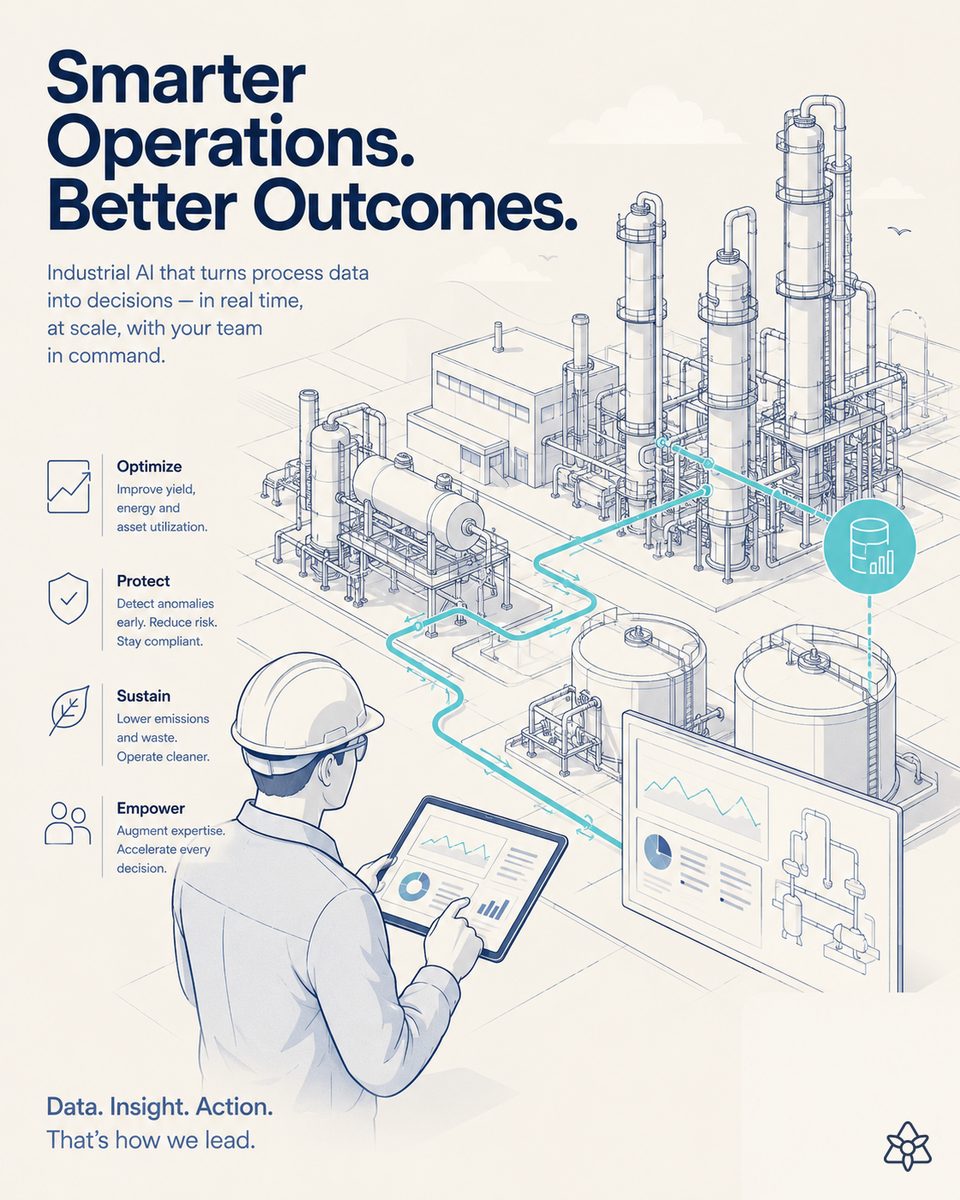
The reaction happens inside the screw — and the operator sees the consequence, not the cause.
Reactive compounding of additives — phenolic and phosphite antioxidants, acid scavengers, peroxides, concentrated additive masterbatch — is a controlled chemical reaction inside a twin-screw extruder. The process window is narrow: half a degree too much in the melt, a tenth of a point of torque too high, a micron off in the antioxidant dosing, and you get gels, yellowing, or MFI out of band.
The operator reads the panel: torque, pressure per zone, thermal profile. He does not see the reaction — he infers it. By the time gels reach the screen changer or the customer, it is too late. And the argument with the compound's customer is always the same: “it wasn't the dosing, it was the recipe”, “it wasn't the recipe, it was your screw”. Without a dossier that ties the five threads together at once, root cause gets rebuilt on intuition.
The problem is not instrumentation — the extruder already measures almost everything. It is that torque, pressure, MFI, temperatures and dosing live in different systems, and the correlation that anticipates gels is not made in the moment. That has just changed.
iLEAN Edge does not add another DCS — it puts live correlation on the extruder.
Reactive compounding has the data — what it does not have is a place where the data meets batch by batch, live, against the stable batch. iLEAN Edge is the putty that seals that crack: it crosses the five relevant signals, maintains the golden batch per recipe and proposes the adjustment when the process signature starts to drift. The extruder is still your extruder; the PLC is still your PLC.
Edge correlates torque, pressure, MFI, temperatures and dosing. The agent recognizes the stable batch signature and says when it drifts. The person signs — without a signature, nothing reaches the PLC.
The iLEAN pieces applied to the reactive extruder:
- Edge — a terminal with inline computation next to the extruder. It reads torque, pressure per zone, melt temperatures, online MFI (if you have a rheometer/SmartFlow) and the actual dosing of the gravimetric feeders. It maintains the stable batch signature per recipe and raises an alert when it starts to drift — before gels appear at the screen changer. It works with no network: the critical computation does not depend on WiFi.
- Connect — the putty between the DCS, the compound PLC, the MES and the lab. It captures the additive supplier's COA (it arrived by email; now it is usable data), the lab's offline MFI result, and the campaign recipe. If the equipment is old, Connect captures it from a photo of the panel or from a local file, without asking you to replace it.
- Agents and the three rings — the agent proposes the adjustment with visible reasoning; the process manager signs. The packaged, signed change enters the hardened mailbox of the OT ring, where the PLC is already waiting. For plants with lower criticality, threshold-conditioned auto-approval; for high-risk plants, a mandatory signature. You configure it, with no code to touch.
Reactive control vs. live correlation with iLEAN Edge
| Aspect | Classic control | With iLEAN Edge |
|---|---|---|
| Drift detection | The operator reads torque and pressure, then reacts | Live golden batch signature, alert before the gels |
| MFI | Offline, two shifts later | Online, cross-referenced with dosing within the batch |
| Restarting an old campaign | Rebuild the set point by trial and error | Recover the stable set point from last time |
| Feeder changes | Manual set point, with no traced rationale | Agent proposal, human signature, record |
| Traceability for the customer | Batch sheet rebuilt after the complaint | Per-batch dossier with every signal |
| The "screw vs. recipe" argument | By intuition and email | By cross-referenced data, on screen |
Impact estimate for your plant — to be validated with your numbers.
The block below is an estimate to be validated with the specific data of your plant. We put it forward so the committee has an order of magnitude; we refine it during the diagnostic.
- Compounder with a co-rotating twin-screw extruder, gravimetric additive feeders (phenolic + phosphite antioxidant, acid scavenger), one or two documented complaints about gels or out-of-band MFI in the last financial year.
- Edge pilot on one extruder (reading torque and pressure per zone + online MFI + actual dosing + recipe). First value expected within a few weeks: the next drift is anticipated before it reaches the screen changer.
- Indicative payback between 4 and 9 months, depending on the frequency of documented gels and the cost of a lost campaign. Expected reduction in MFI variability ≥ 30% over the worst quartile of batches — you already have the stable batch; what Edge fixes is the odd one out.
- The hard lever is a campaign that is not lost to gels — the compound's customer keeps the contract when they see a plan, not just an apology.
And the process manager's reasonable doubt
“What if the AI changes the dosing when it shouldn't?” — hallucination is a problem of free generation, not of anchored tasks. Here the AI crosses measured signals and compares them with the golden batch signature — it invents nothing. In tasks like these, the best models brought error below 1.5% [1]. And even so, the feeder does not move without a human signature: the three rings exist precisely for this.
[1] OpenAI paper “Why Language Models Hallucinate”, 2025 — on the reliability of AI in anchored tasks.
[2] Automotive quality standard in the order of 25 PPM. Symestic.
What people ask about reactive additive extrusion in compounding
What makes reactive compounding of antioxidants and acid scavengers so difficult?
The process window is narrow and the reaction happens inside the extruder: if the dosing of antioxidant (phenolic, phosphite) or acid scavenger (stearic acid, hydrotalcite) drifts, or if the screw's thermal profile moves by a couple of degrees, you get gels, yellow degradation, or MFI loss outside specification. The operator does not see the reaction — he sees torque and pressure, and reacts when it is already too late. The compounded material reaches the customer with properties out of band, and the reason gets argued over by email.
Which signals does iLEAN Edge correlate to anticipate gels?
Five families that live in different systems: torque and pressure per screw zone from the extruder's DCS/PLC, online MFI (process rheometer or a SmartFlow sensor if you have one), melt temperatures, and the actual dosing of each gravimetric feeder (base polymer, antioxidant, acid scavenger, peroxide where applicable). Edge builds the signature of the stable batch (the golden batch) per recipe and, when torque rises above the band while MFI drops, it says so before gels show up in the part.
Does the AI change the dosing on its own?
No. Gravimetric feeders live in the OT ring. Edge proposes the adjustment with the rationale on screen (which signal triggered it, what deviation is anticipated, which set point change would correct the drift) and the process manager signs. He executes the actual change on the console he has always used, or the system packages the change cryptographically signed and leaves it in the hardened mailbox of ring 1. Without a human signature it does not reach the PLC. You configure it per plant: auto-approval with a threshold, or mandatory validation.
Does it work with co-rotating and counter-rotating twin-screw extruders?
Yes. Edge assumes no brand and no geometry — it stores the signature of your specific screw (Coperion, Leistritz, Berstorff, KraussMaffei, others) by L/D, element profile and recipe. Drift detection is trained on your own history: the torque-pressure-MFI pattern that precedes a gelled batch on your extruder may be different from the one on a similar machine, and the agent learns it batch by batch. Restarting an old campaign becomes faster — the system recovers the stable set point from the last time you ran that recipe.
What about traceability for the end customer?
The agent builds the per-batch dossier with every signal: actual batch-by-batch dosing, torque/pressure, online MFI, melt temperature, adjustments signed by a person. When the compound's end customer asks for an explanation of a property deviation, the quality manager makes the call with the film of the batch in front of him — not with a generic incident sheet. For ISO 9001 / IATF 16949 audits, the dossier is already built.
More cases in petrochemical
- Qualicoat powder coating on aluminum profiles — a cured lump is a 7-meter bar sent to rework.iLEAN Edge spots lumps and powder thickness before the oven on Qualicoat architectural profiles — the…
- The edge band peels off three weeks later — and the complaint arrives when the furniture is already in the customer's home.iLEAN Edge crosses melter temperature, humidity and edgebander speed to hold PUR open time and prevent…
- Low-migration food ink in rotogravure — one photoinitiator that slipped into SVHC is a recall.How iLEAN keeps the EuPIA/Swiss matrix live per SKU, blocks non-compliant formulas and builds the…
- SHE traceability of MDI in PU sealant — the isocyanate data cannot arrive after the valve is open.iLEAN Connect captures MDI/TDI delivery notes, cross-checks them with stock and formula and flags SHE…
- You want AI in the pyrophoric catalyst plant — without compromising the SIL or opening the OT to the outside.iLEAN's three rings uphold the SIS and human validation in pyrophoric catalyst activation and unloading,…
- A barrier roll with comets and craters sells as seconds — it shouldn't take two shifts to find out.iLEAN Vision detects comets, craters and uncoated areas on silicone/PVDC barrier coaters and…
Tell us your case and in 48h we'll send you the estimated ROI of this AI project for your reactive compounding line.
We work on your extruder's real data, not ours. Diagnostic with no commitment.
Request estimated ROI in 48h See specialty chemicals