Qualicoat powder coating on aluminum profiles — a cured lump is a 7-meter bar sent to rework.
On architectural profiles, a lump under the powder is scrap, manual recoating and a whole profile to rework. iLEAN Edge sees the powder before the oven with CNN vision, fires the actuator and rejects the bar — the powder is recovered and the person decides whether it goes back to the booth or into the rework circuit. It is the literal extension of the powder coating case to the architectural sector.
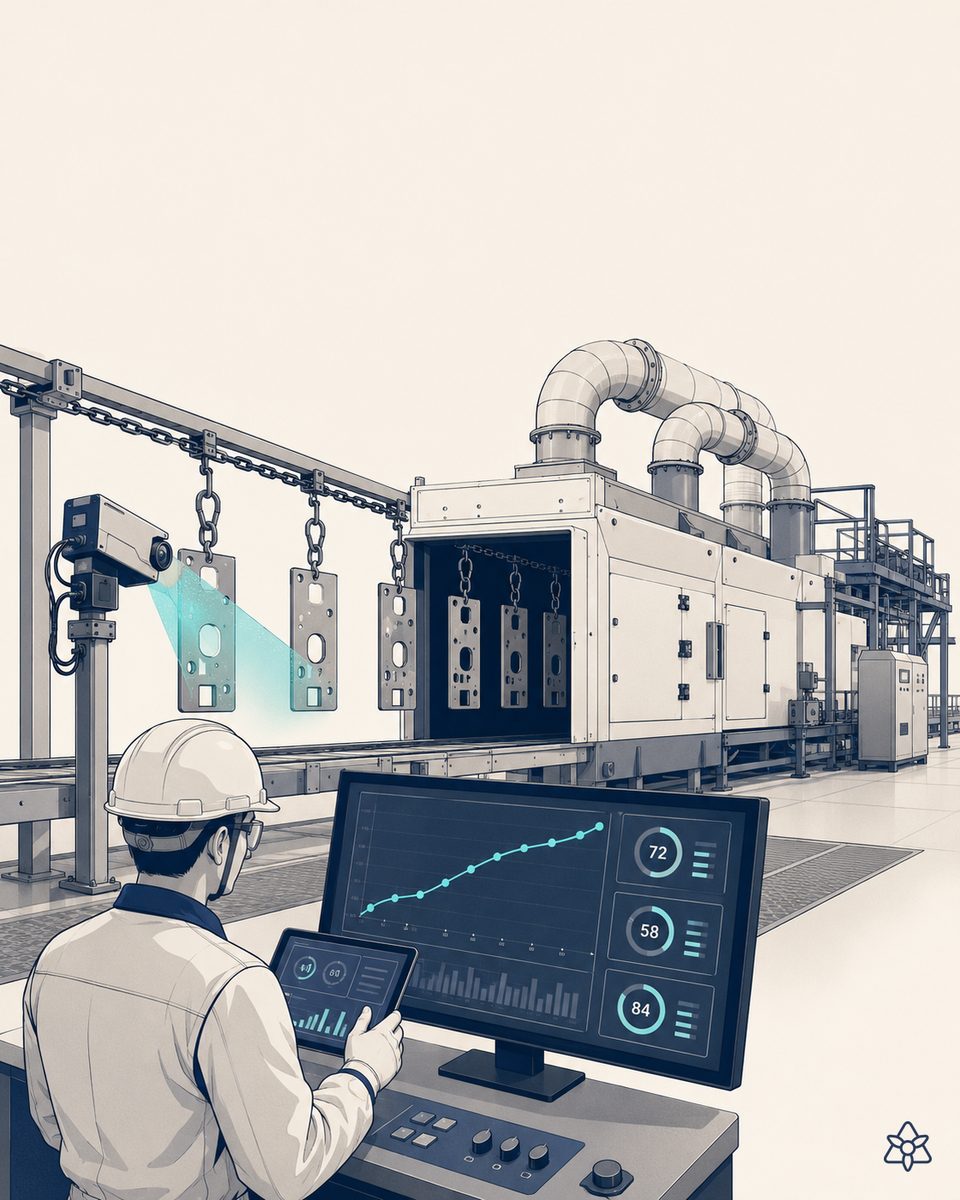
A cured defect is not rework — it is sanding, labor and a degraded profile.
On a powder coating line for architectural profiles, the critical moment is before the oven. Up to that point, a lump or a sag is uncured powder: you blow it off, it goes back into the circuit and the bar returns to the booth. After the oven, the same incident moves into a different cost category:
- Manual sanding of the profile — sanding an architectural profile to remove a cured lump is slow, it leaves a mark and it takes the thickness below the target Qualicoat class.
- Re-application + second cure — gas, kWh, line occupancy, and the risk of not reaching the required thickness because the substrate has already been sanded.
- Risk of failing Qualicoat — if the final thickness falls outside the class, the bar is no longer that product. Either it drops a class or it goes to scrap.
The booth operator knows this — the problem is that he cannot see the whole bar in time. A 7-meter bar with several visible faces moves at line speed, and the eye covers the nearby zone, not the rest. The classic system works 99% of the time. That 1% is the bar that reaches the oven with a lump in the middle of the profile.
iLEAN does not change the booth or the oven — it provides the eyes the operator cannot have on the whole bar at once.
The problem on profiles is not a lack of skill: it is that the human eye does not scale to long bars with several faces moving at line speed. iLEAN acts as the putty that seals that crack between the booth and the oven, without asking you to change the powder, the hoist or the burner. It is the natural extension of the powder coating case already documented in automotive to the architectural sector.
Edge sees the powder before the oven and rejects the bar. Connect reads the dispenser and the booth however they come. The agent cross-references the bar's recipe and the Qualicoat class. The person signs whether the bar goes back to the booth or on to rework — the line does not decide alone.
The three iLEAN pieces applied to powder coating on architectural profiles:
- iLEAN Edge — one or more vision terminals (CNN) over the conveyor at the booth exit, before the oven. They recognize the lump and sag patterns, fire an actuator (light stack + signal at the station) and allow the bar to be rejected in milliseconds. It works with no network: if the plant loses WiFi, Edge keeps detecting and stopping defective bars.
- iLEAN Connect — reads the powder dispenser and the booth control by whatever route they allow: modern integration if there is one, a panel reading or a photo of the display if it is old. And it captures the recipe record (Qualicoat class, color, target thickness) from the ERP, the MES or the spreadsheet where the coating manager keeps it.
- Agent — cross-references the detected defect, the bar's recipe and the history (what changed since the last good bar: powder, humidity, gun settings). It proposes a root cause to the booth manager, not just the isolated defect. At the end of the lot, it leaves a per-bar dossier for the Qualicoat auditor.
Visual inspection at the end vs. detection before the oven
| Aspect | Classic inspection | With iLEAN Edge + Connect + Agent |
|---|---|---|
| Detection point | Oven exit or shipping | Before the oven, with the powder still uncured |
| Powder recovery | No — the powder is already cured | Yes — it goes back to the booth circuit |
| Type of rework | Sanding + re-application + re-curing | Blow-off + return to the booth |
| Qualicoat class risk | High if sanding was needed | Low — the profile keeps its base thickness |
| Root cause of the defect | “The gun, I suppose” | The agent cross-references history and recipe |
| Operation with no network | n/a | Edge keeps running on the panel's power |
Impact estimate for your plant — to be validated with your numbers.
The block below is an estimate to be validated with the specific data of your plant. We put it forward so the committee has an order of magnitude; we refine it during the diagnostic.
- Qualicoat plant coating architectural profiles, one or several booths, long multi-face bars, a mix of classes (Cl. 1, Cl. 2, Cl. 1.5).
- Edge pilot on one booth (CNN cameras before the oven + rejection actuator + integration with the dispenser and the recipe). First value expected within a few weeks.
- Expected reduction in bars needing heavy rework (sanding + re-application) ≥ 30% against the documented frequency of recent months.
- Indicative payback between 4 and 9 months, depending on the average rework cost per bar and the percentage of bars currently downgraded to a lower class because of sanding.
- The hard lever is changing the category of the defect: from deep rework to a clean re-application. The powder is recovered, the bar keeps its class, and the oven does not burn a profile's cycle on rework.
And the booth manager's reasonable doubt
“What if the camera rejects a good bar because of a reflection?” — hallucination is a problem of free generation, not of anchored tasks. In tasks where the AI simply recognizes a visual pattern on a controlled substrate (powder on aluminum inside the booth) and compares it with the learned pattern, the best models brought error below 1.5% [1]. And even so, what is critical is never decided alone: iLEAN holds the bar and the booth manager signs whether it is re-applied or goes to rework. The three safety rings exist precisely for this.
[1] OpenAI paper “Why Language Models Hallucinate”, 2025 — on the reliability of AI in anchored tasks.
What people ask about powder coating on architectural profiles
What does Qualicoat require on thickness and appearance for architectural profiles?
The Qualicoat label sets the minimum powder coating thickness according to the product class (class 1, 1.5, 2, 2.5, 3, depending on the durability expected outdoors) and requires a finish free of visible defects — no lumps, no sags, no areas short of paint. On facade profiles that means dozens of linear meters per bar that must meet the thickness range along the whole profile, not just at the final measuring point. A lump in the middle of a 7-meter profile is not an incident: it is the whole bar going to rework.
How does iLEAN detect a lump before the oven on aluminum profiles?
With an Edge terminal carrying a CNN camera over the conveyor at the exit of the powder application booth, before the curing oven. The camera recognizes the lump pattern (local powder density higher than normal) or a sag, fires the actuator (light stack + signal at the station) and allows the bar to be rejected before it enters the oven. Because the coating has not yet solidified, both the bar and the powder can be recovered — blow it off, back to the booth, with no heavy rework.
What happens to the recovered powder?
It goes to the booth's recovery circuit like any other overspray. The key point is that it never reached the oven: it was not cured. On profiles that difference is huge, because a cured lump forces you to sand the profile down, reapply and cure again — labor cost, gas and a degraded finish. Detecting before the oven changes the category of the defect, from deep rework to a clean re-application.
Does it work on long profiles and complex geometries?
Yes — the pattern holds; what changes is the camera setup. A 7-meter bar with several visible faces may need two or more cameras to cover the useful width at sufficient resolution. The immersion team defines the layout and the thresholds together with your booth manager; an automotive pattern is never applied to profiles without recalibration. It works with no network: as long as Edge has power, its detection and rejection cycle keeps running.
How much does the pilot cost and when do you see the first value?
The order of magnitude of an Edge pilot on architectural profiles is close to the powder coating pilot already documented in automotive — terminals + cameras + rejection actuator + integration with the booth control, plus the annual license. First value (detection above 90%) shows up within a few weeks. Indicative payback between 4 and 9 months, depending on volume and the average rework cost per bar. We ask for your plant's data and send you the estimated ROI in 48h.
More cases in petrochemical
- An agro co-formulant that breaks in the customer's tank is an effective HLB nobody measured in time.iLEAN Edge computes the effective HLB from real ethoxylation and active matter, and holds out-of-band…
- The big order calls for one consistent shade — and the plant produces batch by batch with unavoidable variance.iLEAN Agents group organic pigment batches by customer, adjust the reactor sequence and build the final…
- Pigment dispersion in a bead mill — "a little longer" gets paid for in kWh, beads and rejected batches.iLEAN Edge cross-checks the digital grindometer, viscosity and the bead mill's specific energy to…
- The edge band peels off three weeks later — and the complaint arrives when the furniture is already in the customer's home.iLEAN Edge crosses melter temperature, humidity and edgebander speed to hold PUR open time and prevent…
- Low-migration food ink in rotogravure — one photoinitiator that slipped into SVHC is a recall.How iLEAN keeps the EuPIA/Swiss matrix live per SKU, blocks non-compliant formulas and builds the…
- A gelled compounding batch is not an operator error — it is a correlation nobody had in front of them in time.iLEAN Edge correlates torque, pressure and online MFI in reactive extrusion of antioxidants and acid…
Tell us your case and in 48h we'll send you the estimated ROI of this AI project for your coating booth.
We work on your plant's real data, not ours. Diagnostic with no commitment.
Request estimated ROI in 48h See specialty chemicals