AI control for batch chemical reactors — the reactor depends on the recipe and on the operator's eye, and that eye walks out the day they retire.
A batch chemical reactor depends on the recipe and on the operator's eye. iLEAN learns the golden batch of every product, sees the deviation in real time and suggests corrections to the operator without replacing the DCS. The SIS stays sovereign, the person decides — and the veteran operator's knowledge becomes permanent plant capability.
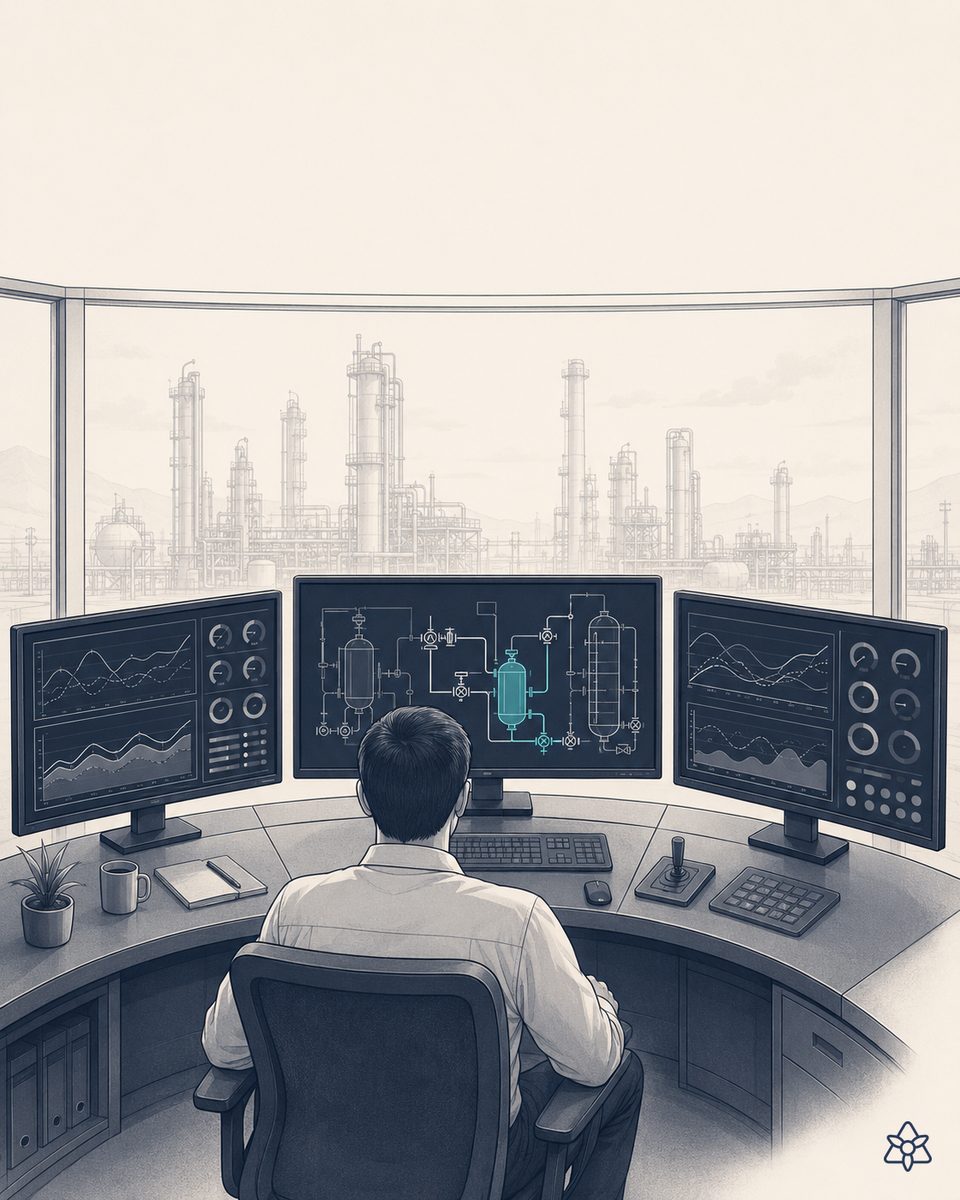
Same reactor, same recipe, two different shifts — different yield.
In a batch chemical reactor, the recipe says what has to happen and the DCS executes it. But two nominally identical batches can show noticeable differences in yield, quality or cycle time, and almost always for reasons the veteran operator's eye reads and the system does not:
- Raw material variability — the catalyst lot, the quality of the solvent, the moisture in a solid reagent. The recipe is not retuned batch by batch, but the reactor certainly notices.
- Equipment variability — the exchanger with more fouling, the agitator with different clearance, the cooling that performs worse in summer.
- Operating variability — operator A closes the dosing two minutes earlier than operator B, and that changes the exothermic profile.
The veteran operator knows how to correct on the fly: they anticipate the exothermic curve, adjust the ramp, hold the next reagent back two more minutes. The problem is that this knowledge lives in their head, and the day they retire it walks out with them. And the junior operator, without that instinct, is left with the recipe as written and the DCS as configured. That is what iLEAN changes.
iLEAN replaces neither the DCS nor the operator — it turns the veteran's instinct into plant capability.
The promise of advanced batch control is not more automation; it is giving the junior operator the same safety net the veteran has: seeing the batch against the golden batch, getting the suggested correction at the right moment, deciding with judgment. iLEAN acts as the putty between the DCS, the LIMS and the operator's eye — without touching the SIS, without replacing regulatory control.
Brain learns the golden batch of every product. Edge captures the fine-grained reality of the reactor. The agent suggests the correction to the operator. The SIS stays sovereign, the operator signs — and the plant stops depending on which shift happens to be on.
The three iLEAN pieces applied to the batch reactor:
- Brain (golden-batch model + open-loop APC) — learns the ideal trajectory of each product from the historian (PI, IP.21, Exaquantum) and the LIMS. It measures every new batch against that golden batch in real time and proposes corrections to setpoints, dosing, thermal ramp or agitation. The operator accepts, adjusts or rejects — the closed loop is still executed by the DCS.
- Edge (fine-grained reality capture + vision where it applies) — extra sensors where they are missing (pH, viscosity, color via vision, screens on old equipment), normalizing the data in milliseconds. It works without a network: if the plant loses connectivity, Edge keeps capturing and buffering.
- Agent — it orchestrates the veteran's knowledge (“this catalyst needs 3 °C less on the ramp”) and folds it into the golden batch, turning instinct into a shared rule. And it prepares the per-batch dossier for quality and traceability without the operator having to write anything at closeout.
Fixed recipe + the operator's eye vs. a reactor with an AI golden batch
| Aspect | Fixed recipe + DCS + instinct | With iLEAN Brain + Edge + Agent |
|---|---|---|
| Batch-to-batch yield | Depends on the shift, the raw material lot and the veteran | Converges to the golden batch for each product |
| Raw material variability | Recipe is not retuned batch by batch | Brain suggests adjustments based on actual incoming quality |
| The veteran's knowledge | In their head — gone the day they retire | Built into the model as permanent capability |
| Junior operator on shift | Recipe and DCS — and beyond that, luck | Explicit on-screen suggestion, with context and reason |
| Integration with the DCS | n/a — the DCS does not learn | Reads the historian, suggests on the HMI, SIS untouched |
| Per-batch dossier | Rebuilt from shift reports and logbooks | Automatic, with deviations explained |
Impact estimate for your plant — to be validated with your numbers.
The block below is an estimate to be validated with the specific data of your plant. We put it forward so the committee has an order of magnitude; we refine it during the diagnostic.
- Chemical plant with 2-6 multi-product batch reactors, a standard market DCS (Honeywell, Yokogawa, ABB, Emerson), a historian in production and a LIMS with per-batch quality history.
- Brain + Edge pilot on one reactor and 1-2 representative products. First value expected within a few weeks: an initial golden batch trained and suggestions shown to the operator on screen.
- Indicative payback between 4 and 9 months, depending on product margin, historical yield variability and the fully-loaded cost of cycle time.
- A ≥30% reduction in batch-to-batch variability of the main KPI. The hard lever is cutting the standard deviation, not only the mean — manufacturing capacity recovered without touching the reactor.
And the production manager's reasonable doubt
“What if the AI suggests the wrong setpoint and we lose a batch?” — hallucination is a problem of free generation, not of anchored tasks. In tasks where the AI simply compares a real curve against a known golden batch and suggests a delta, the best models brought error below 1.5% [1]. And even so, iLEAN does not operate the reactor: it suggests to the operator, who accepts or rejects. The SIS stays sovereign — this is not a dark factory, this is assist and simplify. See the three safety rings.
[1] OpenAI paper “Why Language Models Hallucinate”, 2025 — on the reliability of AI in anchored tasks.
What people ask about AI control of batch chemical reactors
What is the golden batch in a batch chemical reactor?
The golden batch is the ideal process trajectory — temperatures, pressures, dosing, agitation, exotherms — that produced the best batch on record (maximum yield, quality in spec, controlled cycle) for each product and format. iLEAN Brain learns that golden batch by cross-referencing DCS history, LIMS data and the operator's notes, and then measures every new batch against it in real time to catch the deviation before it becomes an out-of-spec batch.
How is the model trained?
It is trained offline on the history you already have — DCS, LIMS, quality records from the last campaigns — and validated against the batches the veteran operator knows were “good ones”. It does not need a huge dataset: in a batch chemical reactor, a handful of campaigns per product is enough to build a useful reference trajectory. The model is then fine-tuned with operator feedback on the floor: “I closed this batch late because the catalyst was different” goes into the system and is folded into the golden batch, turning the veteran's knowledge into permanent plant capability.
What about a multi-product reactor?
Brain keeps one golden batch per product/format and also learns the transitions between campaigns — the carryover effect from the previous product, the purge curve, the stabilization time. When the operator starts the next campaign, the system already knows which deviations to expect from the transition and what to correct, so every SKU changeover stops being a shot in the dark for whoever is on shift.
Does it work with a Honeywell, Yokogawa, ABB or Emerson DCS?
Yes. iLEAN does not replace the DCS: it reads from the historian (PI System, AspenTech IP.21, Yokogawa Exaquantum) or over OPC UA/MQTT, and proposes corrections to the operator on the HMI or on a terminal next to the panel. The operator accepts, adjusts or rejects the suggestion from their seat, inside the DCS safety logic. The SIS (Safety Instrumented System) stays sovereign: iLEAN never operates the plant, it suggests to the operator. The three rings guarantee that critical OT is left untouched.
How much variability reduction should you expect?
An estimate to be validated with your data: a ≥30% reduction in batch-to-batch variability of the main KPI (yield, cycle time, final quality), with first value within a few weeks of training the first product. The hard lever is not just average yield — it is the standard deviation between batches, which is what destroys margin and eats extra manufacturing capacity just to reach the same sellable volume. We ask for your data and send you the estimated ROI in 48h.
More cases in petrochemical
- Anodized aluminum with AI — one shade out of range and the profile comes back from the customer.How iLEAN cross-checks part appearance, anodizing baths and the customer specification to guarantee…
- Asphalt and bitumen control with AI — the tank temperature rules, and the standard does not wait.How iLEAN combines Edge, Connect and Agents to control penetration, softening point and polymer blending…
- Base oil control with AI — an off-spec batch is several m³ that get downgraded.How iLEAN joins Edge, Connect and Agents to control viscosity, viscosity index and the blending of Group…
- Biofuel control with AI — chemistry, the standard and traceability cross-referenced in one place.How iLEAN combines Edge, Connect and Agents to control transesterification, free glycerin and RED III…
- Cement and clinker control with AI — the kiln drives the whole plant, and every kcal counts.How iLEAN combines Edge, Connect and Agents to control LSF, clinker moduli, fineness and kiln energy use…
- CEMS stack emissions with AI — an analyzer in drift is not an incident, it is the quarter's reporting invalidated.iLEAN validates analyzers, predicts failures and generates BREF/CORINAIR emissions reporting with no…
Tell us about your reactor and in 48h we'll send you the estimated ROI of AI control for your chemical batch.
We work on your plant's real data, not ours. Diagnostic with no commitment.
Request estimated ROI in 48h See chemicals and petrochemicals