Epoxy resin control with AI — a batch out of spec is not an incident, it is a customer lost.
A good epoxy resin is where three realities meet — bisphenol-A/epichlorohydrin stoichiometry, the reactor's exotherm curve and viscosity and EEW at the end of the batch. iLEAN cross-references those three with vision and in-line sensors plus integration with your LIMS and SCADA, and holds the batch before packing when something does not add up. The person signs.
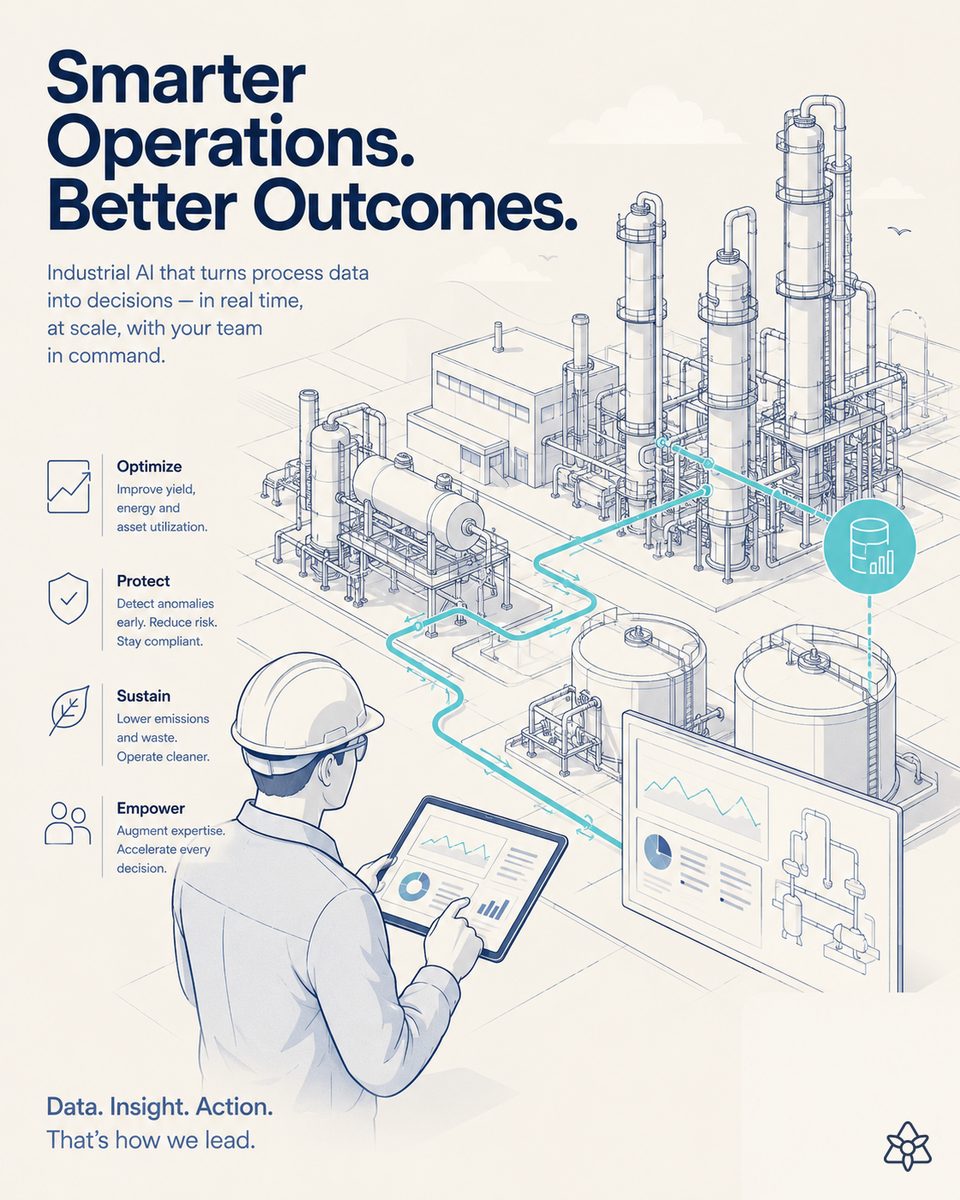
The recipe is always the same. The batch never is.
Anyone running a resin plant knows it: the nominal recipe is stable, but the real batch depends on things the recipe does not capture.
- Raw material changes from supplier to supplier — bisphenol-A can arrive with a different share of the o,o'-isomer, epichlorohydrin picks up moisture depending on how it was shipped, and the catalyst performs differently between lot A and lot B from the same manufacturer. The incoming analysis is in the LIMS, but it rarely reaches process control in time.
- The reactor is not always the same reactor — a heat exchanger slowly losing efficiency, a worn agitator, a dosing valve that meters less precisely than when it was new. Today's exotherm curve is not the one from six months ago, even if the SCADA setpoint has not changed.
- The customer spec does not forgive — an EEW (epoxy equivalent weight) outside the ±10-unit window is a rejected batch. A viscosity outside the agreed Brookfield range means renegotiation. A MIL-PRF standard or an aerospace customer's TDS does not accept a letter of explanation: either it complies or it does not.
The lab measures at the end of the batch and returns the number hours later. By then the batch is made and, if you are lucky, it goes to rework; if you are not, to hazardous waste. The problem is not the recipe — it is that the classic system always arrives late, and every late batch is a cost that eats into the quarter.
iLEAN does not change your reactor — it adds the intelligence that was missing on top of the data you already generate.
The problem in epoxy resin control is not a lack of information: it is information that lives on islands — the LIMS knows how the raw material came in, the SCADA knows what is happening inside the reactor right now, the ERP knows which customer is waiting for that batch and to which spec, but none of the three talks to the next one at the speed the batch demands. iLEAN acts as the putty that fills those gaps, without asking you to change your SCADA, your LIMS or the plant.
Edge sees viscosity and temperature in line. Connect reads the LIMS analysis and the customer spec wherever they live. The agent cross-references them against the expected curve and, if something does not add up, holds the batch before packing. The person signs — never the other way round.
The three iLEAN pieces applied to epoxy resin control:
- Edge — a terminal with machine vision (CNN) and in-line signal capture: in-line Brookfield viscometer, refractometer, reactor thermocouples. It reads the exotherm curve in real time and, if the slope drifts away from the trained model, it triggers the status light and notifies the operator before the batch is lost. It works with no network. If the plant loses WiFi, Edge keeps reading and holding batches — what is critical cannot depend on connectivity.
- Connect — captures the raw-material analysis whether it comes from a modern LIMS, from the lab's spreadsheet or from the sheet the R&D manager updates every Monday. And it also captures what arrives from outside (the aerospace customer's TDS, a change in the RoHS standard, an email from the supplier flagging a bisphenol lot with a different isomer profile) at second zero, with nobody having to forward anything.
- Agent — cross-references the batch recipe, the raw-material analysis, the real reactor curve and the customer spec. If there is a deviation, it does not send an email at 10 pm: it holds the batch and alerts the quality manager through whichever channel they use. It also generates the conformity dossier — which raw material came in, how the reactor behaved, what complied and what did not — ready for an auditor or a customer. The person validates and signs; the batch does not ship on its own.
Manual control vs. cross-referenced control with iLEAN
| Aspect | Manual control + LIMS at the end | With iLEAN Edge + Connect + Agent |
|---|---|---|
| Detecting a viscosity deviation | When the lab returns the number (hours) | In line, during the batch |
| Anticipating the exotherm | Reaction once the limit is crossed | Warning when the slope predicts the rise |
| Cross-check with raw-material analysis | The operator checks the LIMS if there is time | Connect brings it to the reactor panel automatically |
| Customer spec compliance (TDS/MIL-PRF) | Post-batch verification, rework if it fails | Real-time validation, hold before packing |
| Conformity dossier per batch | Rebuilt by hand, days | Generated automatically, ready to sign |
| Operation with no network | n/a | Edge keeps running on the panel's power |
Impact estimate for your plant — to be validated with your numbers.
The block below is an estimate to be validated with the specific data of your plant. We put it forward so the committee has an order of magnitude; we refine it during the diagnostic.
- Mid-sized epoxy resin plant (liquid and solid), 2-3 batch reactors, a mix of standard resins and customer-spec grades (aerospace, electronics, composites).
- Edge pilot on one reactor (in-line viscometer/refractometer + thermocouple capture + integration with the LIMS and the customer spec). First value expected within a few weeks.
- Indicative payback between 4 and 9 months, depending on how often batches have been rejected or reworked in recent years and on the average cost of an out-of-spec batch in your product mix.
- The hard lever is a single rejected batch avoided: lost raw material, reactor energy, tank occupancy, delay to the customer. The expected reduction in in-line rejects is ≥ 30% over your current baseline.
And the technical director's reasonable doubt
“What if the AI gets an exotherm prediction wrong and stops a batch that was running fine?” — hallucination is a problem of free generation, not of anchored tasks. In tasks where the AI merely compares a real curve against a model trained on your own reactor, the best models brought error below 1.5% [1]. And even so, what is critical is never decided alone: iLEAN proposes and the person signs. The three safety rings exist precisely for this — the agent does not touch critical OT.
[1] OpenAI paper “Why Language Models Hallucinate”, 2025 — on the reliability of AI in anchored tasks.
What people ask about epoxy resin control with AI
Why does an epoxy resin batch go out of spec even when the recipe is the usual one?
Because the nominal recipe and the reality inside the reactor almost never match: bisphenol-A purity varies between suppliers, epichlorohydrin carries ambient moisture, the agitator performs differently as it wears, and the exotherm curve of the batch depends on the real condition of the heat exchanger. The classic system measures at the end of the batch — and by then the batch is already made. iLEAN Edge reads viscosity in line, Connect captures the raw-material analysis, and the Agents anticipate the deviation before the batch moves on to packing.
How does iLEAN detect a runaway exotherm in epoxy synthesis?
By cross-referencing the reactor temperature curve with the coolant flow through the heat exchanger and the instantaneous concentration of epichlorohydrin added. Edge captures the PLC signals in real time, the Agents compare them against the expected profile for that recipe, and they warn the operator as soon as the slope rises faster than the model predicts. Acting on the valve is the person's job — the Agents propose, they do not operate critical OT.
Does it work if the plant has old reactors with a closed SCADA?
Yes. iLEAN Connect has three capture levels: direct integration when the machine has a modern interface, reading the local computer when it is legacy and isolated, and manual capture (a photo of the panel) when all you have is analog. A reactor with a closed SCADA comes in at the second level: Connect reads the data without touching the OT network. The three-ring architecture guarantees that neither the reactor nor the functional safety system loses its isolation.
How does it fit with the customer specification (TDS, MSDS, MIL-PRF)?
Customer technical specifications — the TDS for a specific EEW, a MIL-PRF standard for aerospace-grade resin, or a requirement from a composites manufacturer — live in PDFs that the R&D team keeps in a shared folder. Connect reads them, the Agents generate the batch conformity dossier (analysis, reactor curve, raw material used) and leave it ready for the quality manager to sign. A reproducible file, not a spreadsheet rebuilt after the fact.
How much does an AI pilot cost in a small or mid-sized epoxy resin plant?
The order of magnitude of an Edge pilot on an epoxy resin line is in line with any Edge pilot in a chemical plant: an initial investment covering a vision-equipped terminal + in-line sensors (viscometer/refractometer) + integration with SCADA and LIMS, plus an annual license. A reasonable payback to present to the committee is a matter of months — the hard lever is one rejected batch avoided or one customer complaint fewer. We ask for your plant's data and send you the estimated ROI in 48h.
More cases in petrochemical
- Barrel and derivative traceability with AI — from incoming crude to the customer's diesel, with no gaps in the genealogy.iLEAN links incoming crude, refining unit and finished product by batch and by tank. Complete genealogy.
- Detergent formulation with AI — the batch that separates in the warehouse never showed its face in the reactor.How iLEAN cross-references surfactants, enzymes, viscosity, foam and batch traceability to keep the…
- Energy optimization with an AI digital twin — a badly tuned plant burns steam and electricity every single shift.iLEAN runs a digital twin of your chemical plant and proposes optimal setpoints every shift to cut…
- Float glass with AI — catching the bath drift half an hour before the ribbon falls from prime to B.How iLEAN cross-references ribbon vision, tin bath and annealing lehr to anticipate float glass…
- Steel galvanizing with AI — zinc is expensive; what leaves through excessive drainage never comes back.How iLEAN combines in-line vision, zinc bath capture and agents to anticipate hot-dip galvanizing…
- Hazardous waste traceability in the chemical industry — a broken manifest is a penalty, a bad classification is a premium rate.iLEAN traces hazardous waste from the plant to the licensed contractor. EPA/EU compliance with no paper.
Tell us your case and in 48h we'll send you the estimated ROI of this AI project for your epoxy plant.
We work on your plant's real data, not ours. Diagnostic with no commitment.
Request estimated ROI in 48h See petrochemical