Steel galvanizing with AI — zinc is expensive; what leaves through excessive drainage never comes back.
Controlling hot-dip galvanizing means cross-referencing three things that are almost never in the same place — how the part looks as it leaves the bath, the kettle's chemistry and temperature, and the run history. iLEAN sees the part with Edge vision, reads the bath with Connect even if the kettle is 20 years old, and an agent anticipates the defect before the zinc disappears. The person signs.
← See all solutions for petrochemical and process industries
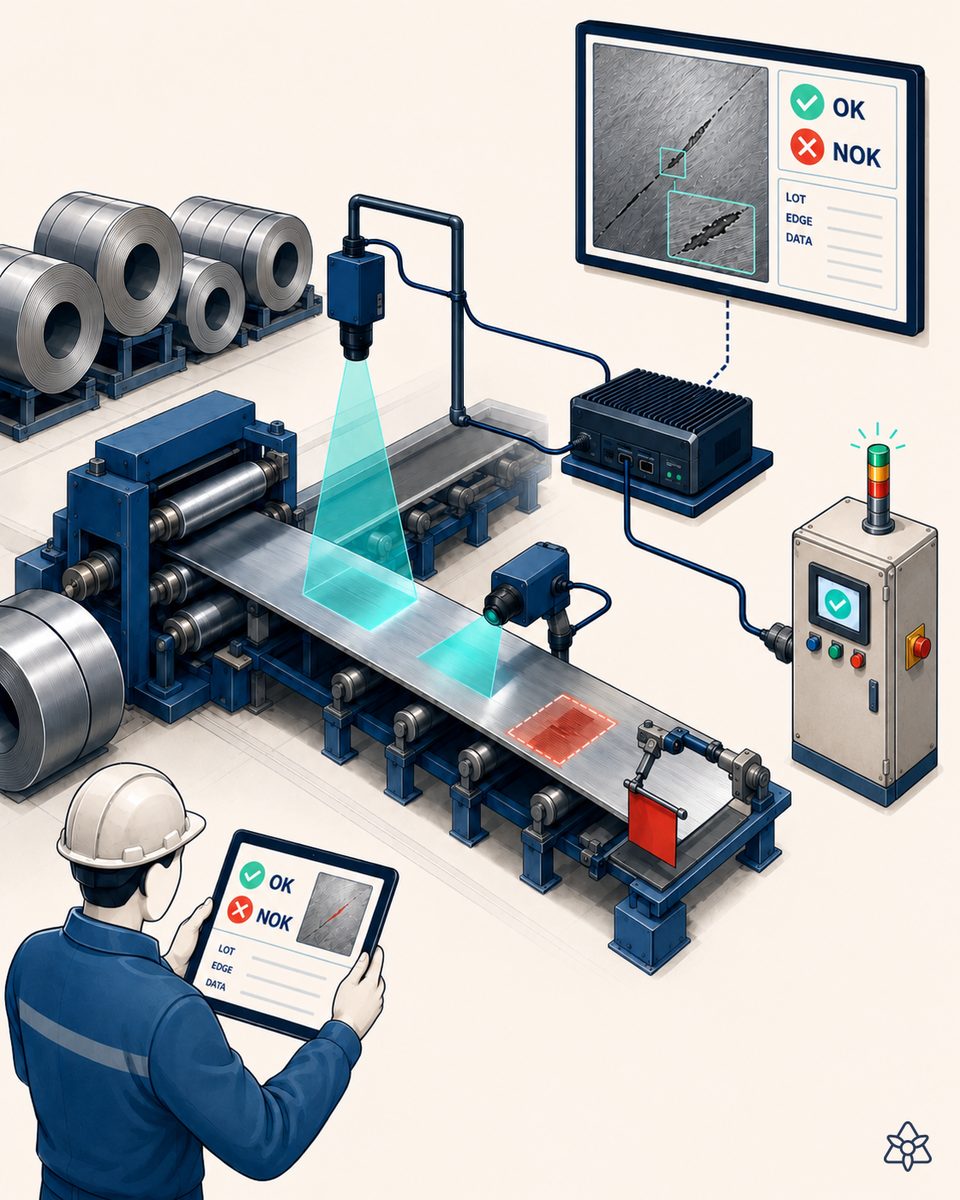
The defect is born in the bath; you see it when it is already scrap.
On a hot-dip galvanizing line, defects rarely appear out of nowhere. The kettle chemistry drifts — a little more iron, dross forming slowly, a temperature off by a degree — and the parts coming out start looking different: irregular spangle, uneven thickness, a black area that did not coat properly, drainage that carries away too much zinc. All of that gets measured. The problem is not the measurement; it is that every data point lives on its own island:
- The bath — temperature, lab composition, kilos of zinc added. Sometimes on a SCADA panel only the kettle operator sees, sometimes in a LIMS Excel file, sometimes in the kettle lead's head.
- The part — you inspect it visually at the end, with a flashlight, and sign off the batch. Thickness is measured by sampling, not in line.
- The run history — immersion speed, immersion time, pretreatment conditions, previous batch. In the MES, if you have one, or in the shift report.
When the customer complaint arrives (thickness out of spec, damage on site from insufficient protection), you have to reconstruct three weeks of production by hand to find the root cause. The zinc that left never comes back. Neither does the rejected load.
iLEAN does not add a fourth system — it seals the cracks between the three you already have.
The galvanizing problem is not a lack of data; it is information living on islands that never reaches the decision-maker in time at the critical moment (the exit from the bath). iLEAN acts as the putty that fills those gaps, without asking you to change the kettle, the furnace SCADA or the lab's LIMS.
Edge sees the part as it leaves the bath. Connect reads the kettle wherever the data lives — an old panel, the LIMS, the kettle lead's Excel file. The agent cross-references it with the history and, if something does not add up, holds the load or alerts the air knife. The person signs.
The three iLEAN pieces applied to steel galvanizing control:
- Edge — a terminal with computer vision (CNN) over the part as it leaves the kettle. It detects uneven thickness, uncoated areas, adhered dross, ash inclusions, anomalous spangle and excessive drainage in milliseconds, and triggers a local actuator (stack light, alarm, per-load record). It works without a network. As long as it has power, it keeps seeing and recording.
- Connect — captures the bath parameters whether they come from a modern SCADA, from the kettle panel with an isolated computer, or from the LIMS Excel file the lab updates twice a day. And it also captures what comes from outside (the zinc supplier's analysis, the steel batch datasheet) at second zero.
- Agent — cross-references the Edge image, the bath parameters, the run history and the customer specification. If a series starts draining above the range, it does not wait for the end of the shift: it alerts the kettle lead with a proposed adjustment (air knife, exit speed, jig angle). The person validates and acts.
Classic galvanizing vs. galvanizing cross-referenced with iLEAN
| Aspect | Galvanizing with sampling + shift reports | With iLEAN Edge + Connect + Agent |
|---|---|---|
| Part inspection | Visual sampling at the end of the batch | 100% in line, part by part, before cooling |
| Coating thickness | Measured by destructive / magnetic sampling | Continuous estimate by vision + bath cross-reference |
| Dross / ash detection | Operator's eye when pulling the jig | Edge vision on every exit, automatic record |
| Defect root cause | Hand-rebuilt from past shifts | Per-load dossier with cross-referenced bath data |
| Zinc over-consumption | Spotted at month-end on the dashboard | Alarm before the series turns into kilos |
| Operation without network | n/a | Edge keeps operating on the panel's power |
Impact estimate for your plant — to be validated with your numbers.
The block below is an estimate to be validated with the specific data of your plant. We put it forward so the committee has an order of magnitude; we refine it during the diagnostic.
- Continuous hot-dip galvanizing line with one main kettle, a mix of coil and long products, coating thickness to standard (EN ISO 1461 / EN 10346 as applicable).
- Edge pilot over the bath exit + Connect reading of the SCADA or kettle panel. First value expected within a few weeks on dross/ash detection and continuous appearance tracking.
- Indicative payback between 4 and 9 months, depending on the current cost of zinc over-consumption and the share of loads regalvanized for cosmetic defects / out-of-spec thickness.
- A reasonable reduction to expect: ≥30% in parts reworked for cosmetic defects, once the model is calibrated to your plant's product mix.
The kettle lead's reasonable doubt
“What if the AI fires false positives when natural spangle varies?” — hallucination is a problem of free generation, not of anchored tasks. In tasks where the AI recontextualizes an image against a known reference (the good part from your own history), the best models brought error below 1.5% [1]. And even so, what is critical is never decided alone: iLEAN holds the load and the person signs. The three safety rings exist precisely for this.
[1] OpenAI paper “Why Language Models Hallucinate”, 2025 — on the reliability of AI in anchored tasks.
What people ask about AI galvanizing control
What typical defects does AI detect in hot-dip galvanizing?
The usual hot-dip suspects: uneven thickness of the zinc coating, uncoated (black) areas, adhered dross (iron-zinc intermetallics dragged up from the bottom), ash inclusions (ash from the bath surface), uneven spangles and runs. iLEAN Edge with computer vision detects them on the part as it leaves the bath, before the cooling zone, while there is still time to react — touch up the drainage, adjust the withdrawal angle, pull the part for regalvanizing — without the defect reaching the customer.
How does zinc bath composition affect defects?
The bath chemistry (zinc, lead, aluminum, nickel) and its temperature drive coating thickness, dross formation and spangle appearance. The problem is not that it goes unmeasured — it is measured — but that the data lives in a lab sheet or on an old kettle panel, and almost never reaches the shift lead at the moment of the defect. iLEAN Connect captures that data whether it comes from the LIMS, the kettle panel or an Excel file, and an agent cross-references it with the defective part — returning the root cause in minutes, not at Monday's meeting.
Can AI reduce zinc over-consumption?
Yes, and it is usually the biggest economic lever in a galvanizing plant. Zinc is the dominant raw material, and excessive drainage means zinc leaving with the part beyond the specification — a hard, unrecoverable cost. iLEAN Edge measures coating thickness in line (vision + drainage profile) and triggers an alarm when a series of parts drains above the optimal range; the operator adjusts the air knife, the jig angle or the withdrawal speed before the deviation turns into kilos of lost zinc.
Does it work without a network in the galvanizing plant?
Yes. iLEAN Edge is a physical terminal with a trained CNN and a local actuator — if the plant loses Internet, WiFi and the ERP connection, its basic detect-and-intervene cycle keeps running as long as it has power. In a galvanizing plant where heat and humidity make connectivity hard, that is not a footnote: it is the reason the system stays in production when others go down.
How does it integrate with the ERP/MES without rewriting anything?
iLEAN does not replace your ERP or your MES — it sits on top and fills the cracks between them. iLEAN Connect captures data from systems with a modern interface (direct integration), from old equipment with an isolated local computer (panel reading), and from the unstructured formats the system ignores (the lab's Excel file, a photo of a zinc delivery note, a WhatsApp from the kettle lead). The agent cross-references all of it with the Edge image and assembles the per-load dossier. Nothing has to be thrown away.
More cases in petrochemical
- Energy optimization with an AI digital twin — a badly tuned plant burns steam and electricity every single shift.iLEAN runs a digital twin of your chemical plant and proposes optimal setpoints every shift to cut…
- Epoxy resin control with AI — a batch out of spec is not an incident, it is a customer lost.How iLEAN cross-references bisphenol-A/epichlorohydrin stoichiometry, the exotherm curve and in-line…
- Float glass with AI — catching the bath drift half an hour before the ribbon falls from prime to B.How iLEAN cross-references ribbon vision, tin bath and annealing lehr to anticipate float glass…
- Hazardous waste traceability in the chemical industry — a broken manifest is a penalty, a bad classification is a premium rate.iLEAN traces hazardous waste from the plant to the licensed contractor. EPA/EU compliance with no paper.
- Heat exchangers with AI — fouling is invisible, but it bills you every month.iLEAN models heat exchanger fouling and proposes the optimal cleaning window between turnarounds. No…
- Hot rolled steel control with AI — the window is narrow and the defect shows up with the coil already cold.How iLEAN cross-references heat, mill curve and surface vision on the strip to catch defects and…
Tell us your case and in 48h we'll send you the estimated ROI of this AI project for your galvanizing plant.
We work on your plant's real data, not ours. Diagnostic with no commitment.
Request estimated ROI in 48h See petrochemical