Heat exchangers with AI — fouling is invisible, but it bills you every month.
A fouled exchanger steals efficiency day after day and nobody notices until unit capacity drops or an emergency shutdown hits. iLEAN models fouling with the data you already have in the DCS and proposes the optimal cleaning window before the excess energy cost overtakes the cost of a planned shutdown. The maintenance manager signs.
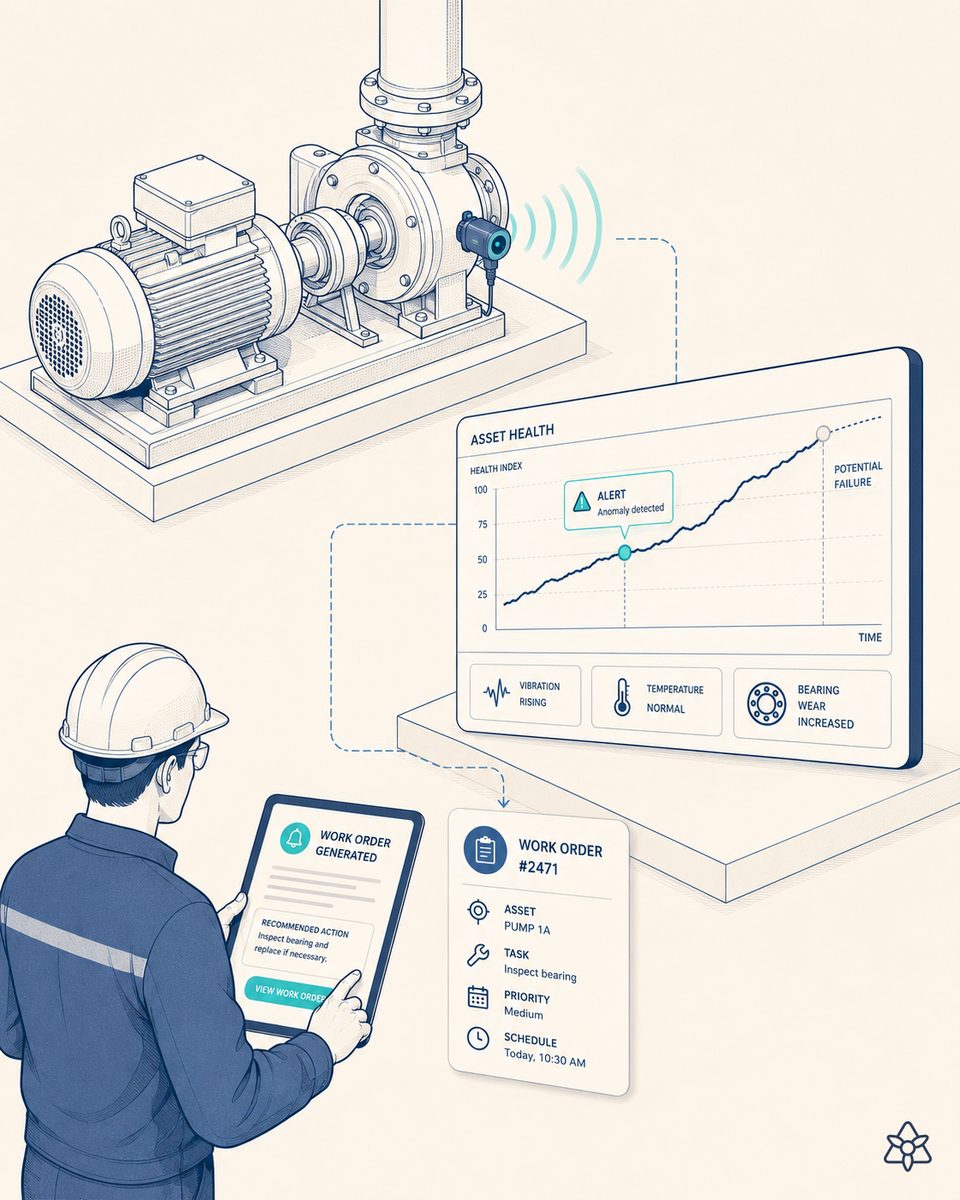
An exchanger does not fail all at once — it fouls little by little and nobody is looking.
In an exchanger train in a chemical plant, fouling progresses day by day. Heat transfer drops, flow is raised to compensate, energy consumption climbs, and the operator signing the shift report writes “operating normally” because the plant is still running. It is — at 80% of nameplate efficiency, and nobody puts a number on that bleed.
Classic planning works in two modes: by calendar (clean every X months, fouled or not) or by crisis (when the operator sees capacity fall, a shutdown is forced through). Calendar mode throws money at cleanings that were not due; crisis mode creates emergency shutdowns that drag downstream units with them and make the incident ten times more expensive. Whoever has to decide is blind to the fouling curve of each unit — not because they don't want to see it, but because computing U exchanger by exchanger every day does not fit in anyone's day.
iLEAN does not change your DCS — it puts the brain on top that computes fouling every day.
The data needed to detect fouling is already in the plant. What is missing is a system that reads it continuously, cross-references it with the clean model of the exchanger and projects the curve forward. iLEAN acts as the putty between the DCS, the LIMS and the maintenance decision, without asking you to change the SCADA or install new sensors.
Edge reads. Brain models and projects. The person decides when the cleaning crew goes in — never the other way round.
The two iLEAN pieces applied to predictive maintenance on exchangers:
- Edge — a terminal that connects to the DCS over OPC-UA, OPC-DA, Modbus or MQTT and captures the necessary signals (inlet and outlet temperatures on the primary and secondary sides, flows, pressures) in real time. When the DCS does not provide them, Connect fills the crack by reading from the equipment's local PC or digitizing the operating sheet. Edge computes U continuously and compares it with the clean curve.
- Brain — the agent cross-references the U(t) curve of every exchanger with the fluid composition from the LIMS, the operating regime, the turnaround calendar and the energy cost of running away from the optimum. It models fouling as a physical process (Kern, Ebert-Panchal, or a fitted empirical model) and projects the curve. When the excess energy cost exceeds the cost of an intermediate cleaning, it proposes the optimal window.
- Security — the three iLEAN rings guarantee that the critical SCADA and DCS are left untouched: data leaves through the hardened mailbox, no inbound port is opened. Inference and modeling live in the outer ring; only human-signed recommendations go back into the OT ring, and only if configured that way.
Manual exchanger predictive maintenance vs. iLEAN Edge + Brain
| Aspect | Calendar-based or crisis-based planning | With iLEAN Edge + Brain |
|---|---|---|
| Fouling measurement | One-off U calculation in a spreadsheet at every shutdown | U computed continuously from DCS signals |
| Prediction | None — you act when capacity falls | Fouling curve projected per unit |
| Cleaning window | Fixed calendar or crisis | Optimum of energy cost vs. cleaning cost |
| Emergency shutdowns | Frequent on critical exchangers | Anticipated, planned shutdown instead |
| Type of cleaning | Decided on the veteran's instinct | Recommended by the nature of the fouling (chemical, mechanical) |
| Traceability for the energy auditor | Scattered across shift reports and sheets | Continuous, signed record of the U coefficient |
Impact estimate for your plant — to be validated with your numbers.
The block below is an estimate to be validated with the specific data of your plant. We put it forward so the committee has an order of magnitude; we refine it during the diagnostic.
- Chemical plant with a train of 6-10 TEMA exchangers in continuous service, a Honeywell/Emerson/Yokogawa DCS, a major turnaround every 2-3 years and occasional emergency shutdowns from fouling.
- Edge + Brain pilot focused on the 2-3 critical exchangers in the train. First value expected within a few weeks: historical U(t) curve reconstructed + a recommended optimal window for the next cycle.
- Indicative payback between 4 and 9 months, depending on current energy cost and the average cost of an emergency shutdown in the unit.
- Expected reduction in energy consumption attributable to undetected fouling above 30% (conservative estimate) on the units covered.
And the maintenance manager's reasonable doubt
“What if the AI proposes cleaning and it was not the right moment?” — the recommendation does not execute itself. iLEAN proposes the window with the projection and the associated cost; the manager decides. For anchored tasks such as computing U or projecting fouling, modern models brought error below 1.5% [1] — the system does not invent, it computes on data that is already there. And even so, the model always comes with the uncertainty of the projection attached, so the manager knows how much confidence to give it.
[1] OpenAI paper “Why Language Models Hallucinate”, 2025 — on the reliability of AI in anchored tasks.
What people ask about AI predictive maintenance on heat exchangers
How is fouling measured without installing extra sensors?
Fouling is inferred from the deviation of the overall heat transfer coefficient (U) against the clean model of the exchanger. The data needed to compute U is already in the DCS or the SCADA — inlet and outlet temperatures on both sides, flows, pressures. iLEAN cross-references those signals with the fluid composition (from the lab or the LIMS) and the characteristic curve of the exchanger. The Edge piece does not add sensors: it adds the continuous inference nobody had time to compute in a spreadsheet every single day.
How is the optimal cleaning planned between major turnarounds?
The Brain agent projects the fouling curve of every exchanger forward and cross-references it with the turnaround calendar and the accumulated energy cost of operating away from the optimum. When the excess energy cost exceeds the cost of an intermediate cleaning (chemical, mechanical or hydroblasting), it proposes the window. The maintenance manager decides and signs the order — the planning does not execute itself, it is assisted.
Does it work with legacy TEMA exchangers with no new sensors?
Yes. TEMA exchangers (BEM, AES, AKT, etc.) have been in plants for decades and usually have the minimum thermocouples and flow meters needed to compute U. iLEAN Connect reads from the DCS wherever the data lives, and if the reading is manual (an operator writes it down every shift), it digitizes the sheet. You do not change the exchanger, you do not change the SCADA — you fill the crack between the raw data and the decision.
What are typical energy savings?
The conservative estimate — to be validated with your plant's data — is a reduction in energy consumption attributable to undetected fouling of above 30% on the exchangers covered, with first value in a few weeks. The hard lever combines fuel/electricity savings, recovered nameplate capacity and a lower risk of emergency shutdown. We send you the estimated ROI in 48h with your plant's numbers.
Does it integrate with Honeywell, Emerson, Yokogawa or ABB DCS?
Yes. iLEAN Connect has OPC-UA, OPC-DA, Modbus and MQTT connectors, which cover practically any DCS installed in a chemical plant. Where there is no standard connector, a minimal gateway reads from the local PC. DCS data never leaves the OT ring — it travels to the outer ring through the hardened mailbox of the three iLEAN rings, without opening inbound ports to the SCADA.
More cases in petrochemical
- Float glass with AI — catching the bath drift half an hour before the ribbon falls from prime to B.How iLEAN cross-references ribbon vision, tin bath and annealing lehr to anticipate float glass…
- Steel galvanizing with AI — zinc is expensive; what leaves through excessive drainage never comes back.How iLEAN combines in-line vision, zinc bath capture and agents to anticipate hot-dip galvanizing…
- Hazardous waste traceability in the chemical industry — a broken manifest is a penalty, a bad classification is a premium rate.iLEAN traces hazardous waste from the plant to the licensed contractor. EPA/EU compliance with no paper.
- Hot rolled steel control with AI — the window is narrow and the defect shows up with the coil already cold.How iLEAN cross-references heat, mill curve and surface vision on the strip to catch defects and…
- Green hydrogen by electrolysis with AI — when every kWh decides whether the project pays off.How iLEAN cross-references electrolyzer stacks, balance of plant and the power grid to anticipate…
- Industrial adhesive control with AI — one drum with out-of-range viscosity means the customer's line is down.How iLEAN cross-references in-line viscosity, tack and open time of industrial adhesive with the batch…
Tell us about your case and in 48h we'll send you the estimated ROI of this exchanger predictive project for your plant.
We work on your plant's real data, not ours. Diagnostic with no commitment.
Request estimated ROI in 48h See petrochemicals