Barrel and derivative traceability with AI — from incoming crude to the customer's diesel, with no gaps in the genealogy.
A refinery traces crude, intermediates and product by unit and by tank. When the customer, the auditor or the end buyer asks where a batch came from, what separates the calm plant from the one that loses a week is having built the complete genealogy in the moment, not afterwards. iLEAN links every step by batch and by tank — the person signs.
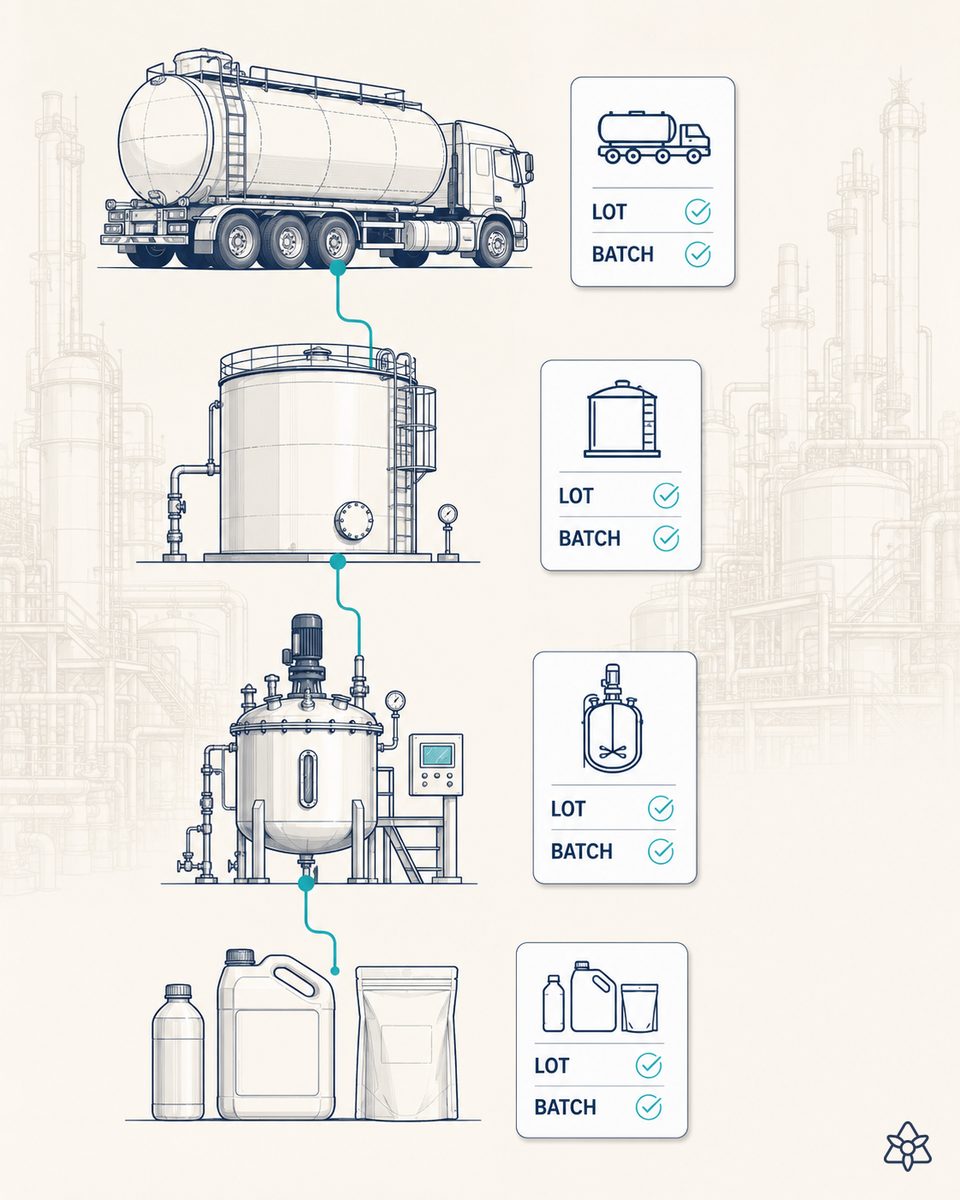
The genealogy exists — but it lives spread across four systems and two people's heads.
Any scheduling, quality or product manager in a refinery knows that traceability exists. The trouble is that it is not in one place:
- The crude discharge sits in SAP IS-Oil (bill of lading, certificate of origin, lab discharge assay).
- The pass through the units (atmospheric, vacuum, hydrotreating, reforming) sits in the DCS historian — temperatures, flow rates, conversion, yields.
- Tank farm movements sit in the tank-farm SCADA and in the dock operator's shift reports, with blending criteria that every plant resolves its own way.
- Lab test results sit in the LIMS, with a natural lag between sampling and result that the operator at the line never sees in real time.
- The customer certificate is assembled by hand when the truck or the vessel is loaded, cross-referencing four sources and the shift lead's memory.
The system works — until a customer complains, an auditor asks for a specific period, or an end buyer demands to know which crude their diesel came from. Then the reconstruction begins: one week, two people, a spreadsheet with the batch genealogy hanging off it. Data existing is not the same as data being joined up.
iLEAN does not replace SAP IS-Oil, the DCS or the LIMS — it seals the cracks between them.
Every system in the refinery does its own job well. The classic problem is not that one more system is missing, but that between SAP IS-Oil, the DCS, the tank-farm SCADA and the LIMS there are dead zones that the operator fills in with a notebook and the memory of the veteran on the dock. iLEAN is the putty that fills those cracks — it captures real tank measurements, operator shift reports, LIMS test results and DCS movements, cross-references them with SAP IS-Oil, and keeps the genealogy alive at every movement.
Tracer maintains the weighted genealogy movement by movement. Edge captures reality on the dock and in the tank farm. Brain cross-references SAP IS-Oil, the DCS and the LIMS. The person signs the delivery to the customer — always.
The three iLEAN pieces applied to barrel and derivative traceability:
- iLEAN Tracer — the genealogy engine: it maintains the real blend by tank and by movement, with the weighted origin of every component, without the operator having to keep count by hand. When a backward query comes in ("this batch — which crude is in it?"), it answers in seconds instead of in a week.
- iLEAN Edge — terminals on the dock, in the tank farm and at the units that read what the machines never push to the DCS: manual tank gauging, the reading from the old probe, the image of the tanker truck seal, the OCR of the dock operator's paperwork. It works with no network; on the dock that matters.
- iLEAN Brain — cross-references SAP IS-Oil, DCS, LIMS, tank farm data and crude diet to flag discrepancies in the moment (tank measurement and mass balance do not agree, the lab result is outside the expected specification), and prepares the batch data sheet for the product manager, who signs.
Classic derivative traceability vs. continuous genealogy with iLEAN
| Aspect | Classic traceability (SAP IS-Oil + DCS + notebook) | With iLEAN Tracer + Edge + Brain |
|---|---|---|
| Batch genealogy | Rebuilt by hand whenever somebody asks | Maintained at every movement, queryable in seconds |
| Blend in the tank | "Majority component" or the operator's estimate | Real weighted blend, traced movement by movement |
| Cross-reference with LIMS | Asynchronous, depends on the product manager's eye | Automatic, alerts if a result does not match expectations |
| Customer certificate | Template filled in at loading, several manual cross-checks | Data sheet prepared by iLEAN Writer, signed by a human |
| Auditor / end buyer query | A week of reconstruction by two people | Dossier with the full genealogy in a couple of clicks |
| Customer complaint | Retrospective investigation, blurry focus | Genealogy and test results available, immediate focus |
Impact estimate for your plant — to be validated with your numbers.
The block below is an estimate to be validated with the data of your crude mix, your tank farm and your real query rate. We put it forward so the committee has an order of magnitude; we refine it during the diagnostic.
- Mid-sized refinery or petrochemical complex running a multi-crude diet, a multi-product tank farm, exports to several markets and regulated certificates (EN 590 sulfur, FAME, a growing carbon footprint requirement).
- Pilot on one product family (e.g. automotive gasoils): integration with SAP IS-Oil, DCS and LIMS; Tracer maintains the genealogy; Writer prepares the data sheet. First value expected within a few weeks.
- Expected reduction in response time to a customer/auditor query of ≥ 30% and, on large loads, far more (from a week to a few hours). To be validated with your real rate.
- Indicative payback between 4 and 9 months, driven by two levers: avoiding specification penalties and reducing complaints by attaching the data sheet on the day of delivery.
And the product manager's reasonable doubt
"What if the AI gets the blend weighting wrong and I give the customer an origin that is not the right one?" — hallucination is a problem of free generation, not of anchored tasks. In tasks where the AI merely recontextualizes a piece of data from one system into another (reading a movement from the tank-farm SCADA, cross-referencing it with the DCS mass balance, calculating the weighted blend in the tank), the best models brought error below 1.5% [1]. And even so, what is critical is never closed out alone: iLEAN proposes the data sheet, the person signs the customer certificate. The three safety rings exist precisely for this.
[1] OpenAI paper "Why Language Models Hallucinate", 2025 — on the reliability of AI in anchored tasks.
What people ask about barrel and derivative traceability with AI
How far back can a refinery derivative be traced?
What the customer or the regulator wants to know is always the same: which crude this diesel comes from, which refining units it went through, in which tanks it was blended, what reblending it went through and who else received that blend. iLEAN traces the complete genealogy by batch and by tank: the crude discharge order, the pass through the atmospheric/vacuum units, through hydrotreating and blending, all the way to loading the tanker truck or the vessel with its bill of lading. The genealogy is not rebuilt at the end — it is built movement by movement and signed off at the moment.
How does it cross-reference with SAP IS-Oil?
iLEAN Connect plugs into SAP IS-Oil through the standard entry points (BAPI/RFC, IDoc, OData), reads stock movements by tank and the discharge/loading orders, and cross-references them with the reality captured on site (tank gauging, lab tests, unit parameters). If the SAP IS-Oil figure says one thing and the tank-farm SCADA says another, the system flags it — instead of the discrepancy surfacing three weeks later during reblending. SAP IS-Oil remains the legal source of record; iLEAN is the putty that closes the gaps where reality and the ERP disagree.
What about the quality the customer demands?
The end customer does not want to see your refinery — they want to see that the batch they received meets their specification (calorific value, sulfur, FAME, cold filter plugging point) and, increasingly, its carbon footprint and its origin. iLEAN Writer prepares the batch data sheet automatically: lab tests cross-referenced with the tank genealogy, a customer certificate with every parameter validated and the product manager's signature. When a complaint comes in, there is no need to rebuild a week of movements — the dossier is already there.
Does it work with multi-crude diets and reblending?
Yes, and that is where it pays off most. A refinery rarely processes a single crude: it runs variable diets, continuous reblending between tanks of the same product and final blends to optimize cost. Classic "majority component" genealogy (the batch is whatever went into the tank in the largest quantity) loses precision when the customer or the auditor asks for a defensible answer. iLEAN Tracer maintains the real weighted blend movement by movement, without the operator having to keep the record by hand, and resolves the backward query when somebody asks "does this batch contain crude from origin X?".
Does it reduce customer complaints?
Most customer complaints on derivatives are not about bad product — they are about uncertainty in the certificate: a parameter that does not line up with the specification, an origin the customer was not expecting, a delay in producing the dossier when an end buyer asks for it. iLEAN reduces that uncertainty because the genealogy and the test results travel with the batch, not behind it. We send you an estimate in 48h based on your crude mix, your tank farm and your main customers — not on a generic case.
More cases in petrochemical
- Cosmetics manufacturing with AI — the emulsion that split, the batch that passed GMP by hand and the audit that started over.How iLEAN cross-checks emulsion, color, filling and the GMP batch record to hold cosmetics manufacturing…
- Cracking control (FCC / steam cracker) with AI — severity, feedstock and margin on the same screen.How iLEAN cross-checks severity, feedstock, catalyst and margins in an FCC / steam cracker to anticipate…
- Crop protection control with AI — a mislabeled drum is not an incident, it is a recall and a penalty.How iLEAN cross-checks active ingredient dosing, GHS labeling and EFSA/MAPA registration in a crop…
- Detergent formulation with AI — the batch that separates in the warehouse never showed its face in the reactor.How iLEAN cross-references surfactants, enzymes, viscosity, foam and batch traceability to keep the…
- Energy optimization with an AI digital twin — a badly tuned plant burns steam and electricity every single shift.iLEAN runs a digital twin of your chemical plant and proposes optimal setpoints every shift to cut…
- Epoxy resin control with AI — a batch out of spec is not an incident, it is a customer lost.How iLEAN cross-references bisphenol-A/epichlorohydrin stoichiometry, the exotherm curve and in-line…
Tell us about your refinery and in 48h we'll send you the estimated ROI of an iLEAN deployment for the traceability of your derivatives.
We work on the real data of your crude mix, your tank farm and your customers, not on ours. Diagnostic with no commitment.
Request estimated ROI in 48h See petrochemical