Industrial paint manufacturing with AI — when delta-E is decided by a spectrophotometer reading that comes too late.
The color, gloss and viscosity of an industrial paint lot are where the pigment's real variability, the order and energy of dispersion and a recipe frozen in the MES or a spreadsheet meet. iLEAN joins the three with in-line vision and anticipates the drift before packing. The person signs — the lot is not released on its own.
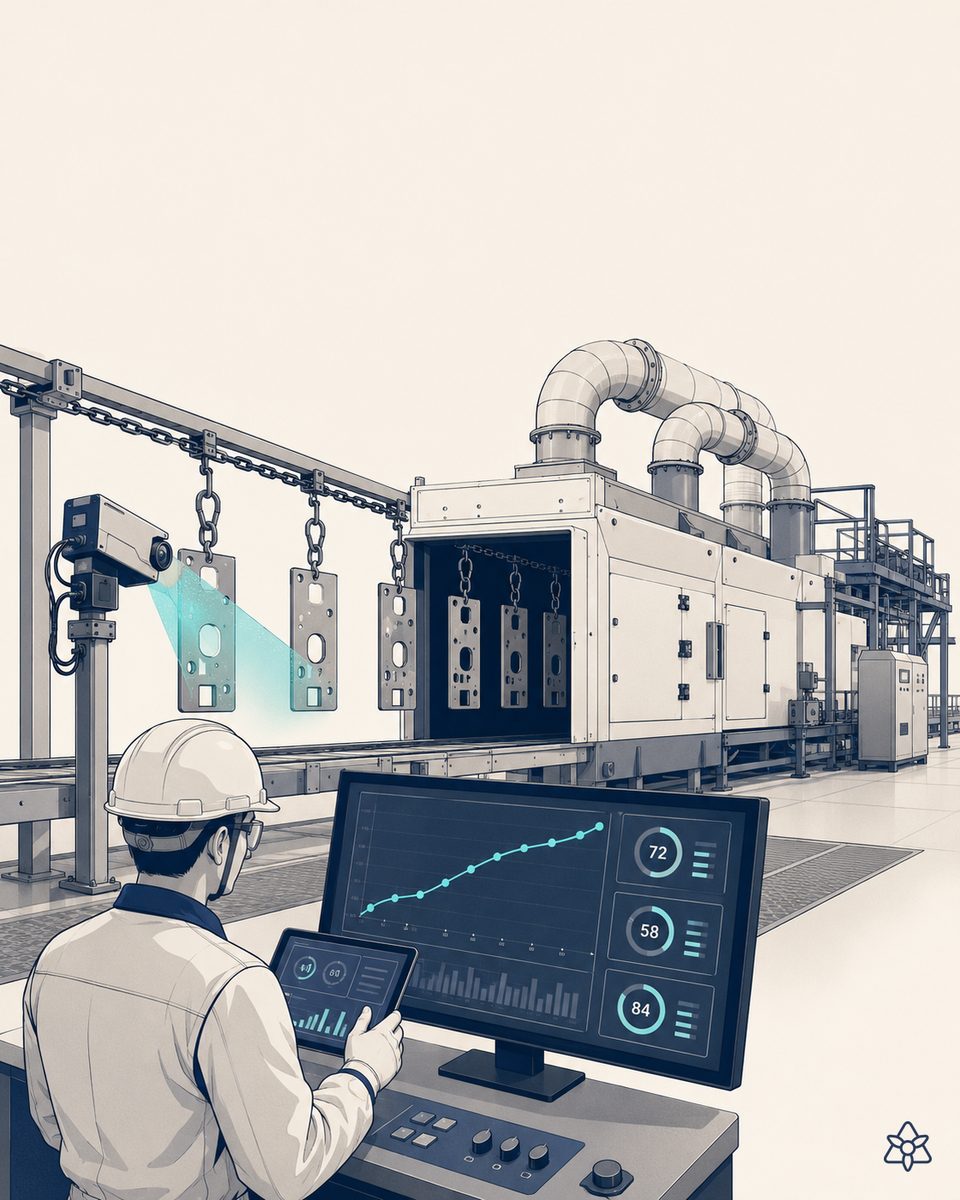
The delta-E the spectrophotometer finds too late is always the same mistake: the cross-check nobody made in time.
An industrial paint plant lives in the balance between three worlds that barely talk to each other:
- The pigment batch and the variability declared (or not) in the supplier's certificate, which arrives by email or as a PDF to the purchasing department. The veteran formulator knows the difference between two iron oxide batches by heart; the system does not see it.
- Dispersion — the order of addition of surfactants, the mill's energy and time, the jacket temperature. It lives in the disperser's SCADA when there is one, on a local panel when there is not.
- Final control — viscosity measured with a Ford cup, gloss, the spectrophotometer against the standard and delta-E. The lab does it when the lot is already nearly packed. If it is out of range, you either adjust after the fact or take the return.
The production manager has the recipe and the SCADA. The lab manager has the spectrophotometers and the standards. The R&D manager has the pigment's variability in a spreadsheet updated every week. And nobody has all three on the same screen at the moment the lot is being made. The classic system works 96% of the time. That 4% is the lots that get reworked, reformulated or returned — and each one lands on the quarterly quality committee's desk.
iLEAN is not a new MES — it is the putty between the formulator, the disperser and the lab.
The problem with color and viscosity is not a lack of instrumentation: it is information living on islands (the batch certificate, the frozen recipe, the mill profile, the spectrophotometer reading) that at the critical moment never arrives cross-referenced. iLEAN acts as the putty that fills the gaps, without asking you to change your ERP, MES, dispersers or instruments.
Edge sees the paste during dispersion. Connect captures the pigment certificate and the recipe wherever they live. The agent cross-references the three and proposes the adjustment before packing. The person signs — the lot is not released on its own.
The three iLEAN pieces applied to industrial paint manufacturing:
- Edge — a terminal with vision (CNN) and analog inputs at the disperser and in the packing area. It detects abnormal foam, early separation, lumps, provisional color against a reference panel and visual drift in the appearance. It reads continuous viscosity, jacket temperature and gauges that were never integrated. It triggers a hold when the pattern is clear. It works with no network.
- Connect — captures the pigment certificate whether it comes by EDI or as a PDF in the technical director's inbox, the lot recipe in the MES, the ERP or the formulation manager's spreadsheet, and the supplier's historical variability. What arrives from outside (a customer switching to a different standard, a new supplier batch with a declared deviation) enters the system at second zero.
- Agent — cross-references the pigment certificate, the recipe, the real dispersion profile and the provisional color reading. It recognizes the pattern (“with this oxide batch, this line usually comes in at +1.2 delta-E unless you raise the energy for 4 more minutes”) and proposes the adjustment before packing. It generates the per-lot dossier for the REACH auditor and for the end customer. The person validates and signs.
Manufacturing run from post-lot lab results vs. anticipation with iLEAN
| Aspect | SCADA + lab + the formulator's eye | With iLEAN Edge + Connect + Agent |
|---|---|---|
| Pigment variability | Certificate by email, stays in purchasing | Cross-referenced with the formula and the real dispersion profile |
| Drift detection | Spectrophotometer at the end of the lot | Anticipated during dispersion, before packing |
| Rework over delta-E | Manual re-tinting, lots returned | Adjustment proposed in line, before packing |
| The veteran formulator's knowledge | Lives in their head | Captured as a persistent pattern in the agent |
| Operation with no network | n/a | Edge keeps reading and holding |
| Per-lot dossier (REACH, customer) | Rebuilt by hand over hours | Automatic traceability with a photo of the appearance and the certificate |
Impact estimate for your plant — to be validated with your numbers.
The block below is an estimate to be validated with your plant's real data. We put it forward so the committee has an order of magnitude; we refine it during the diagnostic.
- Industrial paint plant for automotive, construction or general industry, multi-formula, multi-customer, with recurring rework over delta-E or out-of-range viscosity.
- Edge pilot on one dispersion + packing line, Connect for the pigment certificate and the recipe, and an agent doing the cross-referencing. First value expected within a few weeks.
- Indicative payback between 4 and 9 months, depending on the current percentage of reworked lots, the average cost of rework and the cost of a returned lot.
- The hard lever is threefold: rework reduced by ≥30%, fewer returned lots and better use of pigment (which is the expensive raw material).
And the quality manager's reasonable doubt
“What if the AI gets it wrong and lets through a lot with delta-E out of range?” — hallucination is a problem of free generation, not of anchored tasks. In tasks where the AI compares what the camera and the instruments see against the recipe and the certificate (recontextualizing a piece of data), the best models brought error below 1.5% [1]. And even so, what is critical is never decided alone: iLEAN holds and the person signs. The three safety rings exist precisely for this.
[1] OpenAI paper “Why Language Models Hallucinate”, 2025 — on the reliability of AI in anchored tasks.
What people ask about AI in industrial paint manufacturing
Why does industrial paint manufacturing still produce lots returned over color?
Because the final color depends on too many variables that arrive at different moments: the pigment batch and the variability declared in the supplier's certificate, the order of addition of surfactants and dispersants, the dispersion time and energy, viscosity, gloss and, at the end, the spectrophotometer reading against the standard. When the lab says “delta-E out of range” with the lot already packed, rework is expensive or impossible. iLEAN cross-references those sources at second zero to anticipate the adjustment.
What can iLEAN Edge read on a paint manufacturing line?
Edge is a terminal with vision (CNN) and analog inputs that sees the line the way a veteran operator does: the look of the paste during dispersion, foam, separation, lumps, provisional color against a reference panel, mill viscosity, gauge readings and jacket temperatures that were never integrated. And it logs the event so the agent can cross-reference it with the formula stage and the pigment batch.
How do you anticipate color or viscosity drift?
By cross-referencing the pigment batch and its certificate (a photo of the document if it arrives on paper, EDI if it is integrated), the lot recipe in the MES or in the formulation manager's spreadsheet, the disperser's energy profile, the viscosity measured in line and the provisional color reading. The agent recognizes that “with this iron oxide batch, in this mill, delta-E ends up out of range unless you add 0.3% extra dispersant” and proposes the adjustment before packing. The person validates and signs.
And traceability for a REACH auditor or a construction sector customer?
The agent generates the per-lot file automatically: the certificate for every pigment used, the real formula stage, the dispersion profile, viscosity and color readings, a photo of the appearance at packing, and the associated safety data sheets. The file that used to be rebuilt by hand over hours comes out as a signed dossier when the lot closes. The person reviews and signs.
What ROI can you expect in an industrial paint plant?
Estimate to be validated: an Edge pilot over one manufacturing line (disperser + packing), first value within a few weeks by anticipating lots that were heading outside the target delta-E or viscosity. Indicative payback between 4 and 9 months on reduced rework, fewer returned lots and better pigment yield. We ask for your plant's real data and send you the estimated ROI in 48h.
More cases in petrochemical
- Hot rolled steel control with AI — the window is narrow and the defect shows up with the coil already cold.How iLEAN cross-references heat, mill curve and surface vision on the strip to catch defects and…
- Green hydrogen by electrolysis with AI — when every kWh decides whether the project pays off.How iLEAN cross-references electrolyzer stacks, balance of plant and the power grid to anticipate…
- Industrial adhesive control with AI — one drum with out-of-range viscosity means the customer's line is down.How iLEAN cross-references in-line viscosity, tack and open time of industrial adhesive with the batch…
- ISO 14001/50001 in a chemical plant with AI — evidence you live day to day, not something you rebuild the night before the auditor arrives.iLEAN keeps environmental and energy KPIs live for ISO 14001/50001, with audit evidence ready at any…
- LNG plant control with AI — without touching the cryogenic SCADA, without losing the human signature.How iLEAN joins Connect, Agents and the three rings to see boil-off, liquefaction ratio and LNG quality…
- Multilanguage chemical product SDS with AI — updating stops being a manual sprint.iLEAN generates SDS per product in N languages and keeps the active version current with REACH/CLP…
Tell us your case and in 48h we'll send you the estimated ROI of this AI project for your industrial paint plant.
We work on your plant's real data, not ours. Diagnostic with no commitment.
Request estimated ROI in 48h See petrochemical