NPK fertilizer control with AI — an off-grade bag is not an incident, it is a fine and a lost customer.
A correct NPK fertilizer is the intersection of three realities — the N-P-K grade declared on the bag, the real particle size and moisture after the granulator and dryer and EU Regulation 2019/1009 + the importing customer's spec. iLEAN cross-checks those three with in-line vision and sensors plus integration with your LIMS and SCADA, and holds the batch before bagging when something does not add up. The person signs.
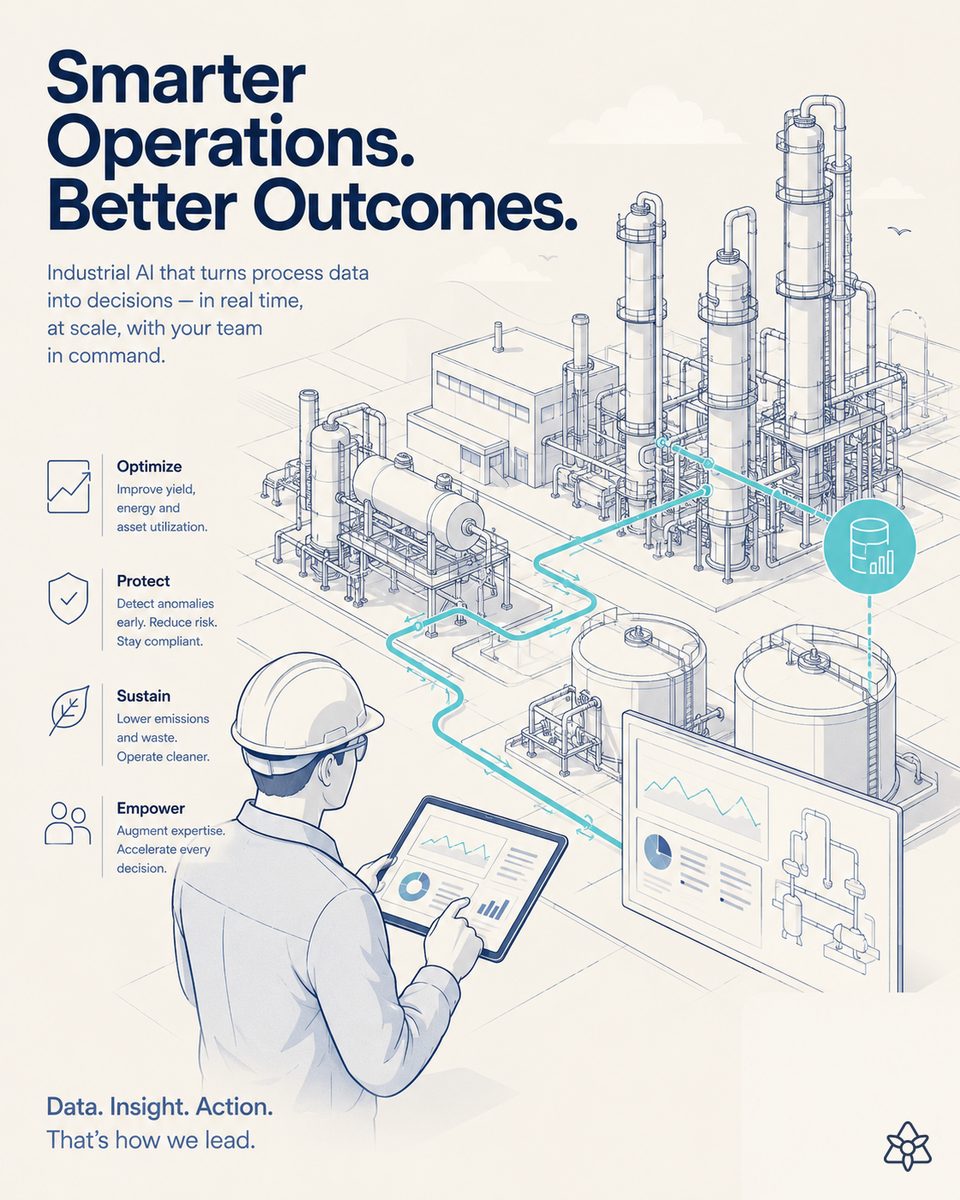
The bag does not lie — but the lab arrives four hours late.
The manager of an NPK fertilizer plant lives with three realities that are rarely in sync:
- N-P-K dosing changes with every raw material — urea, ammonium nitrate, monoammonium phosphate (MAP) and potassium chloride (KCl) each arrive with their own supplier analysis, and the real nutrient percentage of the batch does not always match the nominal recipe. The LIMS knows it; the granulator operator, almost never in time.
- The granulator and the dryer do not always deliver the same thing — drum speed, binder, ambient humidity and knife wear all change the particle size distribution. A percentage of fines above expectations and the bag segregates in transport: the last customer receives a different fertilizer from the first.
- The regulation does not accept a letter of explanation — EU Regulation 2019/1009 sets tight tolerances for the grade declared on the bag. An inspection re-grading or an importer analysis below tolerance means recall, fine and a customer who buys elsewhere next year.
The lab analyzes by sampling and returns the result hours later. By then the batch is bagged, palletized and, with luck, still in the warehouse. The problem is not the recipe, it is that the classic system always arrives late — and every inspection re-grading or every importer return shows up across the whole financial year.
iLEAN does not change your granulator — it puts the missing intelligence on the data you are already generating.
The problem in NPK fertilizer control is not a lack of information: it is information living on islands — the LIMS knows how the raw material came in, the SCADA knows the drum speed and dryer temperature, the ERP knows which importer the pallet is going to and with what tolerance, but none of them talks to the next one at bagging speed. iLEAN acts as the putty that fills those gaps, without asking you to change your SCADA, your LIMS or the plant.
Edge sees particle size and moisture in line. Connect reads the LIMS analysis and the importer's spec. The agent cross-checks against the EU tolerance and, if something does not add up, holds the batch before bagging. The person signs — never the other way round.
The three iLEAN pieces applied to NPK fertilizer control:
- Edge — a terminal with machine vision (CNN) over the granulator outfeed conveyor (classifying 1-2-3-4 mm particle size in real time), an NIR moisture sensor after the dryer, and capture of the dosing from every weigh hopper. If the particle size distribution drifts, it triggers a status light and notifies the operator. It works with no network.
- Connect — captures the raw material analysis whether it comes from the LIMS, from the lab spreadsheet or from the supplier's PDF. And it also captures what arrives from outside (the EU Regulation 2019/1009 in force, the African or European importer's spec, the carrier's email with storage conditions) at second zero, with nobody forwarding anything.
- Agent — cross-checks the real N-P-K dosing, the measured particle size, the moisture and the customer spec against the EU tolerance. If there is a deviation, it holds the batch and alerts the quality manager through whatever channel they use. It also generates the conformity dossier — which raw material came in, which grade came out, which particle size — ready for inspection or for the importer. The person validates and signs; the pallet does not ship on its own.
Manual control vs. cross-checked control with iLEAN
| Aspect | Manual control + lab by sampling | With iLEAN Edge + Connect + Agent |
|---|---|---|
| Detecting off-grade N-P-K | When the lab returns the result (hours) | Continuously during granulation |
| Particle size distribution | Manual sieve once a shift | Vision over the conveyor, batch by batch |
| Moisture after the dryer | One-off sample | In-line NIR, continuous |
| Cross-check against EU 2019/1009 tolerance | Documentary review after the batch | Real-time validation, hold if out of range |
| Traceability by pallet/importer | Rebuilt by hand | Per-batch dossier, automatic |
| Operation with no network | n/a | Edge keeps running on the panel's own light |
Impact estimate for your plant — to be validated with your numbers.
The block below is an estimate to be validated with the specific data of your plant. We put it forward so the committee has an order of magnitude; we refine it during the diagnostic.
- Mid-sized granulated NPK plant (blending urea/nitrate, MAP/DAP, KCl/SOP), 1-2 granulation and drying trains, bagging in 25-50 kg bags and big bags.
- Edge pilot on one train (vision over the granulator outfeed conveyor + NIR moisture + integration with hopper dosing and the LIMS). First value expected in a few weeks.
- Indicative payback between 4 and 9 months, depending on the frequency of inspection re-gradings, rework due to segregation and importer returns documented in recent years.
- The hard lever is a single re-grading avoided at an importer: product held, transport, re-analysis, fine for an out-of-tolerance declaration. The expected reduction in in-line rejects is ≥ 30% over the current baseline.
And the technical director's reasonable doubt
“What if the AI gets the vision-based particle size wrong and holds a batch that was fine?” — hallucination is a problem of free generation, not of anchored tasks. In tasks where the AI merely classifies particle size against a distribution trained on your own batches, the best models brought error below 1.5% [1]. And even so, what is critical is never decided alone: iLEAN holds and the person signs. The three safety rings exist precisely for this, and the agent never touches the functional safety electronics around the nitrate.
[1] OpenAI paper “Why Language Models Hallucinate”, 2025 — on the reliability of AI in anchored tasks.
What people ask about NPK fertilizer control with AI
What does AI control in an NPK fertilizer plant?
The four variables that decide whether the bag meets its declared grade: N, P and K dosing (urea/nitrate, monoammonium phosphate, potassium chloride/sulfate), particle size at the granulator outlet, moisture after the dryer and bag labeling with the declared grade. iLEAN Edge captures particle size and moisture in line, Connect cross-checks the recipe against the raw material LIMS, and the Agents anticipate the deviation before bagging.
How do you keep the bag from segregating during transport?
By cross-checking the particle size distribution measured in line against the nominal NPK recipe. If the granulator delivers a higher percentage of fines than expected, the Agents anticipate it, alert the operator to adjust the binder or the drum speed, and hold the batch before it moves to bagging if the distribution drifts out of range. Segregation during transport is a direct consequence of an out-of-range particle size in the plant — and that is where it gets stopped.
How does it fit EU Regulation 2019/1009 on fertilizing products?
EU Regulation 2019/1009 requires you to declare real nutrient content within tight tolerances and to document the traceability of every batch. iLEAN Connect reads the analysis sheets from the LIMS and from the supplier, Edge captures the in-line measurements and the Agents generate the per-batch conformity dossier — which raw material, which dosing, which particle size, which moisture — ready for the inspection and for the importing customer.
What about safety when there is ammonium nitrate in the mix?
Seveso-III rules and their national transposition for high-concentration ammonium nitrate require temperature control and cross-contamination control. iLEAN Edge captures hopper, dryer and silo temperature, the Agents cross-check it against the recipe and raise an alert on any deviation that drifts away from the safe profile. And capture never replaces the functional safety instrument — the three rings guarantee that the agent does not touch critical OT; it only proposes, and the person decides.
How much does an AI pilot cost in an NPK fertilizer plant?
The order of magnitude of an Edge pilot in an NPK plant is in line with any Edge pilot in a bulk chemical plant: an initial investment covering a vision-equipped terminal (particle size) + in-line sensors (NIR moisture, temperature) + integration with SCADA and LIMS, plus an annual license. A reasonable payback to put in front of the committee is a few months — the hard lever is one recall or one re-grading avoided at an importing customer. We ask for your plant's data and send you the estimated ROI in 48h.
More cases in petrochemical
- LNG plant control with AI — without touching the cryogenic SCADA, without losing the human signature.How iLEAN joins Connect, Agents and the three rings to see boil-off, liquefaction ratio and LNG quality…
- Multilanguage chemical product SDS with AI — updating stops being a manual sprint.iLEAN generates SDS per product in N languages and keeps the active version current with REACH/CLP…
- Multiproduct campaign changeover with AI — a badly executed changeover is not a delay, it is cross-contamination.iLEAN coordinates campaign changeover on a multiproduct reactor: verified cleaning plus the next recipe…
- PET, PE and PVC extrusion with AI — the drift that reaches the customer when there are already 8 hours of bad reel.How iLEAN cross-references screw response, masterbatch batch, moisture drift and gel/band vision to hold…
- Circular economy in petrochemicals with AI — the mass balance does not hold up in a spreadsheet; with iLEAN, it does.How iLEAN joins invoices, lab data and operations to keep the ISCC PLUS mass balance alive, trace…
- Petrochemical plant OEE with AI — an OEE that has been dressed up is an OEE you cannot attack.iLEAN calculates real petrochemical OEE by combining availability, yield and quality, and breaks the…
Tell us your case and in 48h we'll send you the estimated ROI of this AI project for your NPK plant.
We work on your plant's real data, not ours. Diagnostic with no commitment.
Request estimated ROI in 48h See petrochemical