PET, PE and PVC extrusion with AI — the drift that reaches the customer when there are already 8 hours of bad reel.
Extrudate quality depends on three things that are almost never on the same screen: the actual moisture of the material, the variability of the masterbatch batch and the screw's response to those two variables. iLEAN brings the three together with in-line vision and proposes the adjustment before the reel ships. The person signs — the extruder never reconfigures itself.
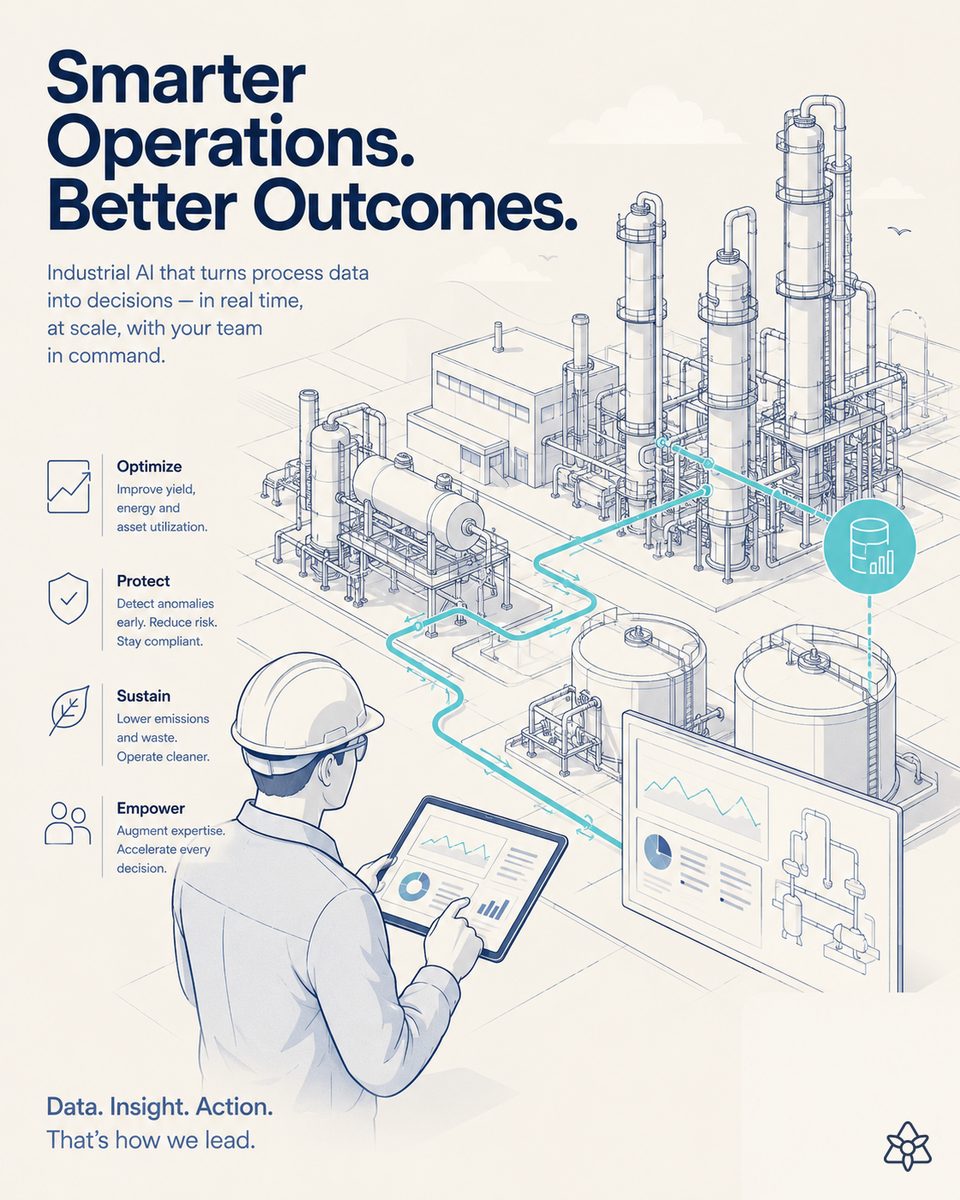
By the time the gel shows up, eight hours of reel are already gone.
PET, PE or PVC extrusion looks stable until it isn't. Every production manager knows the story: the SCADA is green, the laser sizer says thickness is within tolerance — and two hours later the customer's quality department returns a reel for gel, for a longitudinal band or for a variation in clarity. The pattern repeats because the three real causes live in three different places:
- The moisture of the material entering the screw, which depends on the dryer, on the recipe and on ambient temperature. It lives on the dryer panel, sometimes integrated with nothing at all.
- The masterbatch or resin batch, with its variability declared on a certificate of analysis that arrives by email from the supplier and almost never crosses the factory to reach the extruder.
- The response of the screw and the calender to those two variables — torque, pressure, barrel temperature, haul-off speed — logged in the SCADA, but with nobody correlating it with the other two in real time.
The shift lead has three screens and the SCADA charts. The veteran operator knows that “that resin, at this moisture, gives you a band after 40 minutes”, but that knowledge walks out the door the day he retires. The classic system works 99% of the time. That 1% is eight hours of reel discovered at the customer — and every time it is hard cost plus reputational damage.
iLEAN does not replace the extruder's SCADA — it captures the islands the SCADA could not see.
The extrusion problem is not a lack of sensors: it is information living on separate islands (dryer, batch certificate, the veteran's eye, laser sizer) that, at the critical moment (the batch change, the recipe change), does not reach the decision-maker cross-referenced. iLEAN acts as the putty that seals those cracks, without asking you to change extruder, SCADA or ERP.
Edge sees gel and band in line, before the reel ships. Connect captures the batch certificate and the dryer panel. The agent cross-references the three and proposes the adjustment. The person signs — the line never reconfigures itself.
The three iLEAN pieces applied to PET, PE and PVC extrusion:
- Edge — a computer-vision terminal (CNN) over the calender or the sizer. It detects gel, longitudinal band, fish-eyes, patches of poorly dispersed pigment and clarity drift in milliseconds. It cross-references with the laser sizer and the IR camera. It triggers the actuator (stack light, ejector, controlled stop) when the pattern is clear. It works with no network: if the plant loses WiFi, Edge keeps reading and holding.
- Connect — captures the supplier's certificate of analysis whether it arrives by EDI, email or PDF, the dryer readings (a photo of the panel if it is standalone, an integration if it has an industrial PC), the ambient humidity and the batch recipe. Graduated capture means it works just as well with modern lines as with extruders built twenty years ago.
- Agent — cross-references actual moisture, the masterbatch/resin batch, the screw's response and the defect pattern seen by Edge. It recognizes the characteristic pattern (“with this batch and this moisture you get a band after 40 minutes”) and proposes a recipe adjustment before the defect reaches the film. It generates the per-reel dossier with full traceability for the customer and for the auditor.
Extrusion run by eye vs. extrusion cross-referenced with iLEAN
| Aspect | SCADA + dryer + the operator's eye | With iLEAN Edge + Connect + Agent |
|---|---|---|
| Gel and band detection | Post-reel quality check or customer complaint | In-line vision, milliseconds, before winding |
| Resin batch change | Certificate by email, never reaches the operator | Cross-referenced at second zero with the screw's response |
| Material moisture | Dryer panel, standalone, read by hand | Continuous capture, correlated with historical defects |
| The veteran's knowledge | Lives in his head, leaves with him | Captured as a persistent pattern in the agent |
| Operation without a network | n/a | Edge keeps running with its own light |
| Per-reel dossier for the customer | Rebuilt by hand when a complaint arrives | Automatic traceability, with a photo of the defect if there was one |
Impact estimate for your plant — to be validated with your numbers.
The block below is an estimate to be validated with the real data of your plant. We put it forward so the committee has an order of magnitude; we refine it during the diagnostic.
- A plant extruding film, sheet or pipe in PET/PE/PVC, multi-format and multi-batch, with recurring scrap attributed to gel, band or thickness variation.
- Edge pilot on one line (camera at the calender/sizer + Connect for the dryer and the batch certificate + an agent that cross-references). First value expected within a few weeks.
- Indicative payback between 4 and 9 months, depending on hours/year of scrap from undetected drift, the average cost of a rejected reel and your current level of customer complaints.
- The hard lever is threefold: reel scrap reduction ≥30%, fewer unplanned stoppages caused by gel, and a per-reel dossier that cuts customer complaints.
And the quality manager's reasonable doubt
“What if the AI gets it wrong and lets a reel with gel through?” — hallucination is a problem of free generation, not of anchored tasks. In tasks where the AI merely compares what the camera sees against the recipe and the history (recontextualizing a piece of data), the best models brought error below 1.5% [1]. And even so, what is critical is never decided alone: iLEAN holds and the person signs. The three safety rings are there for exactly this.
[1] OpenAI paper “Why Language Models Hallucinate”, 2025 — on the reliability of AI in anchored tasks.
What people ask about AI control in plastics extrusion
Why does PET, PE or PVC extrusion still cause trouble despite modern SCADA systems?
Because extrudate quality depends on things no single SCADA can correlate on its own: the actual moisture of the material entering the screw, the variability of the masterbatch batch, extruder torque and pressure, barrel temperature, and calender or sizer speed. By the time the drift shows up in thickness or the gel appears, there are already eight hours of reel out of tolerance. iLEAN cross-references all those sources at second zero and proposes the adjustment before the reel ships.
Which typical defects does iLEAN Edge detect on an extrusion line?
Edge runs vision (CNN) trained on the classic defects: gel in film, longitudinal band, fish-eyes, thickness variation, uneven gloss, patches of poorly dispersed pigment. It also reads the laser sizer and the IR camera on the cooling section. When a pattern characteristic of moisture degradation or of gel from a resin batch change appears, it alerts the operator and logs the event so the agent can cross-reference it with the raw-material batch.
How do you anticipate drift caused by a change of resin or masterbatch batch?
By cross-referencing the batch delivery note (a photo of the document if it arrives on paper, an integration if it arrives as EDI), the supplier's certificate of analysis, the dryer's moisture readings and the response of extruder torque and pressure during the first few minutes. The agent recognizes that “with this batch, on this line, a band usually shows up after 40 minutes” and proposes reducing speed or increasing drying time before the defect reaches the film. The person validates and signs.
What if the extrusion line has no integration with SCADA or the ERP?
Connect has graduated capture. If the old extruder only has an analog panel, a person photographs the panel every hour and the data goes in. If it has a standalone industrial PC, Connect connects to it and extracts data periodically. If it has a modern interface, direct integration. It does not force you to change the line or buy a new MES. The putty covers whatever the ERP, MES or SCADA left exposed.
What is the ROI of applying iLEAN on an extrusion line?
Estimate to be validated: an Edge pilot on one multi-format extrusion line, first value within a few weeks with gel and band detection above current thresholds. Indicative payback between 4 and 9 months, depending on hours/year of scrap from undetected drift and the average cost of a rejected reel. The hard lever is threefold: reel scrap reduction (≥30%), fewer unplanned stoppages and better masterbatch yield. We ask for your plant's data and send you the estimated ROI in 48h.
More cases in petrochemical
- Multilanguage chemical product SDS with AI — updating stops being a manual sprint.iLEAN generates SDS per product in N languages and keeps the active version current with REACH/CLP…
- Multiproduct campaign changeover with AI — a badly executed changeover is not a delay, it is cross-contamination.iLEAN coordinates campaign changeover on a multiproduct reactor: verified cleaning plus the next recipe…
- NPK fertilizer control with AI — an off-grade bag is not an incident, it is a fine and a lost customer.How iLEAN cross-checks N-P-K dosing, particle size and moisture in line with the customer spec to avoid…
- Circular economy in petrochemicals with AI — the mass balance does not hold up in a spreadsheet; with iLEAN, it does.How iLEAN joins invoices, lab data and operations to keep the ISCC PLUS mass balance alive, trace…
- Petrochemical plant OEE with AI — an OEE that has been dressed up is an OEE you cannot attack.iLEAN calculates real petrochemical OEE by combining availability, yield and quality, and breaks the…
- Polymer quality on the extrusion line with AI — an out-of-spec MFI at the end of the roll is a lost roll.iLEAN combines online MFI and AI vision of the extruded product to correct the extruder before the…
Tell us your case and in 48h we'll send you the estimated ROI of this AI project for your extrusion line.
We work on your plant's real data, not ours. Diagnostic with no commitment.
Request estimated ROI in 48h See petrochemical