Polymer quality on the extrusion line with AI — an out-of-spec MFI at the end of the roll is a lost roll.
On a polymer extruder (HDPE, LDPE, PP, PVC, compounding) the lab confirms the MFI hours after the roll is finished — and when it says "out of spec," that roll is already scrap or downgrade. iLEAN combines online MFI (bypass rheometer or inferred soft sensor), AI vision of the extruded product and correlation with the recipe to detect the drift while the extruder can still be recovered. In-line detection, correction by the operator, SIS intact.
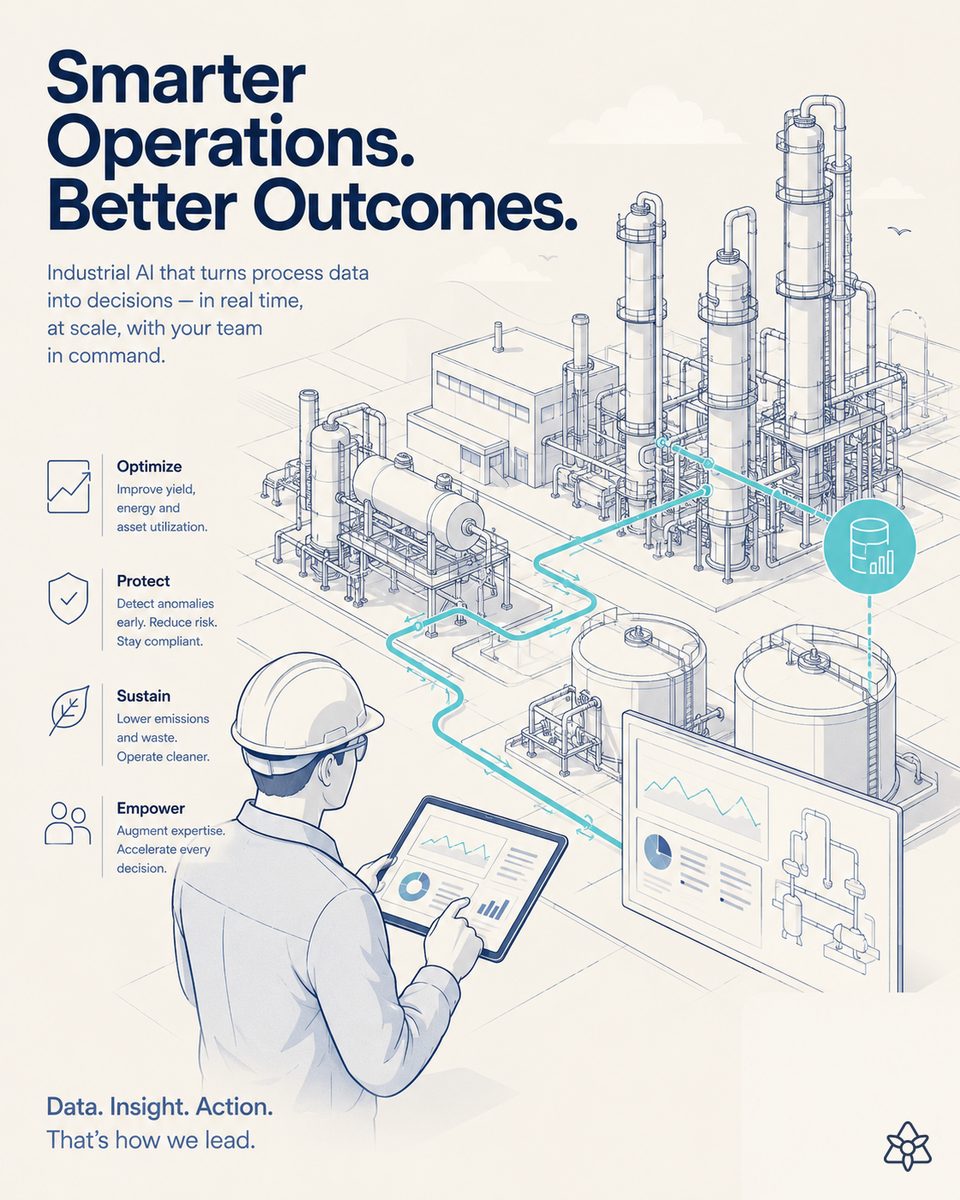
The defect is born in minutes — the lab finds out hours later.
On a polymer extrusion line, the change that ruins the roll is not abrupt — it is a slow drift over minutes that the operator does not see because they are looking at another screen, and that the lab does not catch because it samples every hour or at the end of the roll. Three patterns repeat on the plant floor:
- A change in virgin raw material + rework — the blend of virgin resin and recompound from the line's own scrap slightly changes the viscosity entering the screw. Die pressure creeps up, the product's MFI drifts away. The operator notices once it already shows in the part.
- Campaign startup transient — switching from HDPE to PP, or moving up a grade within the family, the first meters are scrap "by the book." But how much scrap depends on how well the startup setpoints were guessed — and that depends on which veteran happened to be on shift the last time this grade was run.
- Geometry/surface defect — gel, streak, bubble, out of dimension — which the operator spots when walking past the line, but which has been passing unseen for minutes by then.
And above all, the data lives in islands: the DCS knows melt pressure and temperature, the LIMS knows the MFI measured in the lab, the MES knows the recipe and the grade, the bypass rheometer (if installed) lives in its own software, and the operator's eye catches the visible defect but nothing gets written down. The knowledge of how to avoid the problem lives in the shift veteran's head — and leaves with them the day they retire.
iLEAN does not touch the DCS recipe — it closes the quality loop before the roll is lost.
The problem is not a missing sensor: it is information living in islands and a quality loop that closes hours too late, in the lab. iLEAN acts as the putty that seals the gaps between DCS, LIMS, rheometer, MES and the operator's eye, and puts the veteran's intuition back on the shift's screen.
Edge watches the extruded product in line. Vision identifies the defect. Brain estimates MFI continuously. The agent proposes an adjustment. The operator signs — the DCS executes it.
The iLEAN pieces applied to polymer extrusion quality:
- Edge + Vision — a CNN-equipped terminal with a camera positioned over the extruded product (film, pipe, profile, filament, pellet) at the die exit or the calibrator. It detects surface defects (gel, streak, bubble, contamination, out of dimension) in milliseconds and triggers an actuator (traffic light, diversion to trimming, mark on the reel) before the defect spreads. It works without a network: if the plant loses WiFi, Edge keeps detecting and marking, because on a continuous extrusion line what is critical cannot depend on WiFi.
- Connect + Brain — Connect captures the process variables from the DCS (die pressure, melt temperature, screw torque, throughput), the MFI analysis from the LIMS when it arrives, the bypass rheometer if installed, and the recipe and active grade from the MES. Brain builds a continuous MFI soft sensor trained on your history, and a golden batch per grade. When the estimated MFI drifts from center, the system warns minutes before the lab would see it.
- Agent — cross-references the vision detection, the estimated MFI, the die pressure and the active recipe. When it concludes the drift is real, it proposes the concrete recipe adjustment to the DCS operator: "lower the screw by 2 rpm and raise the barrel center by 3 °C, based on 12 similar campaigns of this grade with this raw material." The operator applies it from their console — the SIS is not touched, the DCS recipe is executed by the operator, the agent proposes with the justification alongside.
Hourly lab + operator's eye vs. in-line quality loop
| Aspect | Hourly LIMS + attentive operator | With iLEAN Edge + Vision + Brain |
|---|---|---|
| Out-of-spec MFI detection | At the end of the roll, in the lab | Minutes after the drift begins, in line |
| Visual defect detection | The operator's eye, intermittent | Edge CNN over the product, continuous and marked |
| Campaign startup | The shift veteran's setpoints, variable scrap | Golden-batch setpoints from the last good campaign |
| The veteran's knowledge | Leaves with them the day they retire | Captured as a permanent capability of the plant |
| Operator reaction | Personal playbook + intuition | On-screen adjustment proposal with justification |
| Touches the SIS or the DCS recipe | n/a | Never — the operator validates and executes at their console |
Impact estimate for your plant — to be validated with your numbers.
The block below is an estimate to be validated with the specific data of your plant. We put it forward so the committee has an order of magnitude; we refine it during the diagnostic.
- Plant with 2-5 multi-grade extrusion lines (film/pipe/profile/compounding), existing DCS, LIMS with MFI history, possibly a bypass rheometer.
- Edge + Vision + Brain pilot on the Pareto line: the one moving the largest volume or the most sensitive grade. First value expected within a few weeks.
- Reject reduction ≥ 30% in the pilot campaign, plus a shorter campaign startup transient (the transition roll that is typically scrap).
- Indicative payback between 4 and 9 months, dominated by the cost of the rolls/loads lost today to out-of-spec MFI plus the savings from optimized startup.
And the production manager's reasonable doubt
“What if the agent proposes an adjustment and makes things worse?” — hallucination is a problem of free generation, not of anchored tasks. When the AI limits itself to finding the most similar previous campaign and proposing its adjustment, the best models brought error below 1.5% [1]. And the proposal never enters the DCS on its own: it appears at the operator's console with the justification (which grade, which raw material, which historical pressure, which adjustment worked), and the operator decides and executes. The three-ring architecture guarantees that the SIS and the DCS recipe stay in authorized hands only — the agent contributes intuition, not decisions over the control loop.
[1] OpenAI paper “Why Language Models Hallucinate”, 2025 — on the reliability of AI in anchored tasks.
What people ask about polymer extrusion quality with AI
How is MFI measured online on an extrusion line?
There are three routes, all compatible with iLEAN: a bypass rheometer (installed on a side stream of the melt, it measures MFI/MVR every few minutes), inference from process sensors (die pressure, melt temperature, screw torque and throughput — Brain builds a soft sensor that estimates MFI continuously), and in-line near-infrared (NIR) where the die allows it. Most plants combine a bypass rheometer with an inferred soft sensor so they never depend on a single point; iLEAN cross-references all three when present and learns which combination is most reliable per grade.
And viscosity — can it be measured the same way?
Yes. Melt viscosity is computed much like MFI from pressure and throughput through the die geometry, and is checked against the rheometer where one is installed. For multi-grade operations and for polymers with fillers or additives, the inferred soft sensor works best when trained on campaign history — which is exactly what Brain does with your DCS data without asking you to change the line.
Does it work with a multi-grade extruder and frequent campaign changeovers?
Yes — and that is where the lever is. iLEAN keeps a golden batch per grade: the signature of a good campaign in HDPE, in LDPE, in PP homopolymer, in PP copolymer, in PVC compounding. When a new campaign starts, the agent loads the fingerprint of the last good campaign of that grade with that same raw material and proposes the startup setpoints that came closest to optimum last time. That shortens the startup transient — the transition roll that is typically scrap — without touching the DCS: the proposal reaches the operator, who validates it at their console.
What reject reduction is realistic?
Estimate to be validated with your numbers: on polymer extrusion lines (film, pipe, profile, compounding) that today discover the out-of-spec at the end of the roll through lab analysis, the combination of AI vision of the product + online MFI + recipe correlation usually delivers first value within a few weeks and a reject reduction in the order of ≥ 30% in the pilot campaign. Indicative payback sits between 4 and 9 months, dominated by the cost of a lost roll or a destroyed out-of-spec compound. We refine it with your real reject history per line and per grade.
Does it integrate with existing DCS and MES without touching the SIS recipe?
Yes. iLEAN sits on top of the DCS and the MES — Connect reads over OPC UA/Modbus, Edge is installed on the line itself with its own CNN and its own actuators (traffic light, ejector, diversion to trimming), and the agent proposes recipe corrections to the DCS operator. The actual correction is executed by the operator at their console. The plant's SIS (maximum die pressure, temperature limit, overload trip) is not touched — it is untouchable by design in the OT ring.
More cases in petrochemical
- PET, PE and PVC extrusion with AI — the drift that reaches the customer when there are already 8 hours of bad reel.How iLEAN cross-references screw response, masterbatch batch, moisture drift and gel/band vision to hold…
- Circular economy in petrochemicals with AI — the mass balance does not hold up in a spreadsheet; with iLEAN, it does.How iLEAN joins invoices, lab data and operations to keep the ISCC PLUS mass balance alive, trace…
- Petrochemical plant OEE with AI — an OEE that has been dressed up is an OEE you cannot attack.iLEAN calculates real petrochemical OEE by combining availability, yield and quality, and breaks the…
- Prestressed concrete with AI — the beam that leaves with a strand at 1,510 when it should have been 1,560 is invisible until it reaches the site.How iLEAN cross-references strand tension, concrete mix design and curing so the prestressed beam leaves…
- Pulp and paper with AI — a web break gives no warning, but its signature does.How iLEAN cross-references consistency, sheet formation and in-line defects to anticipate a web break on…
- Predictive maintenance of refinery pumps and compressors — one unplanned failure empties the whole unit.iLEAN combines vibration, bearing temperature and motor current to predict failures in critical refinery…
Tell us your case and in 48h we'll send you the estimated ROI of extrusion quality for your plant.
We work on your real rejects by grade and by line, not on generic figures. Diagnostic with no commitment.
Request estimated ROI in 48h See Petrochemical