Predictive maintenance of refinery pumps and compressors — one unplanned failure empties the whole unit.
An API 610 pump that fails in a refinery process unit can take down the FCC, the HDS or the reformer for hours. iLEAN cross-references vibration, bearing temperature, current and DCS data to name the failure mode weeks ahead, open the work order in your CMMS and schedule the intervention during a planned shutdown. Without touching the SIS.
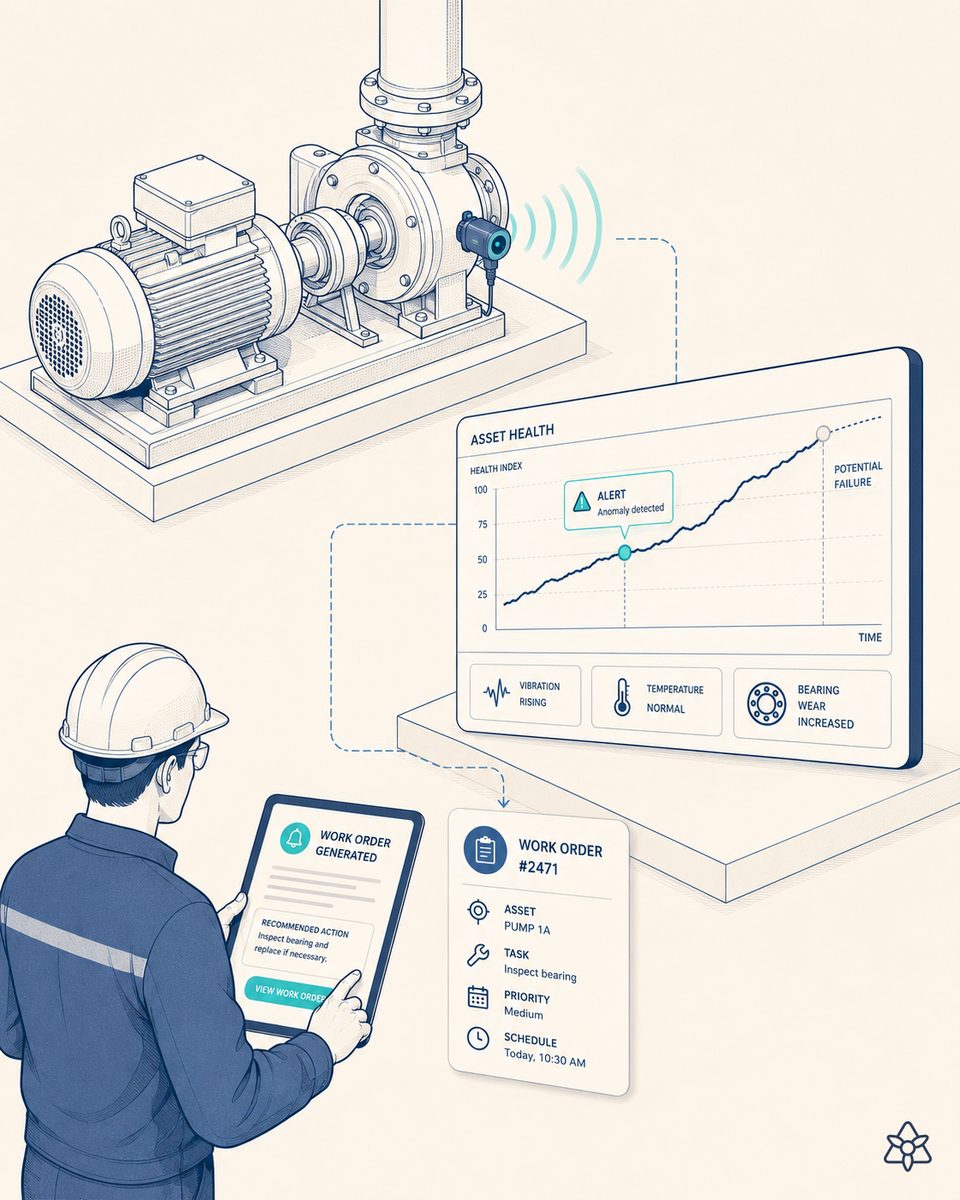
The monitoring is there, but the alarm arrives when it is already too late.
Every serious refinery has vibration monitoring systems (Bently, GE, Emerson AMS) installed decades ago, collecting data from the critical pumps and the axial compressors 24/7. And even so, unplanned shutdowns keep happening. For three reasons that repeat themselves:
- A generic threshold is blind to context — the alarm trips when vibration exceeds X mm/s RMS. But a bearing enters fatigue by slowly raising the spectral envelope long before the overall RMS moves, and a mechanical seal warns you through the gland temperature, not through vibration. The generic threshold finds out late, or does not find out at all.
- The signals live in systems that never talk to each other — monitoring on its own console, the DCS with the process pressures on a separate one, the CMMS (SAP PM, Maximo) with the intervention history on a third, the route inspection reports in the supervisor's spreadsheet. Nobody cross-references the four.
- Route inspection depends on the veteran's eye — and the veteran inspects each pump once a month. Whatever drifts in the second week gets discovered when the pump beeps on the operator's console — or when it runs too hot.
The result is unplanned failures that stop an entire process unit and force a restart worth several hundred thousand euros — all because of a five-kilo bearing.
iLEAN does not replace your monitoring — it seals the cracks between monitoring, DCS, CMMS and the veteran's route.
The problem is not a lack of sensors: it is information living on islands plus a generic alarm that arrives late. iLEAN acts as the putty that fills the gaps between the systems you already have, and gives the maintenance planner an agent that cross-references the four sources and names the failure mode.
Edge sees and measures at the equipment. Connect reads monitoring, DCS, CMMS and the supervisor's spreadsheet. Brain recognizes the failure pattern. The agent opens the work order — the person schedules it.
The iLEAN pieces applied to predicting pump and compressor failure:
- Edge — a terminal with a CNN over a camera and thermography of the bearing and the mechanical seal, whenever the existing monitoring needs to be complemented. It reads the seal, sees the drip, measures the spot temperature of the bearing without entering the DCS. It works with no network, as a non-negotiable design rule: in a process unit, what is critical cannot depend on WiFi.
- Connect — captures the data wherever it comes from: OPC UA integration with the monitoring system (Bently, Emerson AMS, GE), the DCS over Modbus or a proprietary driver, the CMMS through an API or a scheduled export, the route supervisor's spreadsheet from a shared folder. Integration is not a magic button: every island is real work. What changed is that it is now affordable.
- Brain + Agent — on top of all that, Brain recognizes the pattern of each failure mode (bearing fatigue, seal drying out, cavitation, misalignment, unbalance) by cross-referencing vibration + thermography + motor current + differential head. The agent names the probable failure mode, estimates the intervention window (weeks, not hours) and opens the work order in SAP PM/Maximo with the evidence attached — spectral plot, thermographic image, comparison with sister pumps, spare part recommendation. The planner validates and schedules.
Generic-threshold monitoring vs. multivariable prediction with a work order
| Aspect | Classic monitoring + the veteran's route | With iLEAN Edge + Brain + Agent |
|---|---|---|
| Alarm trigger | Generic vibration RMS threshold | Multivariable pattern by failure mode |
| Warning window | Hours — sometimes minutes | Weeks — a work order you can schedule in a planned shutdown |
| Diagnosis | “High vibration” — with no context | “Radial bearing fatigue — replace within the next 4 weeks” |
| Cross-referenced sources | Monitoring, DCS, CMMS and spreadsheet live on islands | All four unified at second zero |
| Work order | Manual, in the weekly meeting | Opened in SAP PM/Maximo with the evidence attached |
| Does it touch the SIS or the DCS | n/a | Never — Connect only reads, the OT ring stays intact |
Impact estimate for your plant — to be validated with your numbers.
The block below is an estimate to be validated with the specific data of your plant. We put it forward so the committee has an order of magnitude; we refine it during the diagnostic.
- Refinery with FCC + HDS + reformer, a fleet of ~150-300 API 610 pumps and 4-8 critical centrifugal compressors, existing Bently/Emerson AMS monitoring, SAP PM or IBM Maximo as the CMMS.
- Edge + Brain pilot on the Pareto family: the 20-30 pumps that historically account for 80% of unplanned failures. First value expected within a few weeks.
- Reduction of unplanned failures of ≥ 30% in the pilot family. The system starts by giving useful warning on the most frequent failure modes (bearing and seal) and learns the less frequent ones over time.
- Indicative payback between 4 and 9 months, dominated by the cost of a single unplanned unit shutdown avoided. In an FCC, the saving from one single shutdown usually covers several complete pilots.
And the maintenance manager's reasonable doubt
“What if the agent opens false work orders and swamps the planner?” — hallucination is a problem of free generation, not of anchored tasks. When the AI limits itself to comparing the current pattern with a history of real failures and naming the most probable mode, the best models brought error below 1.5% [1]. And even so, the agent does not touch the SIS or the DCS: it opens a proposed work order in your CMMS with the evidence, and the planner decides. The three rings exist precisely for this — the OT ring accepts only what has been validated and signed.
[1] OpenAI paper “Why Language Models Hallucinate”, 2025 — on the reliability of AI in anchored tasks.
What people ask about predictive maintenance of refinery pumps and compressors
Which signals does iLEAN combine to predict a pump or compressor failure?
At least five families of signal: vibration at the radial and axial bearings (FFT + envelope), temperature of the bearing and the mechanical seal, the current drawn by the motor (electrical signature), process suction and discharge pressures, and the calculated differential head. Brain cross-references those signals with the failure history of that same pump or of sister pumps — the pattern of a bearing entering fatigue is different from that of a seal drying out, and very different from cavitation. The agent names the probable failure mode, not just a generic alarm.
Does it work on legacy pumps with no new sensors?
Yes — and that is the lever. Connect captures in three modes: native OPC UA/Modbus integration with the monitoring system (Bently, Emerson AMS, GE Bently Nevada), an intermediate mode when the pump only has an old PLC with an isolated interface, and a manual mode when a wireless IIoT accelerometer has to be added at the bearing. iLEAN Edge itself supports a camera with vision and thermography over the bearing and the coupling — the route inspector's eye made permanent, with no instrumentation works.
What about an axial or reciprocating gas compressor?
A critical compressor (axial, centrifugal or reciprocating) has better baseline instrumentation, but the problem is still the same: the signals live in the vendor's system, the process data in the DCS, the inspection reports in a spreadsheet, the outage history in SAP PM. Brain unifies them. A gas compressor usually has a longer failure signature (weeks), which allows a planned intervention during a scheduled shutdown instead of stopping the whole process unit for an emergency. That difference is the bottom line.
How does it integrate with the DCS and the CMMS without touching anything critical?
iLEAN sits on top of the DCS, the monitoring system and the CMMS (SAP PM, IBM Maximo). Connect reads — it never writes to the SIS, never touches the DCS, never accepts an inbound connection into the OT ring. When the agent concludes that a pump must go into maintenance within the next X weeks, it opens the work order in your CMMS with the evidence attached (vibration plot, thermographic image, comparison with sister pumps). The planner validates and schedules. The SIS is untouched.
How many unplanned failures does it remove?
An estimate to be validated with your own history: in refineries with a failure history for API 610 pumps and critical centrifugal compressors, a reasonably scoped Edge + Brain pilot usually delivers first value within a few weeks and a reduction of unplanned failures of ≥ 30% in the pilot family. Indicative payback runs between 4 and 9 months — the hard lever is a single unplanned unit shutdown avoided, which in an FCC or an HDS usually covers several complete pilots. We refine it with your real MTBF and your unit downtime cost.
More cases in petrochemical
- Polymer quality on the extrusion line with AI — an out-of-spec MFI at the end of the roll is a lost roll.iLEAN combines online MFI and AI vision of the extruded product to correct the extruder before the…
- Prestressed concrete with AI — the beam that leaves with a strand at 1,510 when it should have been 1,560 is invisible until it reaches the site.How iLEAN cross-references strand tension, concrete mix design and curing so the prestressed beam leaves…
- Pulp and paper with AI — a web break gives no warning, but its signature does.How iLEAN cross-references consistency, sheet formation and in-line defects to anticipate a web break on…
- SIL 2/3 functional safety with AI in refineries — proof testing current all year, not a sprint the month before the auditor.iLEAN keeps proof testing current and SIF traceability live to comply with IEC 61511 without a sprint.
- Seveso III in a chemical plant with AI — the report is not a sprint, it is living evidence.iLEAN keeps Seveso III evidence live: internal and external emergency plans and the safety report always…
- Specialty chemicals — the golden batch exists; the problem is repeating it.Documented iLEAN cases in specialty chemicals: golden batch, cross-contamination, REACH/CLP and color…
Tell us your case and in 48h we'll send you the estimated ROI of predictive maintenance for your refinery.
We work on your real MTBF and your unit downtime cost, not on industry averages. Diagnostic with no commitment.
Request estimated ROI in 48h See petrochemical