Circular economy in petrochemicals with AI — the mass balance does not hold up in a spreadsheet; with iLEAN, it does.
Circular product in petrochemicals is a promise held up by three things — cradle-to-cradle traceability of the waste, an ISCC PLUS mass balance that survives audit, and a customer declaration that matches plant reality. iLEAN cross-references invoices, analyses, operations and the customer specification with Connect + Agents, on the cryptographic integrity of the three rings. The person signs.
← See all solutions for petrochemicals and process industries
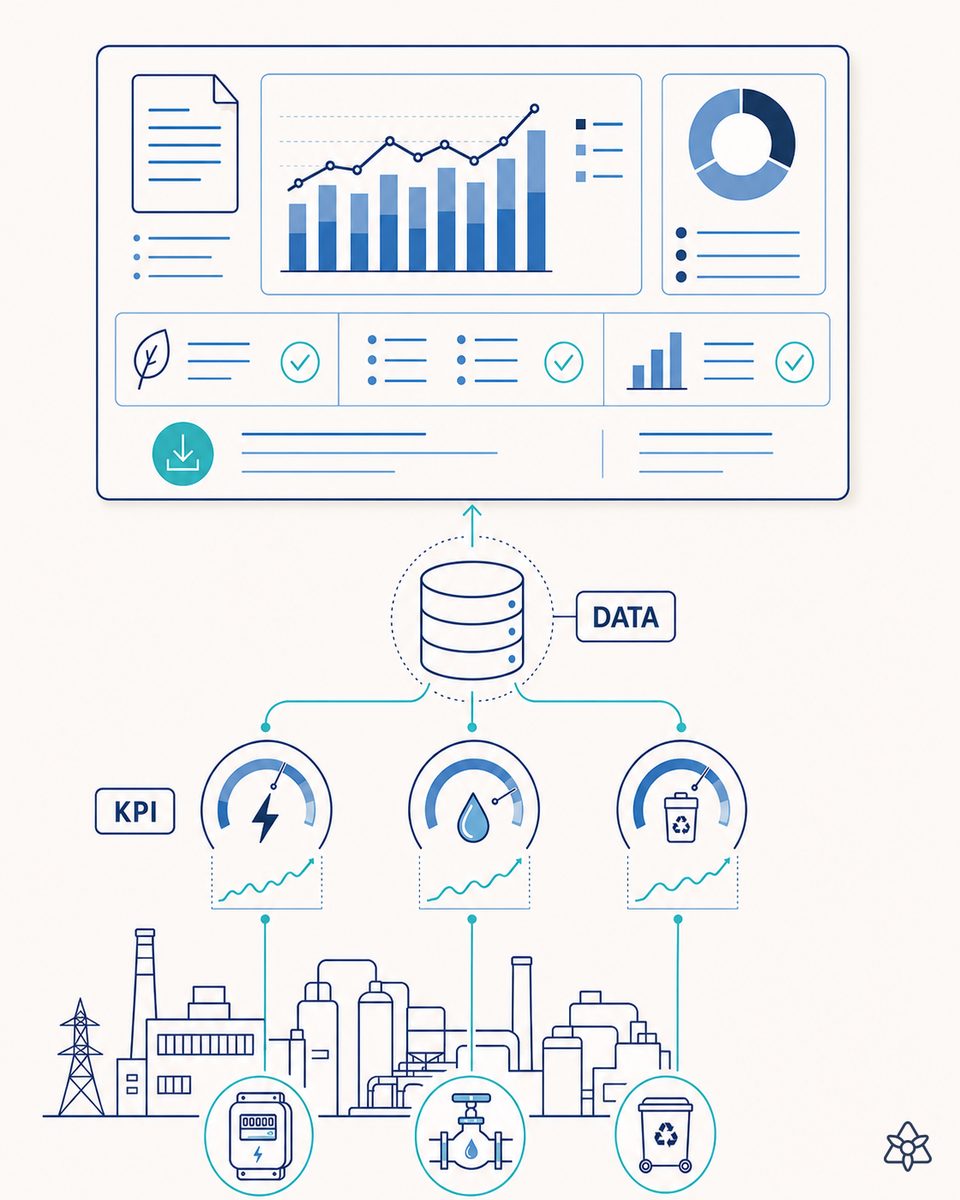
The circular product sells; the dossier is held up by hand.
Circular economy in petrochemicals stops being a slogan the moment the customer (a packaging manufacturer, an FMCG brand) demands product certified with recycled content by mass balance. From then on, everything is traceability. And cradle-to-cradle traceability is propped up today on three wobbly legs:
- The inputs — plastic waste, pyrolysis oil, the supplier invoice with its certificate and its circularity factor. In the ERP, yes, but with the key data (kg of pyrolysis-derived material, % recycled, attached certificate) buried in a PDF hanging off the supplier record.
- The operation — what got cracked, what got blended with what, which batch came out when. In the SCADA, in the MES, in the plant manager's head.
- The outputs — product sold with recycled-content attribution to the customer. In a spreadsheet the sustainability manager keeps alive by sheer will, with macros that break every time the ERP changes anything.
When the ISCC PLUS audit arrives, the sustainability manager asks for two weeks to reconstruct the month. When the customer wants more certificate than can be attributed, somebody has to say no — or explain why yes. The classic system works 99% of the time. That 1% is what you lose in the audit — or worse, what goes undetected until a customer discovers it.
iLEAN does not rewrite the ERP — it keeps the mass balance alive across what you already have.
The circularity problem is not a lack of data: it is data on four separate islands (ERP, SCADA, LIMS, supplier certificate) that only get cross-referenced by hand and only when somebody has time. iLEAN acts as the putty that covers the cracks between all four, without asking you to change any of them.
Connect captures invoices, certificates, operations and supplier emails at second zero. The agent keeps the balance alive, builds the ISCC PLUS dossier and alerts when the commitment to the customer drifts from reality. The person signs — the three rings guarantee integrity.
The three iLEAN pieces applied to the petrochemical circular economy:
- Connect — captures the supplier invoice and certificate (PDF, EDI, email), SCADA data from the cracker / pyrolysis unit, LIMS analyses, and the customer specification. And it also captures what comes from outside (a regulatory change, a new retailer requirement, a new circularity factor published by ISCC) through its native channel.
- Agent — keeps the mass balance alive batch by batch. It cross-references inputs, conversions and outputs, computes the attributable % of recycled content, alerts when the commitment to the customer exceeds what is available, and builds the continuous ISCC PLUS dossier. The sustainability manager goes from building spreadsheets to reviewing the proposal.
- Three safety rings — plant operation stays in ring 1 (critical OT, no Internet); inference and capture in ring 3 (high speed); the mass-balance decisions that count for audit pass through ring 2 (validation chamber) and are cryptographically signed. A person signs every critical step — the AI Act requires it and the architecture enables it.
Manual mass balance vs. a living mass balance with iLEAN
| Aspect | Classic mass balance | With iLEAN Connect + Agent |
|---|---|---|
| Supplier certificate capture | PDF on file, manual download | Automatic capture, circularity factor read out |
| Conversion in the plant | Month-end reconciliation against SCADA | Batch by batch, in the moment |
| Attribution to the customer | Sustainability manager's spreadsheet | Agent calculation with cradle-to-cradle traceability |
| Over-commitment warning | Discovered when delivery is no longer possible | Agent alert before promising the customer |
| ISCC PLUS dossier | Two weeks before every audit | Ready at month-end, signed by the person |
| Integrity and immutability | Trust in the chain of spreadsheets | Ring-signed JSON, revocable per plant |
Impact estimate for your plant — to be validated with your numbers.
The block below is an estimate to be validated with the specific data of your plant. We put it forward so the committee has an order of magnitude; we refine it during the diagnostic.
- Petrochemical plant with pyrolysis-derived / mechanically recycled streams integrated into an existing cracker, ISCC PLUS certification running or planned, several customers with recycled-content declarations.
- Connect + Agent pilot on inbound certificate capture and the batch-by-batch mass balance, starting with the top-priority customer. First value expected within a few weeks: the monthly dossier comes out on its own with the latest month's data.
- Indicative payback between 4 and 9 months, depending on today's price gap between virgin product and certified circular product, and on the current cost of keeping the mass balance by hand (dedicated FTEs, repeated audits, lost sales windows).
- Reasonable reduction to expect: ≥30% in person-hours spent sustaining the mass balance, and practical elimination of the risk of unintentional over-commitment to the customer.
The sustainability director's reasonable doubt
"What if the AI misattributes an invoice and the auditor catches it?" — hallucination is a problem of free generation, not of anchored tasks. Extracting a circularity factor from a PDF, adding up inputs and outputs and reconciling a mass balance are tasks anchored in verifiable data; on them the best models brought error below 1.5% [1]. And even so: what counts for audit is not decided by the AI — it is decided by the person, on a proposal cryptographically signed by the corresponding ring. Full traceability, human responsibility, technical integrity.
[1] OpenAI paper "Why Language Models Hallucinate", 2025 — on the reliability of AI in anchored tasks.
What people ask about the petrochemical circular economy with AI
What is the ISCC PLUS mass balance and why is it so hard to sustain?
The ISCC PLUS mass balance lets you attribute recycled/circular content to a finished product when the chains physically mix (for example virgin polymer with polymer from chemical pyrolysis). The scheme allows a petrochemical plant to offer "certified circular" product without physically separating every stream. It is hard because it demands strict traceability of inputs, conversions and outputs month by month, with dossiers the ERP was never designed to hold. iLEAN Connect captures invoices, delivery notes, certificates of origin and operating data; an agent keeps the balance alive and builds the audit dossier.
How do you trace recycled content cradle-to-cradle?
By cross-referencing what comes in (plastic waste, pyrolysis oil, the supplier certificate with its circularity factor), what happens in the plant (cracker operation, blends, batches) and what goes out (product sold with its recycled-content attribution). In most plants those three flows live in different systems: the ERP handles the invoices; the SCADA, the operation; the LIMS, the analyses; and a spreadsheet kept by the sustainability manager holds the balance by hand. iLEAN joins all four and leaves cradle-to-cradle traceability as a natural byproduct, not as extra effort.
How is AI put to work in waste valorization?
Through three levers: fast characterization of incoming waste by vision and NIR (what comes in and in what proportion); cracker / pyrolysis optimization based on the real mix, not the nominal one; and agent-orchestrated matching of waste streams with plants that can valorize them. All three are jobs done by hand today — and done badly; agents do them continuously and well — and leave the person the decision, not the plumbing of joining the data.
Does it comply with the AI Act and European circularity regulation?
Yes, and by design. iLEAN is built on the three safety rings: the isolated OT network, an intermediate validation chamber, and an outer ring where the AI infers and proposes. The decisions that count for audit (recycled-content attribution, circular product declaration) are always signed by a person; the system enables it by architecture. That fits the European AI Act (human oversight for high-risk AI) and the traceability demanded by ISCC PLUS or the upcoming Packaging and Packaging Waste Regulation.
Can you start without throwing out the ERP or the LIMS?
Yes — it is the only sensible way. iLEAN does not replace the ERP, the LIMS or the SCADA — it sits on top and fills the cracks between them. iLEAN Connect captures the invoice, delivery note, certificate, operating data and supplier email at second zero, whatever format they arrive in. An agent keeps the mass balance alive and builds the ISCC PLUS dossier as it goes. First value arrives within a few weeks and the tools you already paid for keep working.
More cases in petrochemical
- Multiproduct campaign changeover with AI — a badly executed changeover is not a delay, it is cross-contamination.iLEAN coordinates campaign changeover on a multiproduct reactor: verified cleaning plus the next recipe…
- NPK fertilizer control with AI — an off-grade bag is not an incident, it is a fine and a lost customer.How iLEAN cross-checks N-P-K dosing, particle size and moisture in line with the customer spec to avoid…
- PET, PE and PVC extrusion with AI — the drift that reaches the customer when there are already 8 hours of bad reel.How iLEAN cross-references screw response, masterbatch batch, moisture drift and gel/band vision to hold…
- Petrochemical plant OEE with AI — an OEE that has been dressed up is an OEE you cannot attack.iLEAN calculates real petrochemical OEE by combining availability, yield and quality, and breaks the…
- Polymer quality on the extrusion line with AI — an out-of-spec MFI at the end of the roll is a lost roll.iLEAN combines online MFI and AI vision of the extruded product to correct the extruder before the…
- Prestressed concrete with AI — the beam that leaves with a strand at 1,510 when it should have been 1,560 is invisible until it reaches the site.How iLEAN cross-references strand tension, concrete mix design and curing so the prestressed beam leaves…
Tell us your case and in 48h we'll send you the estimated ROI of this AI project for your circular plant.
We work on your plant's real data, not ours. Diagnostic with no commitment.
Request estimated ROI in 48h See petrochemical