Resin arrives fully traced from the dock, with no ERP keying
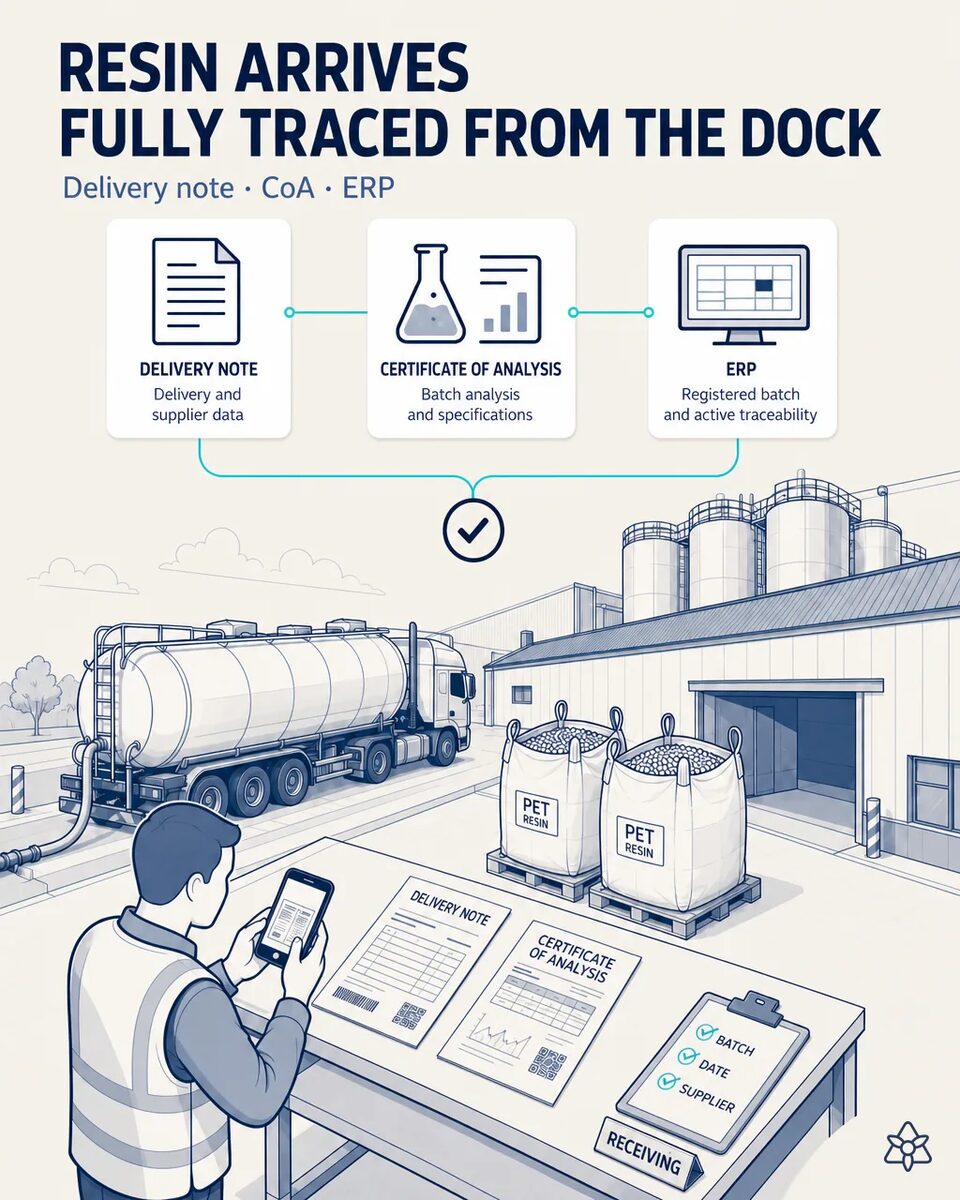
The truck arrives with resin — virgin, recycled or blend — and the receiving supervisor has the delivery note, the batch certificate of analysis and the labels on every big bag or octabin in front of him. He has to sign and then key it line by line into the ERP: either the carrier waits and charges demurrage, or it gets keyed fast and the batch is badly linked. With iLEAN Connect, two photos and one tap are enough for it all to enter the ERP with complete traceability.
Resin is 60-70 % of the cost, and its traceability rests on typing.
Resin receiving is the origin of all traceability in a PET plant, and today it is a manual bottleneck. Resin represents between sixty and seventy per cent of product cost: if the batch is not properly linked to the silo, and the silo to production, the plant's material balance can never be closed. The conflict is one of timing. Keying it properly means an hour of ERP work with the truck on the dock; keying it fast produces badly linked batches that resurface weeks later, when a bottler complains and somebody has to say which silo that bottle came out of. With recycled resin blends the problem gets worse. To stand behind the recycled content declaration handed to the customer you need to know exactly which batch went into which silo and in what proportion. Today that rests on spreadsheets and good faith. On top of that, the supplier's certificate of analysis — declaring intrinsic viscosity, moisture, acetaldehyde and color — is filed away and never looked at again, when it is precisely the data that would explain half a dozen process incidents.
- Resin receiving is the origin of the plant's entire traceability, and today it is a manual bottleneck.
- If the lot is not properly linked to the silo, and the silo to production, the plant's material balance can never be closed.
- The conflict is about time: capturing properly takes an hour in the ERP with the truck at the dock; capturing fast produces badly linked lots.
- And the failure reappears weeks later, when a bottler raises a complaint and the trail leads nowhere.
Connect in photo mode — delivery note, certificate and package labels.
Connect, "photo of the analogue" mode with posting to the ERP. Step by step:
The certificate of analysis stops being a loose PDF: its declared values — intrinsic viscosity, moisture, acetaldehyde, color and recycled content — end up tied to the lot, and transitively to everything made from it.
- Photo of the delivery note. Vision AI recognises each supplier's format without asking them to change it, and extracts the tabular structure: supplier, reference, quantity, batch.
- Photo of the certificate of analysis. The declared values are extracted: intrinsic viscosity, moisture, acetaldehyde, color and recycled content.
- Unit label reading. GS1-128, QR, barcode or plain OCR on every big bag or octabin.
- Early human verification. The receiving supervisor validates the summary with one tap on the industrial tablet.
- Posting to the ERP. Everything enters via API, with the resin batch linked to its destination silo.
- Available downstream. The certificate stops being filed paper and becomes structured data, cross-referenceable with lab tests and drying conditions.
Today's receiving versus captured receiving
| Aspect | Today | With iLEAN Connect |
|---|---|---|
| Receiving blocked | 45-60 minutes | 5-10 minutes |
| Carrier demurrage | Recurring | Eliminated |
| Lot → silo → pallet linking | Partial and manual | Complete and automatic |
| Certificate of analysis | A PDF in a folder | Values tied to the lot |
| Material balance | Cannot be closed | Closable, because the origin is properly tied |
| Receiving and warehouse licenses | Two or three | One, the supervisor who validates |
Estimated impact — to validate with your own numbers.
The block below is an estimate to be validated against your plant's actual data. We put it forward so the committee has an order of magnitude; we refine it during the assessment.
- 💰 CFO angle: the receiving and warehouse module typically requires two or three active licenses. With Connect only the supervisor validates, without entering the ERP: typical 50-70 % reduction in recurring licenses.
- From 45-60 minutes of dock blockage to 5-10, trailer after trailer.
- Carrier demurrage eliminated.
- And the enabler of the flagship case: without the resin lot properly linked to the silo, the material balance never closes.
CFO angle — direct ERP license savings. The receiving and warehouse module typically requires two or three active licences (receiving supervisor, support and manager). With Connect only the supervisor validates, without entering the ERP. Typical reduction of 50-70% in receiving/warehouse module licences, plus the removal of bulk data capture module costs. Estimated payback 3-8 months, combining licences, avoided demurrage and freed-up receiving time. *Estimate to be validated.*
And the fair question from the production manager
«Does it recognize every supplier's delivery note?» — yes, and without asking any of them to change theirs: the model extracts the table structure with no need for a per-supplier template. Package labels are read by standard symbology where present and flat optical recognition where not. It is an anchored task, where the best models drop below 1.5% error [1], and the receiving supervisor validates the summary before anything enters.
[1] OpenAI paper "Why Language Models Hallucinate", 2025 — on the reliability of AI in anchored tasks.
What people ask about digitizing resin receiving
Does it work for virgin, recycled and blended resin?
Yes, and telling them apart is part of the value: the recycled percentage declared on the certificate ends up tied to the lot, which is what later supports the recycled content declaration on the pallet.
Is the certificate of analysis read?
Yes, and it is the part that adds most: intrinsic viscosity, moisture, acetaldehyde, color and recycled content become structured values rather than a PDF nobody opens.
What about big-bag or octabin labels?
They are read by standard symbology when present — GS1-128, QR, barcode — and by flat optical recognition when printed without it.
What if the delivery note and labels disagree?
The discrepancy is highlighted in the summary before the receiving supervisor validates. Today nobody does that cross-check with a trailer waiting.
Is it a prerequisite for the resin balance case?
Yes, it is its foundation. Without the lot properly linked to the silo from the dock, the material balance cannot be closed however well the rest of the plant is instrumented.
More cases from this series
- The audit is always ready, with nothing rebuilt by handEvery critical change and every batch generates its evidence. Agents organises it by standard and…
- Zero grams lost: the resin balance, live, from silo to palletFour coordinated rings close the balance between resin kilos entering through the silo and thousands of…
- The blow molder start-up recipe, captured in one photoThe blow molder set-up sheet, captured by photo: the batch's real recipe enters the system at second…
- The order changes by email and the plan rebuilds itselfiLEAN reads the schedule-change email or WhatsApp, cross-checks it against the live plan and silo…
- The shift lead dictates without stopping his walk through the plantThe shift lead dictates issues while walking between injection and blow molding. iLEAN structures each…
- The PET lab reaches the ERP without a single retyped figureiLEAN reads the PET test sheet as it is saved and, after validation, posts it to the ERP. Typical 50-80%…
Tell us how long it takes today to book in a resin trailer.
We work on your plant's real data, not ours. Assessment with no commitment.
Request estimated ROI within 48h ‹ See all cases of PET packaging See packaging