The PET lab reaches the ERP without a single retyped figure
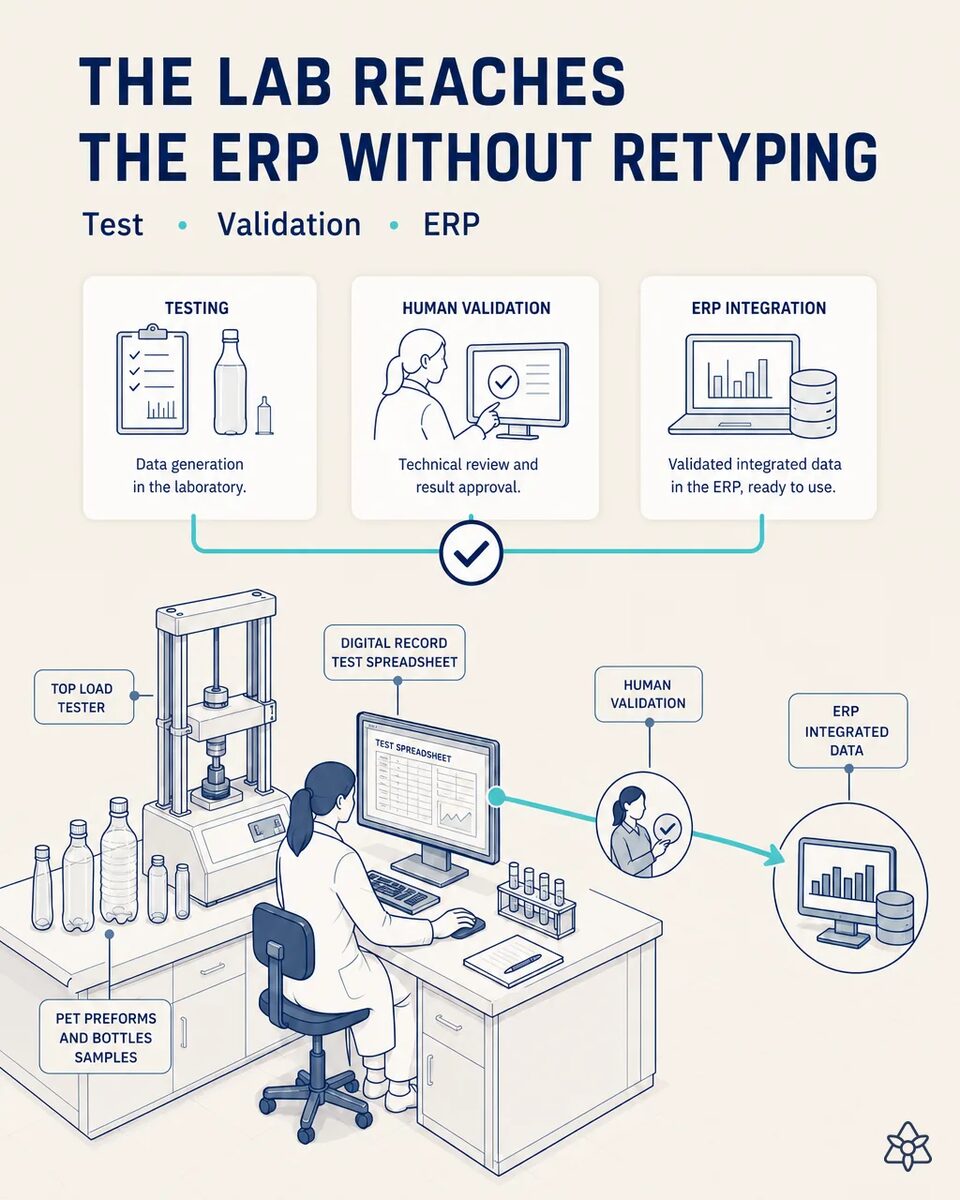
In a PET packaging plant the lab decides: intrinsic viscosity, residual acetaldehyde, resin moisture, weight, top load, environmental stress crack resistance, perpendicularity, wall thickness distribution, color and recycled content. Release or hold comes out of there. And that lab works in a spreadsheet the ERP never sees, with a gap that can reach thirty days. iLEAN Connect reads the sheet when it is saved and, after human validation, posts it to the ERP via API.
The ERP returns an old snapshot of the plant's quality state.
Two parallel worlds coexist. The real spreadsheet, in a shared folder, holding the live data on which decisions are actually made. And the official ERP, with retyped, late data and copy-paste errors. The visible cost is time: roughly half a person-day a month keying into the ERP what was already written. The invisible cost is worse: throughout that gap, any query to the ERP returns an old snapshot of the plant's quality status. And when the bottler challenges a batch, traceability has to be rebuilt by hand across both worlds, copy-paste errors included. That is not quality work, it is documentary archaeology — and it is exactly where the gaps an auditor raises as non-conformities appear.
- The laboratory decides: intrinsic viscosity, residual acetaldehyde, resin moisture, weight, top load, environmental stress crack resistance, perpendicularity, thickness distribution, color and recycled content. Release or block comes out of that.
- And it works in a spreadsheet the ERP cannot see, with a gap that can reach thirty days.
- The visible cost is half a day a month of somebody typing into the ERP what was already written.
- The invisible one is worse: during that gap, any ERP query returns an old picture. And when a bottler raises a complaint, traceability has to be rebuilt by cross-referencing by hand.
Connect in inward listening mode — the folder, not the person.
Connect, "listen inward" mode. iLEAN observes the shared folder — the folder, not the person — and reads the file when it is saved. Step by step:
Only the delta is read: what is new since the previous reading. The whole sheet is not reprocessed each time, which is what makes the case viable on files that have been growing for years.
- Change detection. When the sheet is saved, only the delta is read: what is new since the previous reading.
- Grounded parsing. A grounded language model interprets the sheet's structure — columns, units, merged cells, margin notes — without requiring the lab to change its format.
- Early human verification. The summary is presented to the quality manager, who validates or corrects.
- Posting to the ERP. After sign-off, results enter the ERP via API, tied to the corresponding batch.
- Cross-reference. Test results are linked to the resin batch and its certificate of analysis, to drying conditions read off the panel, and to the real start-up recipe.
The lab technician carries on working exactly as before.
Today's laboratory versus the connected laboratory
| Aspect | Today | With iLEAN Connect |
|---|---|---|
| Gap between real data and ERP | Up to 30 days | Second zero |
| Manual transcription | Half a day a month | Zero |
| Batch release | Decided on stale data | Decided on live data |
| A bottler complaint | Manual cross-referencing of sources | Traceability already cross-referenced |
| Sheet format | Has to be respected | Tolerated as is: columns, units, margin notes |
| Quality module licenses | Five | One, the supervisor who validates |
Estimated impact — to validate against your actual invoice.
The block below is an estimate to be validated against your plant's actual data. We put it forward so the committee has an order of magnitude; we refine it during the assessment.
- 💰 CFO angle: the ERP bills per active user. If five laboratory people log in purely to capture test results, with Connect only the validating supervisor does: typical 50-80 % reduction in recurring licenses.
- Half a day a month of staff recovered.
- From up to 30 days of gap between the real figure and the official one, down to second zero.
- Batch release decided on live data instead of on an old picture.
CFO angle — direct ERP license savings. The ERP bills per active user. If five lab staff log into the ERP purely to key in test results, that is five licences; with Connect only the manager who validates needs to go in. Typical reduction of 50-80% in quality/lab module licences, recurring every year. Estimated payback 4-9 months, combining license savings with the half day a month of retyping. *Estimate to be validated* against last year's ERP invoice.
And the fair question from the production manager
«Different people have been changing that sheet for years — does it hold up?» — that is exactly the anticipated case: parsing does not depend on fixed positions, it interprets columns, units, merged cells and margin notes without requiring anyone to standardize anything. It is an anchored task, where the best models drop below 1.5% error [1], and the quality supervisor validates before the push.
[1] OpenAI paper "Why Language Models Hallucinate", 2025 — on the reliability of AI in anchored tasks.
What people ask about connecting the laboratory
Do we have to standardize the sheet?
No, and it is better not to. Asking the laboratory to change its sheet is the fast route to the system going unused. iLEAN reads the one that exists, in the format it has today.
Does it read the whole sheet every time?
No, only the delta: what is new since the last reading. That is what makes the case viable on files that have been accumulating records for years.
What about tests that take days, like stress crack resistance?
They enter when the analyst saves the result. What changes is not the duration of the test, it is the time between the result and its availability in the system.
Can licenses really be reduced?
It depends on your contract, which is why it is framed as an estimate to validate against last year's invoice. The logic is that anyone logging in purely to type stops needing to.
Does it watch the person?
No: it watches the folder and reacts when the file is saved. There is no tracking of who opens what or how long they spend on it.
More cases from this series
- The audit is always ready, with nothing rebuilt by handEvery critical change and every batch generates its evidence. Agents organises it by standard and…
- Zero grams lost: the resin balance, live, from silo to palletFour coordinated rings close the balance between resin kilos entering through the silo and thousands of…
- The blow molder start-up recipe, captured in one photoThe blow molder set-up sheet, captured by photo: the batch's real recipe enters the system at second…
- The order changes by email and the plan rebuilds itselfiLEAN reads the schedule-change email or WhatsApp, cross-checks it against the live plan and silo…
- The shift lead dictates without stopping his walk through the plantThe shift lead dictates issues while walking between injection and blow molding. iLEAN structures each…
- The pallet is labeled from the order, with no keying in betweenThe print-and-apply unit already has an API but sits isolated. Connect stitches it to the ERP:…
Tell us how many days behind your ERP your laboratory runs today.
We work on your plant's real data, not ours. Assessment with no commitment.
Request estimated ROI within 48h ‹ See all cases of PET packaging See packaging