The order changes by email and the plan rebuilds itself
A PET packaging plant does not sell to consumers: it sells to bottlers and fillers, and those customers change the schedule at short notice. The change does not come in through the ERP, it lands in one person's inbox and gets read when they can. By then molds are mounted and the shift is scheduled against a plan that no longer exists. With iLEAN Connect in chaotic-sources mode, the system is copied in from second zero and hands the planner a concrete resequence, not a notification that an email arrived.
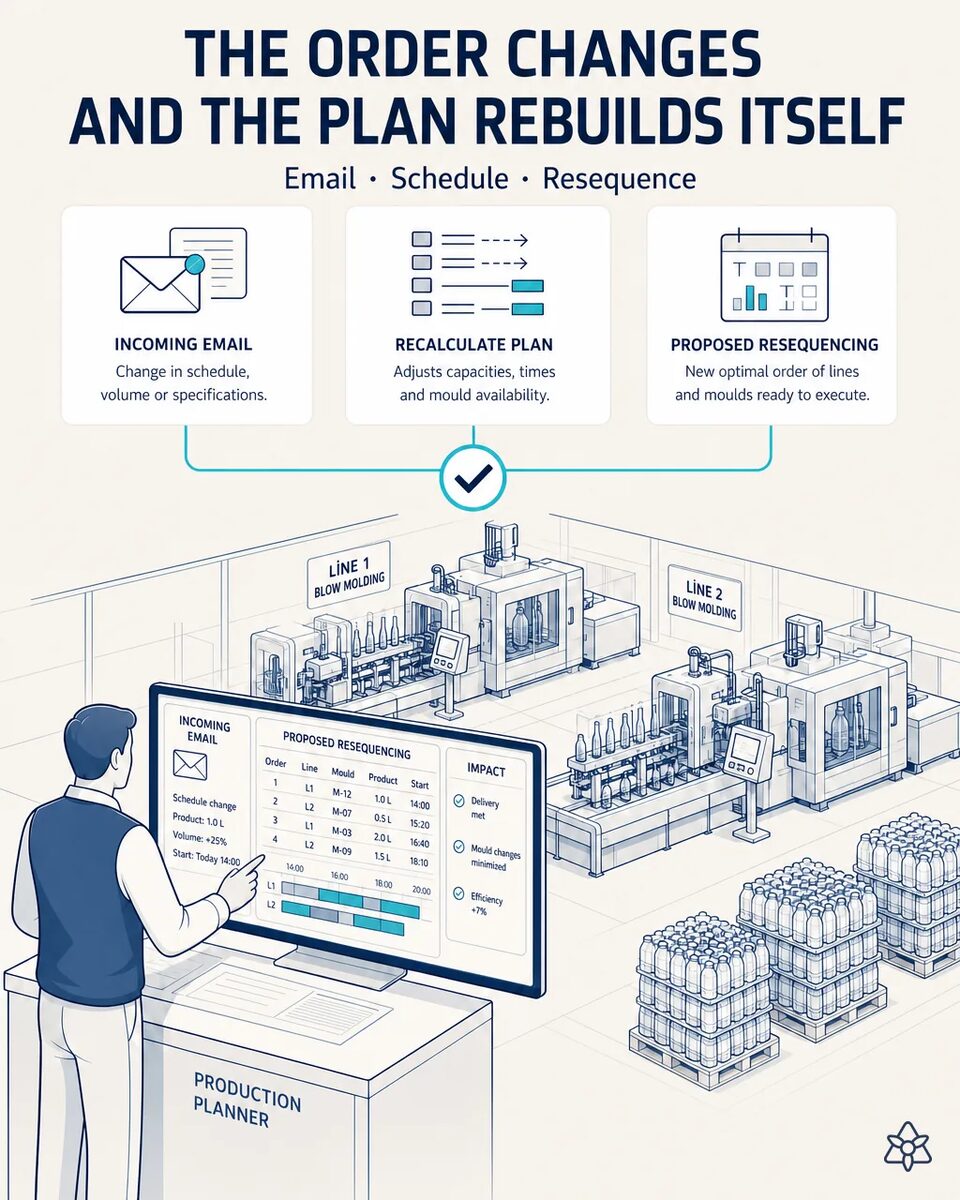
What breaks the plan never arrives structured.
The information that breaks a converting plant's plan almost never arrives structured. It arrives as an email from the bottler pulling four hundred pallets of a water format forward and pushing a soft drink format back. As a notice that the resin tanker is delayed. As a raw material price update. Each of those messages lands in the inbox of someone who cannot watch it in real time. Typical human latency is two to four hours. In that window decisions get made — mounting a mold, starting an order — that then have to be undone. The cost takes two very concrete forms: a mold change that was not needed, with its hours of availability and its kilos to regrind, or a line standing idle waiting for resin that has not arrived. It is exactly the pain any plant describes when it coordinates several lines at once with a high reference mix.
- It arrives as an email pulling in four hundred pallets of a water format and pushing out a soft drink one. As a notice that the resin tanker is delayed. As a raw material price update.
- Each of them lands in the inbox of a person who cannot watch it in real time.
- Typical human latency is two to four hours, and in that window a mold gets mounted and an order started that later has to be undone.
- A converting plant does not sell to consumers: it sells to bottlers and fillers who change the schedule at short notice. That is the norm, not the exception.
Connect in chaotic-sources mode — on corporate order channels.
Connect, "chaotic sources" mode. The corporate order inbox and the WhatsApp Business number are silently copied in around the clock. These are corporate ordering channels, not anybody's private conversations. Step by step:
The corporate order mailbox and the company messaging number are order channels, not private conversations. That distinction is what makes the case acceptable to the team and sustainable over time.
- Listening. The message is processed at second zero, without depending on somebody opening the inbox.
- Intent extraction. The model identifies what it is: a pull-forward, a delay, a format change, a non-conformity or a price change.
- Entity extraction. Customer, reference, quantity, committed date, affected batch.
- Cross-reference with live data. Matched against the ERP production schedule and resin coverage in the silos.
- Concrete proposal. iLEAN returns to the planner which line, which mold, in what order and with what coverage, grouping changes by mold family so format changeovers do not multiply.
- Humans in command. The system proposes; the decision and the sign-off stay with the planner.
Today's order change versus the cross-checked change
| Aspect | Today | With iLEAN Connect |
|---|---|---|
| Latency of a critical alert | 2-4 hours | Seconds |
| Basis for the replan | Yesterday's plan | The live data, with silo coverage |
| Production sequence | Reactive | Grouped by mold and format |
| Mold changes | Made and unmade | The unnecessary ones avoided |
| What you receive | One more email | The concrete resequencing of lines and molds |
| Who decides | The planner | The planner — iLEAN proposes |
Estimated impact — to validate with your own numbers.
The block below is an estimate to be validated against your plant's actual data. We put it forward so the committee has an order of magnitude; we refine it during the assessment.
- Estimated payback 3-7 months, depending on how often the schedule actually changes.
- The main saving is not the person's time: it is the mold changes avoided.
- Line hours not lost waiting for raw material that was already known to be late.
- From replanning against yesterday's plan to replanning against live data, silo coverage included.
Estimated payback 3-7 months, depending on the real frequency of schedule changes. The main saving is not the person's time but the mold changes avoided and the line hours not lost waiting for raw material. *Estimate to be validated* against the last twelve months of schedule changes.
And the fair question from the production manager
«Are you going to read my sales team's email?» — no. iLEAN sits in copy on the corporate order mailbox and the company messaging number: order channels, not private conversations. On extraction, classifying the intent of an order message is an anchored task and the best models drop below 1.5% error [1] — and the resequencing is executed by a person.
[1] OpenAI paper "Why Language Models Hallucinate", 2025 — on the reliability of AI in anchored tasks.
What people ask about reading order changes
Does it tell a pull-in from a delay or a format change?
Yes, that is intent extraction: pull-in, delay, format change, nonconformity or price change. Then it extracts the entities: customer, part number, quantity, committed date and affected lot.
Does it check against the resin in the silo?
Yes, and that is half the value. A pull-in that cannot be served because there is no resin coverage is not an opportunity, it is a problem, and it is worth knowing before moving molds.
Does it replace EDI if we have it?
No. EDI carries the formal order; this case covers the change communicated by hand, which is what breaks the week and what no system reads today.
What about irrelevant messages?
They are discarded without raising an alert. The system only interrupts when crossing the message with the plan produces a concrete action: an alert that over-fires stops being read.
What if the change comes by phone?
That is still not captured this way, and it is worth saying so. It can be logged with the voice mode of the earpiece case, but this case covers written channels.
More cases from this series
- The audit is always ready, with nothing rebuilt by handEvery critical change and every batch generates its evidence. Agents organises it by standard and…
- Zero grams lost: the resin balance, live, from silo to palletFour coordinated rings close the balance between resin kilos entering through the silo and thousands of…
- The blow molder start-up recipe, captured in one photoThe blow molder set-up sheet, captured by photo: the batch's real recipe enters the system at second…
- The shift lead dictates without stopping his walk through the plantThe shift lead dictates issues while walking between injection and blow molding. iLEAN structures each…
- The PET lab reaches the ERP without a single retyped figureiLEAN reads the PET test sheet as it is saved and, after validation, posts it to the ERP. Typical 50-80%…
- The pallet is labeled from the order, with no keying in betweenThe print-and-apply unit already has an API but sits isolated. Connect stitches it to the ERP:…
Tell us how many mold changes you made last month that turned out to be unnecessary.
We work on your plant's real data, not ours. Assessment with no commitment.
Request estimated ROI within 48h ‹ See all cases of PET packaging See packaging