Zero grams lost: the resin balance, live, from silo to pallet
The capital pain of a PET packaging plant is not a one-off incident: it is a slow bleed. Resin is between sixty and seventy per cent of product cost and today nobody can close, live, the balance between the kilos entering through the silo and the thousands of sellable containers leaving through the dock. This case coordinates the eleven previous ones into four rings that close that balance in real time and replan when the order changes.
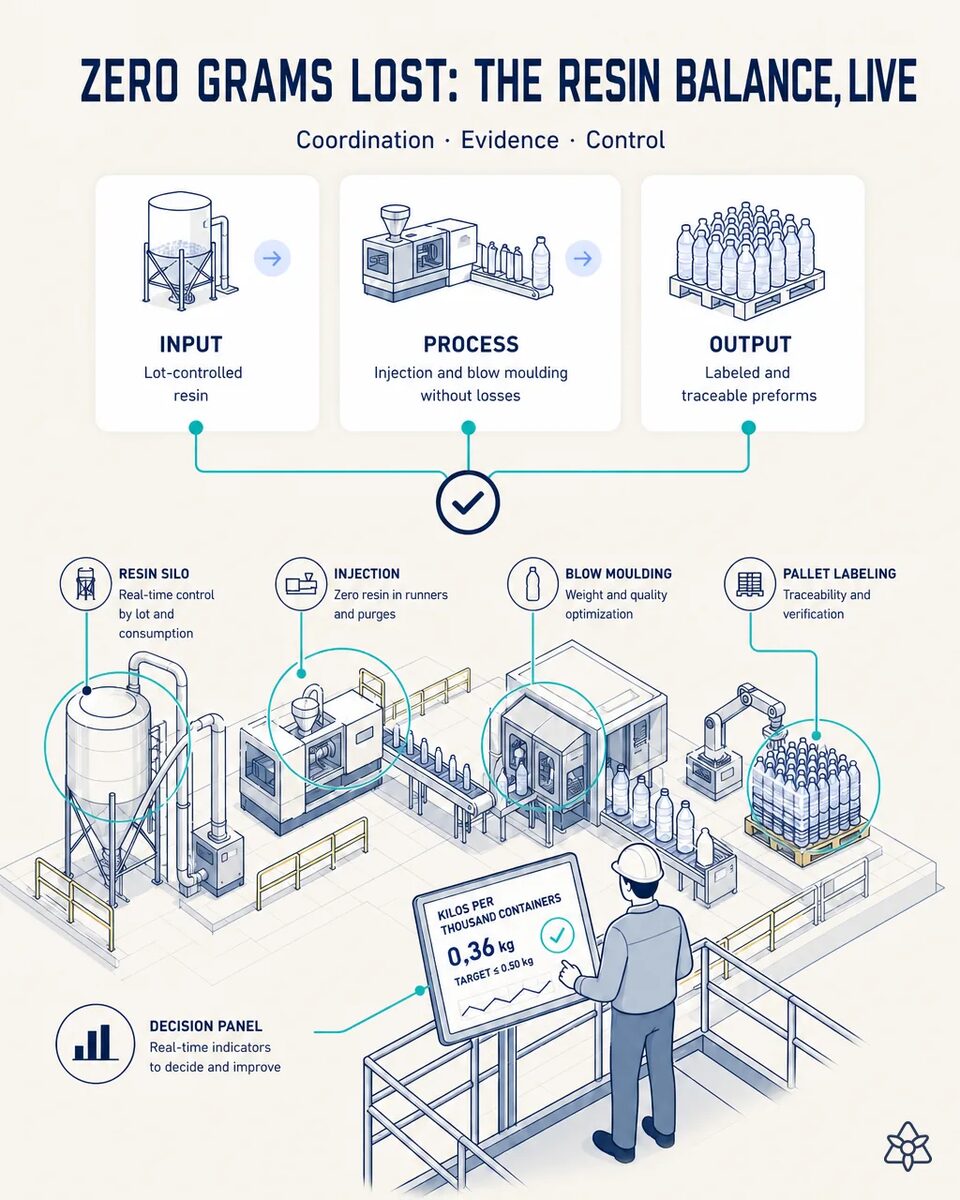
A slow hemorrhage, not a one-off incident.
Four pains that are really one. A resin inventory that is hard to govern, whose availability and consistent quality are a condition of continuous production. A volatile raw material cost that hits profitability directly. Stock levels trapped between the shortage that stops the line and the excess that ties up cash. And multi-line scheduling that breaks every time a customer changes their mind. Everything lost along the way — preform overweight, changeover purge, start-up queue, scrap from defects, held batches — appears aggregated in a month-end settlement, with no root cause and nobody to ask. By then there is nothing left to correct. Overweight deserves a separate mention because it is the quietest of all: one extra gram per bottle, at the scale of a converting plant, is tonnes of resin a year that nobody books as a loss because the product ships conforming.
- Resin is between sixty and seventy percent of the product cost, and today nobody can close live the balance between the kilos entering the silo and the sellable containers leaving the dock.
- Four pains that are really one: resin inventory that is hard to govern, volatile raw material cost, stock caught between the shortage that stops the line and the excess that ties up cash, and multi-line planning that breaks every time a customer changes their mind.
- Everything lost along the way — preform overweight, changeover purging, start-up tail, scrap — is settled at month end, aggregated and with no cause.
- What is settled in aggregate cannot be attacked: there is nobody to attribute it to.
Four rings — no new pieces, it is all of the above orchestrated.
Connect + Edge + Agents + JIDOKA AI + SMED AI, coordinated into four rings. There are no new pieces: it is everything above, orchestrated against the capital pain. Ring 1 — Inlet. Every resin batch enters traced by a photo of the delivery note and the certificate of analysis, with its intrinsic viscosity, its moisture and its recycled content, linked to a specific silo. Drying conditions are read off the panel without touching the equipment. You know what material you have and where it is. Ring 2 — Transformation. The real start-up recipe is recorded; preform and bottle weight is validated inline; the Edge camera attributes every defect to its mold and cavity; the mold change does not start without evidence of a complete purge and weight in window. JIDOKA AI stops the line on a sustained weight deviation. Ring 3 — Outlet. The pallet label prints from the ERP with reference, batch, mold, count and declared recycled content. The kilo that came in through the silo and the container leaving on the pallet are linked end to end. Ring 4 — Decision. Agents cross-references the live balance against the production schedule and the order changes arriving by email or WhatsApp, and proposes which line, which mold, which sequence and which silo coverage. SMED AI groups changeovers by mold family so the resequencing does not eat in changeovers what it gains in service. The audit evidence pack comes out as a by-product. Humans in command. The four rings propose and evidence. Batch release and the replanning decision stay human.
One percentage point of improvement in the ratio of kilos of resin per thousand sellable containers is the largest economic lever a converting plant has. Well above any headcount saving, and that is why it is the capital pain the complete system aims at.
The four rings, and what each one closes
| Ring | Which cases it draws on | What it closes |
|---|---|---|
| 1 · Input | Resin receiving (7) + dryer (2) | Kilos and quality entering, tied to silo and lot |
| 2 · Process | Start-up (1) + laboratory (6) + validation (5) | Real recipe, target weight and signed deviation |
| 3 · Line | Vision (9) + mold changeover (10) | Overweight, scrap and purging, stopped where they happen |
| 4 · Output | Pallet label (8) + evidence pack (11) | Sellable containers counted and traced per pallet |
Estimated impact — to validate with your own numbers.
The block below is an estimate to be validated against your plant's actual data. We put it forward so the committee has an order of magnitude; we refine it during the assessment.
- In a converting plant, one percentage point of improvement in kilos of resin per thousand sellable containers is the largest economic lever that exists, well above any headcount saving.
- From an aggregated monthly settlement to a live figure with root cause by mold, cavity and resin lot.
- Preform overweight: from an invisible loss to a deviation stopped on the line.
- Replanning after a customer change against the real state of silo and line, not against yesterday's plan.
In a PET converting plant, one percentage point of improvement in the ratio of resin kilos per thousand sellable containers is the single largest economic lever there is, far above any headcount saving. Estimated payback 6-12 months. Estimated scrap and purge reduction of at least 30% in the first cycles, plus the OEE points recovered on mold changes and the working capital freed by silo coverage matched to the real schedule. *Estimate to be validated* against the real kilos-per-thousand ratio over the last twelve months.
And the fair question from the production manager
«Do we have to deploy all twelve cases to get the balance?» — no, and framing it that way would be the way never to start. The rings are built in layers and each case pays on its own from the first month. With resin receiving and line start-up you already have all of ring 1 and half of ring 2, which is where half the leak sits, without committing to a long project.
[1] OpenAI paper "Why Language Models Hallucinate", 2025 — on the reliability of AI in anchored tasks.
What people ask about the resin balance
Where do you start?
With ring 1: resin receiving and the dryer. Without the lot properly tied to the silo from the dock, the balance cannot be closed however well the rest of the plant is instrumented.
How accurate is the balance?
As accurate as your measuring points allow. The system does not invent kilos: it crosses what enters, what the recipe declares, what vision rejects and what leaves counted per pallet, and shows where the gap is.
Does it replace the ERP?
No. The ERP remains the system of record; what it lacks today is plant data at the frequency and detail needed to close the balance live.
Does it include preform overweight?
Yes, and it is usually the largest and least visible leak: a few grams per piece multiplied by millions of pieces shows up in no incident report, only in the month-end ratio.
Can the return be estimated before starting?
Yes, and that is what we propose: with your current ratio of kilos per thousand sellable containers and the resin cost, we estimate what each tenth of a point is worth before deciding the order of the layers.
More cases from this series
- The audit is always ready, with nothing rebuilt by handEvery critical change and every batch generates its evidence. Agents organises it by standard and…
- The blow molder start-up recipe, captured in one photoThe blow molder set-up sheet, captured by photo: the batch's real recipe enters the system at second…
- The order changes by email and the plan rebuilds itselfiLEAN reads the schedule-change email or WhatsApp, cross-checks it against the live plan and silo…
- The shift lead dictates without stopping his walk through the plantThe shift lead dictates issues while walking between injection and blow molding. iLEAN structures each…
- The PET lab reaches the ERP without a single retyped figureiLEAN reads the PET test sheet as it is saved and, after validation, posts it to the ERP. Typical 50-80%…
- The pallet is labeled from the order, with no keying in betweenThe print-and-apply unit already has an API but sits isolated. Connect stitches it to the ERP:…
Tell us your current ratio of kilos of resin per thousand sellable containers.
We work on your plant's real data, not ours. Assessment with no commitment.
Request estimated ROI within 48h ‹ See all cases of PET packaging See packaging