The blow molder start-up recipe, captured in one photo
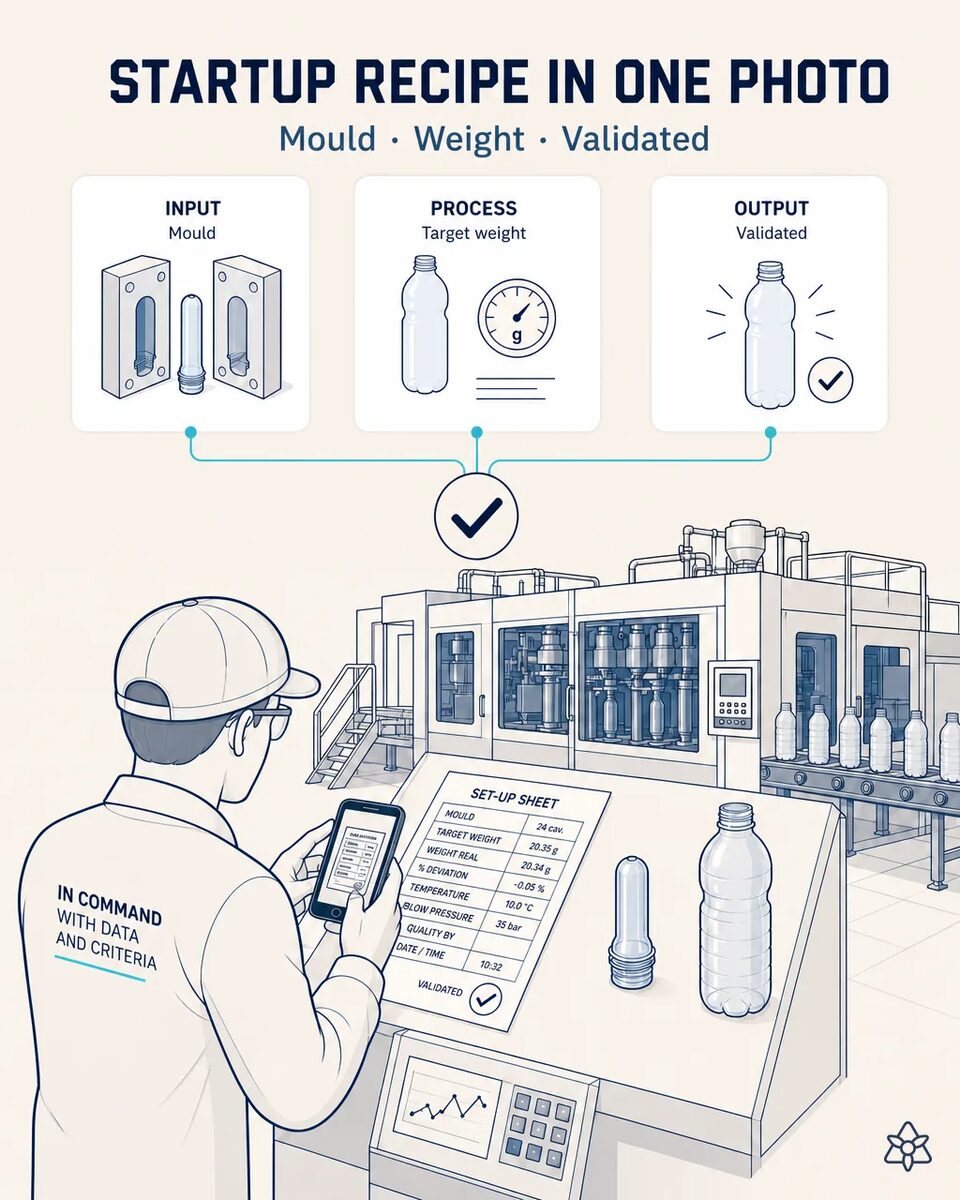
In a PET packaging plant, every changeover starts with a paper set-up sheet: mold and active cavities, oven profile lamp by lamp, pre-blow and blow pressures, stretch rod delay, target weight, resin batch and recycled content. The technician corrects it by hand until the bottle falls inside the window, and that sheet becomes the REAL recipe for the batch — not the theoretical one in the system, but the one that worked that day with that resin. Today it ends up in a binder and next time the setting is hunted from scratch. With iLEAN Connect, one photo at start-up is enough.
The most valuable document of the shift is the worst kept.
The set-up sheet is the most valuable document a PET plant produces in a shift, and the worst preserved. It lives in a binder next to the blow molder or a folder in the production office, handwritten, with crossings-out and margin notes only its author fully understands. The cost does not show up in the accounts, it shows up on the clock. Every time a reference comes round again, the technician gropes for the setting once more: oven profile, pressures, delay. Meanwhile everything coming off the machine goes to regrind. You pay twice — and three and four times — for the same learning. There is a second, slower and more expensive cost: the knowledge is never capitalised. In a group with several plants and new openings, what is not written down cannot be replicated. A new facility starts its learning curve from zero because the mature plant's experience never left the paper.
- The setup sheet ends up being the real recipe of the batch: not the theoretical one in the system, but the one that worked that day with that resin and that recycled content.
- It lives in a folder next to the blow molder or in a drawer in the production office, handwritten, with crossings-out and margin notes only its author understands.
- The cost does not show up in the accounts, it shows up on the clock: every time the part number comes back, the technician gropes for the setting again — oven profile, pressures, stretch delay.
- And meanwhile everything coming off the machine goes to regrind. It is paid twice, and three times, and four.
Connect in photo mode — the technician keeps writing on paper.
Connect, "photo of the analogue" mode. The technician photographs his sheet with a phone or industrial tablet at start-up. Nothing about his routine changes: he keeps writing on paper. Step by step:
The recipe ends up tied to the mold, the resin lot and that day's recycled content. That tie is what turns a sheet of paper into a starting point: next time the part number runs with that blend, the start-up does not begin from zero.
- Capture. A photo of the set-up sheet and, optionally, of the first preform and first bottle of the batch.
- Extraction. A grounded language model recognises the document structure and extracts the fields: mold, active cavities, oven profile, pre-blow and blow pressures, stretch rod delay, target weight, resin batch, recycled content and handwritten notes in the margin.
- Early human verification. The summary appears on the line tablet. The technician confirms with two taps or corrects before the data goes in. Nothing crosses into the central system without a human signature.
- Central memory. The recipe is tied to the mold, the resin batch and the recycled content of that day, and cross-referenced with drying conditions and the lab tests for the same batch.
- Reuse. Next time that format runs, the system proposes the recipe that already worked with an equivalent resin.
Start-up on paper versus start-up captured
| Aspect | Today, on paper | With iLEAN Connect |
|---|---|---|
| Data latency | 4-8 h, or never digitized | Second zero |
| Start-up starting point | Groping from zero | The recipe that already worked |
| Where the knowledge lives | With whoever is on shift | In a queryable history |
| Tied to resin and recycled content | No | Yes, mold by mold and lot by lot |
| Kilos in the start-up tail | To regrind, every time | Shorter with every repetition |
| Technician's routine | — | Unchanged: one photo |
Estimated impact — to validate with your own numbers.
The block below is an estimate to be validated against your plant's actual data. We put it forward so the committee has an order of magnitude; we refine it during the assessment.
- Estimated payback 4-9 months, depending on the number of changeovers per month.
- A shorter start-up tail: kilos of resin that stop going to regrind.
- Less dependence on the specific person who knows how to find the setting.
- From 4-8 hours of latency — or never being digitized — down to second zero.
Estimated payback 4-9 months, depending on how many changeovers run per month. The return arrives two ways: a shorter start-up queue (kilos that stop going to regrind) and reduced dependence on whoever happens to be on shift. *Estimate to be validated* against the plant's real changeover data.
And the fair question from the production manager
«What if it misreads a pressure or an oven profile?» — reading fields from a document with a known structure is an anchored task, where the best models drop below 1.5% error [1]. And there is a second net: the summary appears on the line tablet and the technician confirms with two taps or corrects before the data enters. Nothing crosses unsigned.
[1] OpenAI paper "Why Language Models Hallucinate", 2025 — on the reliability of AI in anchored tasks.
What people ask about digitizing line start-up
Do we have to change the setup sheet?
No, and that is the condition. The sheet is built around that blow molder and how that technician works. Every attempt to replace it with a form ends with the technician writing on paper anyway.
Does it read crossings-out and margin notes?
It interprets them as part of the document structure, and when a field comes back with low confidence it is flagged on the tablet for a person to confirm rather than slipping through.
Does it shorten start-up from day one?
Capture starts on day one; shortening start-up needs the part number to run at least once more with that blend. The value grows with the number of repetitions.
What if the recycled content changes?
That is exactly what makes the capture useful: the recipe is tied to the specific blend, so the history distinguishes the setting that worked at 30 % from the one that worked at 50 %.
Do we need ERP integration?
Not to start. The case runs against iLEAN's central memory and the cross-check with the ERP is connected afterwards, once there is demonstrated value.
More cases from this series
- The audit is always ready, with nothing rebuilt by handEvery critical change and every batch generates its evidence. Agents organises it by standard and…
- Zero grams lost: the resin balance, live, from silo to palletFour coordinated rings close the balance between resin kilos entering through the silo and thousands of…
- The order changes by email and the plan rebuilds itselfiLEAN reads the schedule-change email or WhatsApp, cross-checks it against the live plan and silo…
- The shift lead dictates without stopping his walk through the plantThe shift lead dictates issues while walking between injection and blow molding. iLEAN structures each…
- The PET lab reaches the ERP without a single retyped figureiLEAN reads the PET test sheet as it is saved and, after validation, posts it to the ERP. Typical 50-80%…
- The pallet is labeled from the order, with no keying in betweenThe print-and-apply unit already has an API but sits isolated. Connect stitches it to the ERP:…
Tell us how many kilos go to regrind on every changeover start-up.
We work on your plant's real data, not ours. Assessment with no commitment.
Request estimated ROI within 48h ‹ See all cases of PET packaging See packaging