The audit is always ready, with nothing rebuilt by hand
On food-contact packaging audit day, or the day a customer requests a second party audit, somebody in the plant spends one or two weeks rebuilding the period: which cleaning runs and changeovers happened, which test results came out, which resin batches went into which silo and with what certificate, and how much recycled content there actually was in the pallets declared as such. With iLEAN Edge and Agents, every event generates its evidence as it happens and the auditor downloads the period pack from the portal.
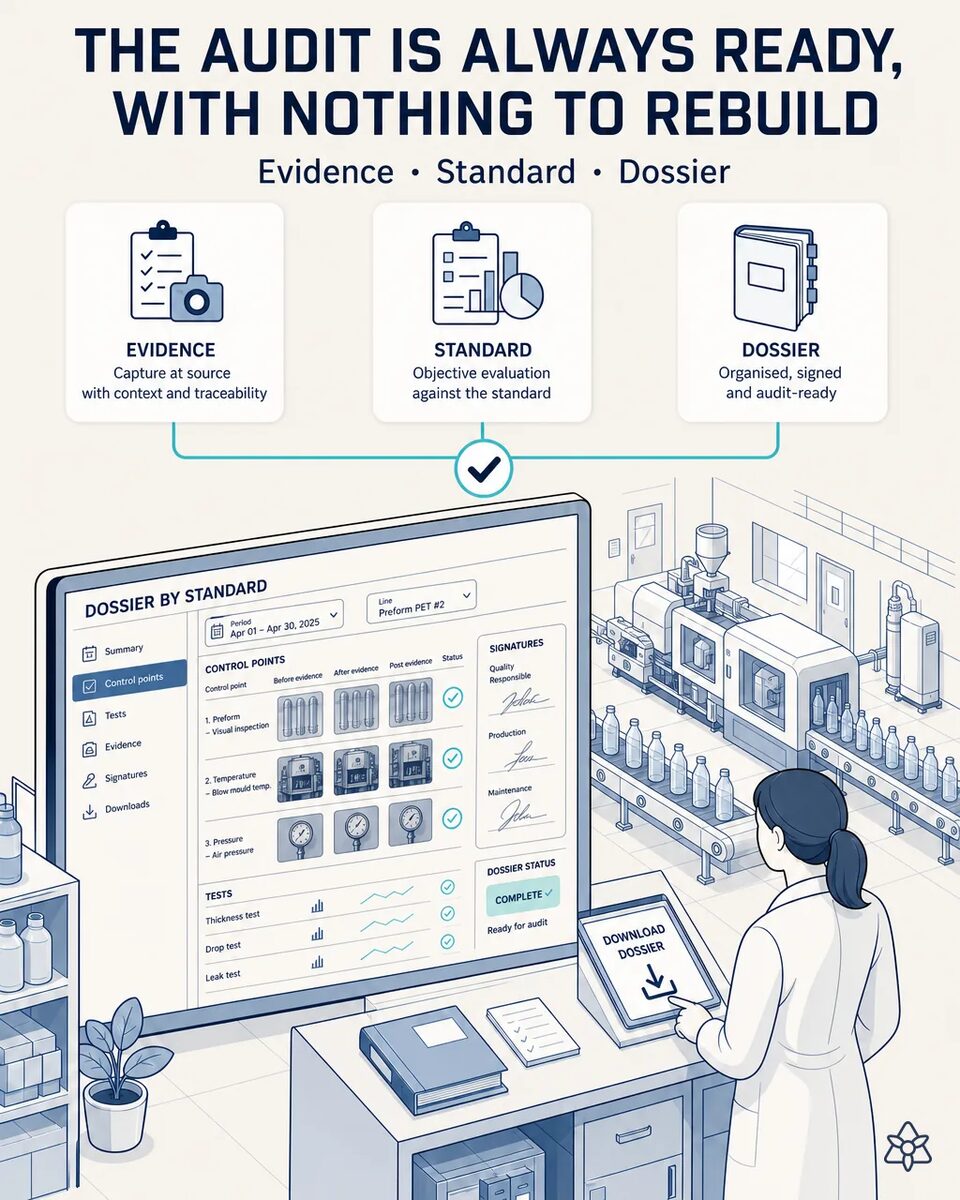
The process does not fail: the ability to prove it does.
The evidence exists: the problem is that it is scattered. Shop floor paper in a binder, lab spreadsheets in a shared folder, emails in personal inboxes, supplier certificates of analysis in another folder. Assembling it is pure reconstruction work, done right before each visit against the clock. It is precisely in that assembly that the gaps appear: the process does not fail, the ability to demonstrate it fails. Non-conformities almost always come out of the documentation, not the operation. On top of the classic requirements of food-contact packaging schemes sits a new and growing one: standing behind the recycled content declaration of the pallets sold as such. That demands a documented chain of custody from the rPET batch received to the container delivered, and today it rests on spreadsheets and good faith. It is the fastest growing documentary gap in the sub-sector.
- The evidence exists, but it is scattered: floor paperwork in a filing cabinet, laboratory sheets in a shared folder, emails in personal inboxes, supplier certificates of analysis in another folder.
- Assembling it is pure reconstruction work, done just before every visit, against the clock.
- It is precisely in that assembly that the gaps appear. Nonconformities almost always come out of the documentation, not the operation.
- And there is a piece specific to this sub-sector: how much recycled content there really was in the pallets declared as such, which is a chain of custody and not a figure on a sheet.
Edge captures, Agents organizes — evidence as a by-product.
Edge captures, Agents organises. Evidence is generated as a by-product of what was already happening: nobody does extra work. Step by step:
Nobody does extra work: the evidence is generated as a by-product of what was already happening. If it asked the plant for additional effort, the pack would be incomplete within three months, just like today's folders.
- Capture at the event. Every critical change generates before and after photos of each control point, timestamped, from the Edge cameras of the mold change case.
- Decision log. Who validated what, when and with what evidence in front of them, from the early human verification on the line tablet.
- Linked data. Lab tests, certificates of analysis for received resin, drying conditions read off the panel and real start-up recipes, all tied to the same batch.
- Organization by standard. Agents structures the material according to the applicable certification scheme and by audited period.
- Complete traceability thread. Resin batch → silo → mold and cavity → pallet → customer, with the declared recycled content at every stage.
- Download by the auditor. The auditor logs into the portal and downloads the period evidence pack. Zero reconstruction by the plant.
Today's preparation versus the permanent evidence pack
| Aspect | Today | With iLEAN Agents |
|---|---|---|
| Preparation before an audit | 1-2 person-weeks | Zero |
| Where the evidence lives | Four different places | Indexed by standard and period |
| Documentation gaps | Appear during reconstruction | Eliminated |
| Recycled content traceability | Spreadsheets | Documented chain of custody |
| Decision log | Does not exist | Who validated what, when and on what evidence |
| An additional customer audit | The work repeats | Same evidence, another view |
Estimated impact — to validate with your own numbers.
The block below is an estimate to be validated against your plant's actual data. We put it forward so the committee has an order of magnitude; we refine it during the assessment.
- Estimated payback 6-12 months, depending on audit frequency and the number of customers who audit.
- Person-weeks of preparation recovered, audit after audit.
- Nonconformity risk from documentation gaps eliminated — and that is where almost all of them come from.
- Protection of the food contact packaging certifications, which is what is really at stake.
Estimated payback 6-12 months, depending on audit frequency and the number of customers that audit. Beyond recovering the person-weeks of preparation, it protects what is really at stake: food-contact packaging certifications are a condition of contract with the big bottlers. Losing one is not a cost, it is losing the customer. *Estimate to be validated.*
And the fair question from the production manager
«Isn't this just another document manager?» — the difference is direction. A document manager stores what somebody decides to upload, after the fact, and inherits the same gaps. Here the evidence is generated on its own at the moment of the event — before and after photos with time stamps, a log of who validated what — and Agents reorganizes it according to whichever scheme asks for it.
[1] OpenAI paper "Why Language Models Hallucinate", 2025 — on the reliability of AI in anchored tasks.
What people ask about the evidence pack
Does it cover recycled content traceability?
Yes, and it is one of the pieces that most justifies the case in this sub-sector: the recycled content declaration is a chain of custody from the supplier certificate to the pallet label, not a figure on a sheet.
Does it serve second-party audits?
Yes. The evidence is the same; what changes is the scheme it is indexed against. That is exactly the work repeated in full for every customer that audits.
What is captured at each critical change?
Before and after photos of each control point with time stamps, from the Edge cameras, plus the log of who validated what and on what evidence.
Do the other cases need to be deployed?
The more there are, the more complete the dossier. With Edge on the changeovers and Connect on laboratory and receiving you already cover the bulk of what is asked for.
What about history from before?
It stays where it is. The pack builds from day one forward; bringing in the history is optional and not a prerequisite to start.
More cases from this series
- Zero grams lost: the resin balance, live, from silo to palletFour coordinated rings close the balance between resin kilos entering through the silo and thousands of…
- The blow molder start-up recipe, captured in one photoThe blow molder set-up sheet, captured by photo: the batch's real recipe enters the system at second…
- The order changes by email and the plan rebuilds itselfiLEAN reads the schedule-change email or WhatsApp, cross-checks it against the live plan and silo…
- The shift lead dictates without stopping his walk through the plantThe shift lead dictates issues while walking between injection and blow molding. iLEAN structures each…
- The PET lab reaches the ERP without a single retyped figureiLEAN reads the PET test sheet as it is saved and, after validation, posts it to the ERP. Typical 50-80%…
- The pallet is labeled from the order, with no keying in betweenThe print-and-apply unit already has an API but sits isolated. Connect stitches it to the ERP:…
Tell us how many person-weeks your last packaging audit cost to prepare.
We work on your plant's real data, not ours. Assessment with no commitment.
Request estimated ROI within 48h ‹ See all cases of PET packaging See packaging