The pallet is labeled from the order, with no keying in between
The pallet label is the last information to leave a PET packaging plant and the first thing the bottler reads on arrival: reference, batch, mold, count, destination customer and declared recycled content. In most plants that print-and-apply unit is already modern and already has an API, but it remains isolated from the ERP and somebody keys the batch into its panel at every changeover. With iLEAN it is stitched to the ERP and what gets printed is what the live order says.
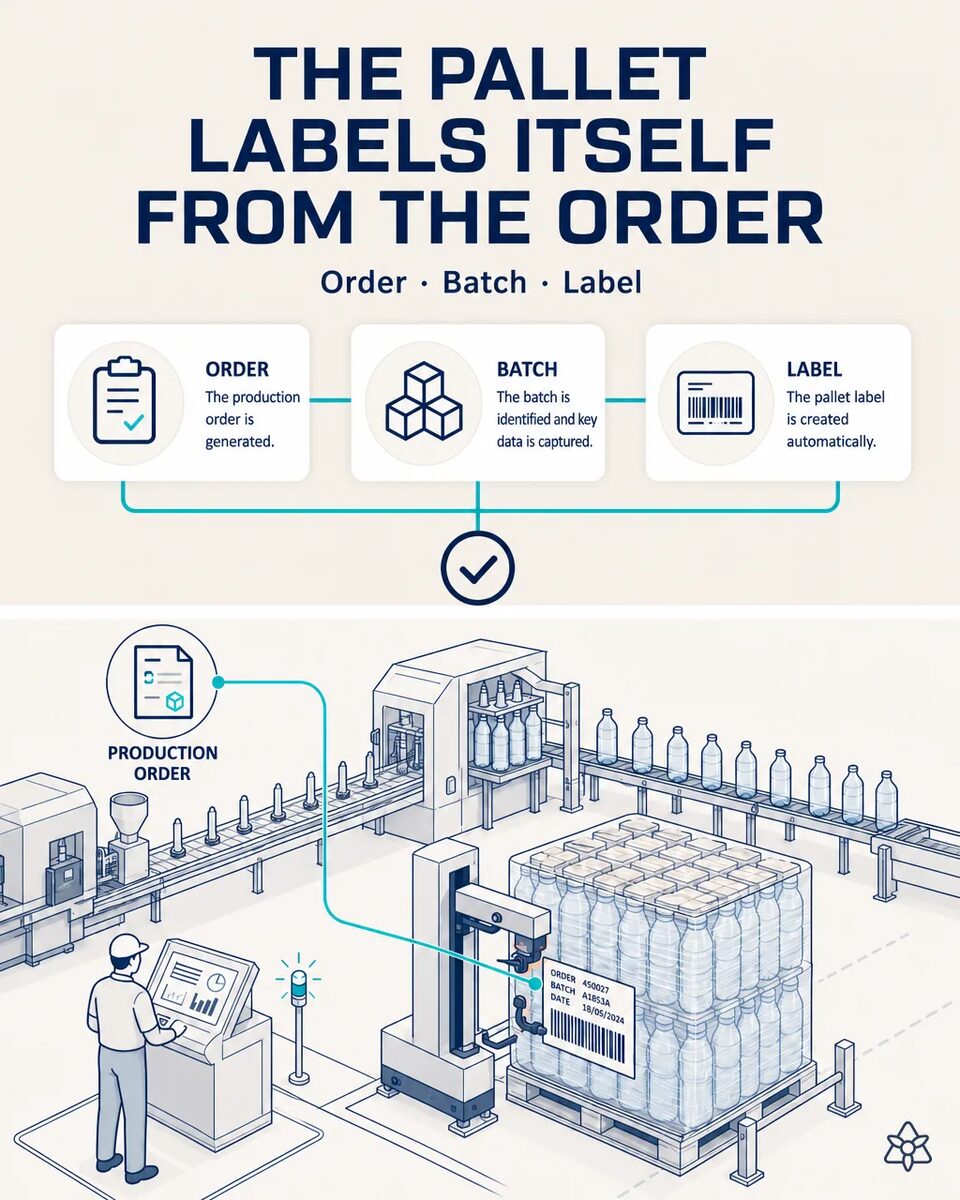
The failure point with the highest consequence per unit of effort.
It is the classic "almost integrated" system. The pallet print-and-apply unit is five or ten years old, has a command interface or an API, and remains disconnected because integrating it properly never becomes the priority over what is urgent. The result is manual keying into the machine panel at every batch change. It is a ten second gesture, and it is the failure point with the greatest consequence per unit of effort in the entire plant. One wrong digit and a whole pallet reaches the customer under the wrong batch. Best case, a return with its transport and its difficult conversation. Worst case, broken traceability: when a quality problem appears you cannot bound which production is affected, and you end up blocking more days than necessary out of caution.
- The pallet label is the last information leaving the plant and the first the bottler reads: part number, lot, mold, count, destination customer and declared recycled content.
- The print-and-apply unit is five or ten years old, has an API, and is still disconnected because integrating it properly never rises above the urgent.
- The result is manual keying on the machine panel at every lot change. It is a ten-second gesture.
- One wrong digit and an entire pallet reaches the customer under the wrong lot — and with it, traceability broken at exactly the point the customer looks at first.
Connect as stitching between two modern systems, through APIs.
Connect as a stitch between two modern systems, over the API. Neither one is replaced. Step by step:
The loop closes with vision: the in-line camera reads the printed label and checks it against the live order. If they disagree, JIDOKA AI stops. Publishing the right data and verifying it was printed are two different things, and here both are covered.
- Trigger from the ERP. When the ERP marks an order as started, it publishes the complete data set.
- Publication to the labeller. Reference, batch, mold and cavities, count per pallet, destination customer and declared recycled content travel to the equipment over the API.
- Printing. The GS1-128 label prints from source data, with no manual intervention. Changing batch becomes a tap in the ERP.
- Closing the loop with Edge. The inline vision camera reads the printed label and checks it against the live order; if they do not match, JIDOKA AI stops the line before the pallet leaves the plant.
- Complete traceability. The pallet is linked to the mold, the resin batch and the lab tests for the period.
The isolated labeler versus the stitched labeler
| Aspect | Today | With iLEAN Connect |
|---|---|---|
| Keystrokes per lot change | One on the machine panel | Zero |
| Typing errors | Several a month | Zero of human origin |
| Returns from mislabeled pallets | Recurring | Sharply reduced |
| Bounding a quality problem | Block as a precaution | Bound by real traceability |
| Declared recycled content | Typed | Travels from the order |
| Verification of what was printed | None | The camera checks it against the order |
Estimated impact — to validate with your own numbers.
The block below is an estimate to be validated against your plant's actual data. We put it forward so the committee has an order of magnitude; we refine it during the assessment.
- Estimated payback 3-6 months — among the fastest in the pool, because the machine already ships an API and the integration effort is low.
- Returns avoided from mislabeled pallets.
- Production days that stop being blocked as a precaution when a quality problem appears.
- From several typing errors a month to zero of human origin.
Estimated payback 3-6 months — among the fastest in the pool, because the integration effort is low (the machine already has an API) and the risk it removes is high. The return concentrates in avoided returns and in production days that stop being blocked out of caution. *Estimate to be validated* against the history of returns and labeling incidents. *Technical note*: if the installed equipment does not offer an open API, the case still holds but requires an intermediate adapter, which raises initial CAPEX somewhat.
And the fair question from the production manager
«If the machine already has an API, why don't we integrate it ourselves?» — you can, and that is the right answer the day the project reaches the top of the list. The problem is that it has not for years, because it competes with the urgent. This stitching replaces neither system and asks for no shutdown window, so it does not join that queue.
[1] OpenAI paper "Why Language Models Hallucinate", 2025 — on the reliability of AI in anchored tasks.
What people ask about the pallet label
Do we have to replace the labeler or the ERP?
Neither. Connect leans on the command interface or API the machine already has and on what the ERP publishes when the order starts.
What data travels?
Part number, lot, mold and cavities, count per pallet, destination customer and declared recycled content. The lot change becomes a tap in the ERP.
Is it verified that the right thing was printed?
Yes, and that is what closes the case: the in-line vision camera reads the printed label and checks it against the live order; if they disagree, JIDOKA AI stops.
Does the same pattern work on other machines?
Yes. Any modern island with an API that is fed by hand today fits the same pattern; you start with the labeler because that is where the error has the most consequence.
What about the declared recycled content?
It travels from the order, which is where it belongs. Typed by hand it is one of the highest-risk data points, because it underpins a declaration with contractual implications.
More cases from this series
- The audit is always ready, with nothing rebuilt by handEvery critical change and every batch generates its evidence. Agents organises it by standard and…
- Zero grams lost: the resin balance, live, from silo to palletFour coordinated rings close the balance between resin kilos entering through the silo and thousands of…
- The blow molder start-up recipe, captured in one photoThe blow molder set-up sheet, captured by photo: the batch's real recipe enters the system at second…
- The order changes by email and the plan rebuilds itselfiLEAN reads the schedule-change email or WhatsApp, cross-checks it against the live plan and silo…
- The shift lead dictates without stopping his walk through the plantThe shift lead dictates issues while walking between injection and blow molding. iLEAN structures each…
- The PET lab reaches the ERP without a single retyped figureiLEAN reads the PET test sheet as it is saved and, after validation, posts it to the ERP. Typical 50-80%…
Tell us how many returns you had last year from a mislabeled pallet.
We work on your plant's real data, not ours. Assessment with no commitment.
Request estimated ROI within 48h ‹ See all cases of PET packaging See packaging