Two plants in the group, finally stitched together
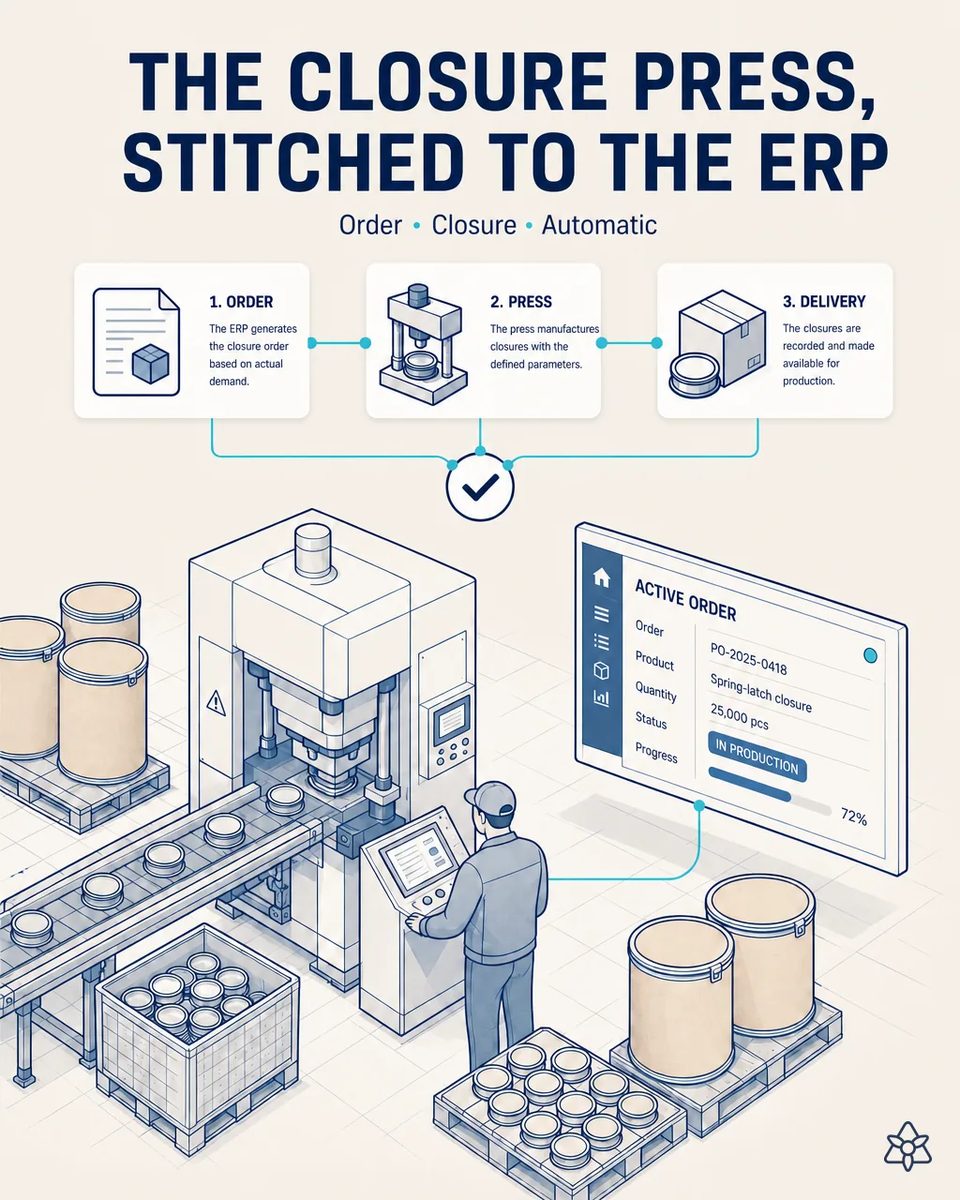
Each drum's spring-latch closure is made on a fairly modern press at the group's sister plant, which has its own API but is isolated from the assembly plant's ERP.
Two plants in the group, connected by phone calls and emails.
Each drum's spring-latch closure is made on a fairly modern press at the group's sister plant, which already has its own API but is isolated from the assembly plant's ERP. Today, when a new order comes in, someone calls or emails to say how many closures of which format are needed and by when — a message that, if lost or late, leaves the assembly line stalled waiting for closures.
- Each drum's spring-latch closure is made on a fairly modern press at the group's sister plant. The closure has to match the drum diameter and the rating of each order.
- That press already has its own API, but it is isolated from the assembly plant's ERP. It is modern enough to integrate; it simply never got to the top of the IT list.
- When a new order comes in, someone calls or emails to say how many closures of which format are needed and by when. The same data already exists in the assembly ERP, typed once more by hand.
- If that message is lost or late, the assembly line stalls waiting for closures — or the wrong format arrives for the drum diameter on the line. Either way, finished drum bodies wait on the floor for a part made somewhere else. The line is ready; the closures are not.
Connect stitches the closure press to the assembly ERP — APIs, not phone calls.
With iLEAN, when the assembly ERP flags an active order, it automatically publishes the required closure format and quantity to the sister plant's press via API. An order change becomes an automatic update, not a phone call.
Neither system is replaced and nobody has to retype an order. When the assembly ERP activates an order, the press at the other plant already knows the format and quantity, and an order change travels the same way instead of waiting for someone to remember to call. The phone call disappears; the decision at each plant stays with its people.
Closure planning between plants today versus stitched by API
| Aspect | Today | With iLEAN Connect |
|---|---|---|
| How the press learns of an order | A phone call or an email | Published from the ERP |
| Closure format for each drum diameter | Repeated by hand | Sent with the order |
| An order change | Another call, if someone remembers | An automatic update |
| Assembly waiting for closures | Recurring stoppages | Planned between plants |
| Wrong closure format delivered | Found at assembly | Prevented at the source |
| Press and ERP | — | Both kept, neither replaced |
Before: closure planning by phone or email, with line stoppages from mismatches. After: automatic planning between plants.
Impact estimate — to be validated with your numbers.
The block below is an estimate to be validated against your plant's actual data. We put it forward so the committee has an order of magnitude; we refine it during the assessment.
- Estimated payback 3-6 months, from fewer assembly-line stoppages due to closure shortages. Each stoppage avoided is a shift of assembly that delivers instead of waiting.
- Closure planning moves from phone and email to automatic planning between the two plants of the group.
- Order changes stop depending on a message reaching the right person at the other site.
- And the format sent to the press is the format in the order, which removes a whole class of mismatches. The two plants of the group plan from the same order instead of from two versions of it.
Estimated payback 3-6 months, from reduced assembly-line stoppages due to closure shortages. Estimate to be validated.
And the fair question from the production manager
“What if the ERP order is wrong and the press makes the wrong closures?” — the press receives exactly what the order says, so a wrong order would be wrong either way; the difference is that now it is visible in one place. Mapping an order to closure format and quantity is an anchored task, where the best models drop below 1.5% error [1], and the planner confirms new mappings before they go live. Once confirmed, the same order always produces the same closure request.
[1] OpenAI paper "Why Language Models Hallucinate", 2025 — on the reliability of AI in anchored tasks.
What people ask about connecting the closure press
Do the two plants need the same ERP?
No. iLEAN talks to the assembly plant's ERP and to the press's own API. What sits in between is the stitching, not a new system. Each plant keeps the software it already knows.
What is sent to the press exactly?
Closure format, quantity and required date for each active order, plus any change to them while the order is live. The press's planner sees the demand as soon as assembly does.
Does the press report back what it produced?
If its API exposes it, yes. Then the assembly plant sees closures made and pending without calling anyone. Planning a shift around closure availability stops being guesswork.
What if the sister plant has its own priorities?
Its planner still decides the press sequence. What changes is that they decide on live orders instead of on a message from yesterday. The press stays under their control.
Can the same approach link other machines across sites?
Yes. Any machine with an interface that is fed by phone today fits the same pattern. The closure press comes first because it stops assembly. A missing closure means no finished drum, however good the body is.
More cases from this series
- The batch exists in the system from minute oneThe production sheet and the drum's control label, digitized with one photo at batch startup. No routine…
- The defective closure no longer reaches the customerAn Edge camera with a trained CNN detects a misaligned closure or off-center hoop in milliseconds and…
- The customer's email, read at zero latencyiLEAN silently monitors customer emails and flags the concrete action before the wrong batch gets made.
- No startup until the camera says it's calibratedEdge cameras and JIDOKA AI won't let a drum format change start until calibration is visually verified.
- The test spreadsheet stops living in a world of its owniLEAN absorbs the rating-test spreadsheet and syncs it to the validated ERP, cutting quality-module…
- Two taps before any data reaches the ERPNothing iLEAN captures reaches the ERP without a human confirming it with 2 taps on a line-side tablet.
Tell us how many line-hours you lost last month waiting for closures.
We work on your plant's real data, not ours. Assessment with no commitment.
Request estimated ROI within 48h ‹ See all cases of fiber drums See packaging