The customer's email, read at zero latency
A chemical customer emails to say the next order needs a different packing group: a more demanding rating.
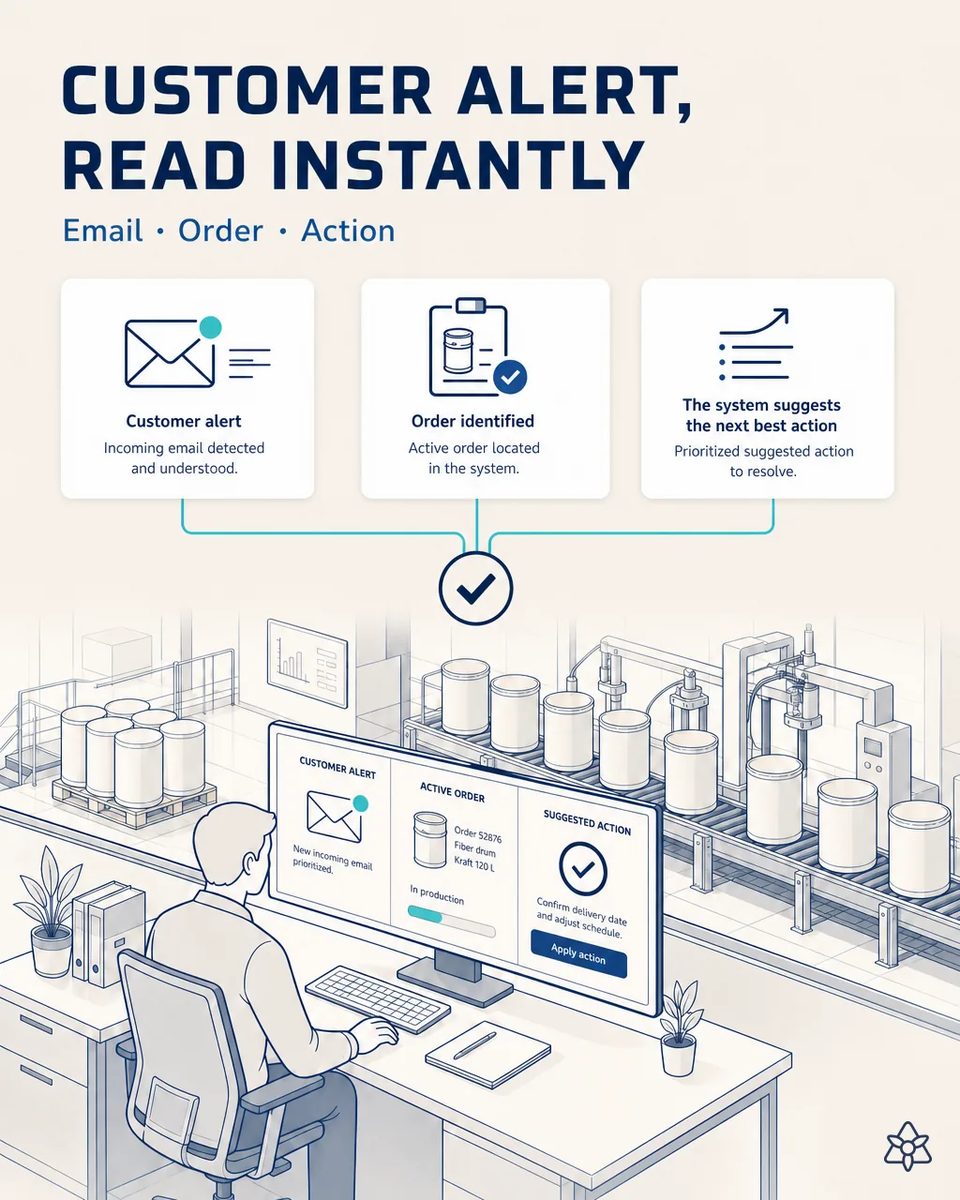
The rating changes by email, and the email is read after the batch has started.
A chemical customer emails to say the next order needs a different packing group — a more demanding rating. The email lands in an inbox checked hours later, by which point a batch is already scheduled to start that afternoon with the old rating. Critical customer alerts arrive by email to one person who can't watch the inbox in real time, so by the time they're read, production decisions already in motion have to be broken.
- A chemical customer writes to say the next order needs a different packing group: a more demanding rating, with different closure, hoop or wall requirements. For a fiber drum that can mean another closure, a steel hoop where there was none, or a liner the old order did not need.
- The message lands in an inbox checked hours later. By then a batch is scheduled to start that afternoon with the old rating. Nobody did anything wrong: the information simply arrived through a channel nobody watches continuously.
- Critical alerts reach one person who cannot watch the inbox in real time, competing with quotes, invoices and routine delivery questions. A change of packing group looks like any other customer email until someone reads it carefully.
- So by the time it is read, production decisions already in motion have to be broken: drums wound for the wrong group, closures already ordered, a delivery date at risk. In dangerous-goods packaging, a drum made for the wrong group cannot be relabeled and sold as the right one.
Connect in silent copy on the order mailbox — the alert arrives as an action.
iLEAN Connect sits in silent copy on the mailbox 24/7. At zero latency it extracts the message's intent, the affected order and the new packing group, cross-checks the ERP, and alerts the production lead with a concrete action — not just "you've got an email".
Reading the email sooner is only half of it. What matters is that the production lead receives the affected order, the new packing group and what has to change on the line, so the decision takes seconds instead of a phone call to find out what the email meant. And if the batch has not started yet, the change costs a reschedule instead of a pallet of drums.
Today's customer alert versus the alert crossed with the order
| Aspect | Today, in the inbox | With iLEAN Connect |
|---|---|---|
| When a packing group change is read | Hours later | At zero latency |
| Link to the affected order | Someone looks it up | Identified in the ERP automatically |
| Batch scheduled with the old rating | Often already running | Flagged before startup |
| What the production lead gets | A forwarded email | A concrete action on the order |
| Routine messages | Mixed in with the critical ones | Kept out of the alert |
| Final decision | Whoever reads it first | The production lead, with context |
Before: hours of human latency and decisions based on what was read hours earlier. After: replanning in seconds, based on the live order.
Impact estimate — to be validated with your numbers.
The block below is an estimate to be validated against your plant's actual data. We put it forward so the committee has an order of magnitude; we refine it during the assessment.
- Estimated payback 3-7 months, depending on how often critical alerts arrive.
- It comes from avoiding batches made with the wrong rating, which in dangerous-goods packaging cannot simply be relabeled. Each one is kraft paper, adhesive, hoops and closures turned into stock nobody ordered.
- From hours of human latency to replanning in seconds, based on the live order rather than on what was read hours earlier.
- And the customer sees a supplier that reacted the same day to a change in specification. For a chemical customer, that responsiveness is part of what keeps the supplier on the approved list.
Estimated payback 3-7 months depending on how often critical alerts arrive, from avoiding batches made with the wrong rating. Estimate to be validated.
And the fair question from the production manager
“How does it know an email is about the rating and not a routine question?” — classifying the intent of a message and pulling out the order and the packing group is an anchored task, where the best models drop below 1.5% error [1]. And it never changes anything on its own: it proposes the action and the production lead decides. Nothing in the schedule moves without a person.
[1] OpenAI paper "Why Language Models Hallucinate", 2025 — on the reliability of AI in anchored tasks.
What people ask about reading customer specification alerts
Does it read our employees' personal mailboxes?
No. It sits in copy on the order or customer-service mailbox you choose, and only sees what customers send to that operational channel. Internal conversations and personal mail stay outside its reach.
Does it understand packing group and UN rating terminology?
Yes. It is configured with the vocabulary of your orders: packing groups, closure types, liners and the rating codes your customers use. A message that says the same thing in three different ways is still recognized as the same change.
What if the customer attaches a new specification sheet?
The attachment is read too. What usually matters is in the PDF, not in the body of the email, so both are parsed together. If the attachment and the email contradict each other, the alert says so.
Does it change the production schedule by itself?
No. It alerts the production lead with the affected order and the proposed change. Replanning stays a human decision. iLEAN prepares the decision; it does not take it.
Does it work with customers who write in other languages?
Yes. Intent extraction does not depend on the language, which is common with chemical and pharma customers abroad. The alert reaches the production lead in your language, whatever language the customer wrote in.
More cases from this series
- The batch exists in the system from minute oneThe production sheet and the drum's control label, digitized with one photo at batch startup. No routine…
- The defective closure no longer reaches the customerAn Edge camera with a trained CNN detects a misaligned closure or off-center hoop in milliseconds and…
- No startup until the camera says it's calibratedEdge cameras and JIDOKA AI won't let a drum format change start until calibration is visually verified.
- The test spreadsheet stops living in a world of its owniLEAN absorbs the rating-test spreadsheet and syncs it to the validated ERP, cutting quality-module…
- Two taps before any data reaches the ERPNothing iLEAN captures reaches the ERP without a human confirming it with 2 taps on a line-side tablet.
- The knowledge that used to die at shift endThe shop foreman dictates issues while walking between the winder and the closure press; iLEAN…
Tell us how many batches last year started with a specification that had already changed.
We work on your plant's real data, not ours. Assessment with no commitment.
Request estimated ROI within 48h ‹ See all cases of fiber drums See packaging