No startup until the camera says it's calibrated
Switching drum diameter, or moving to a more demanding packing group, forces recalibration of the winder and the closure press.
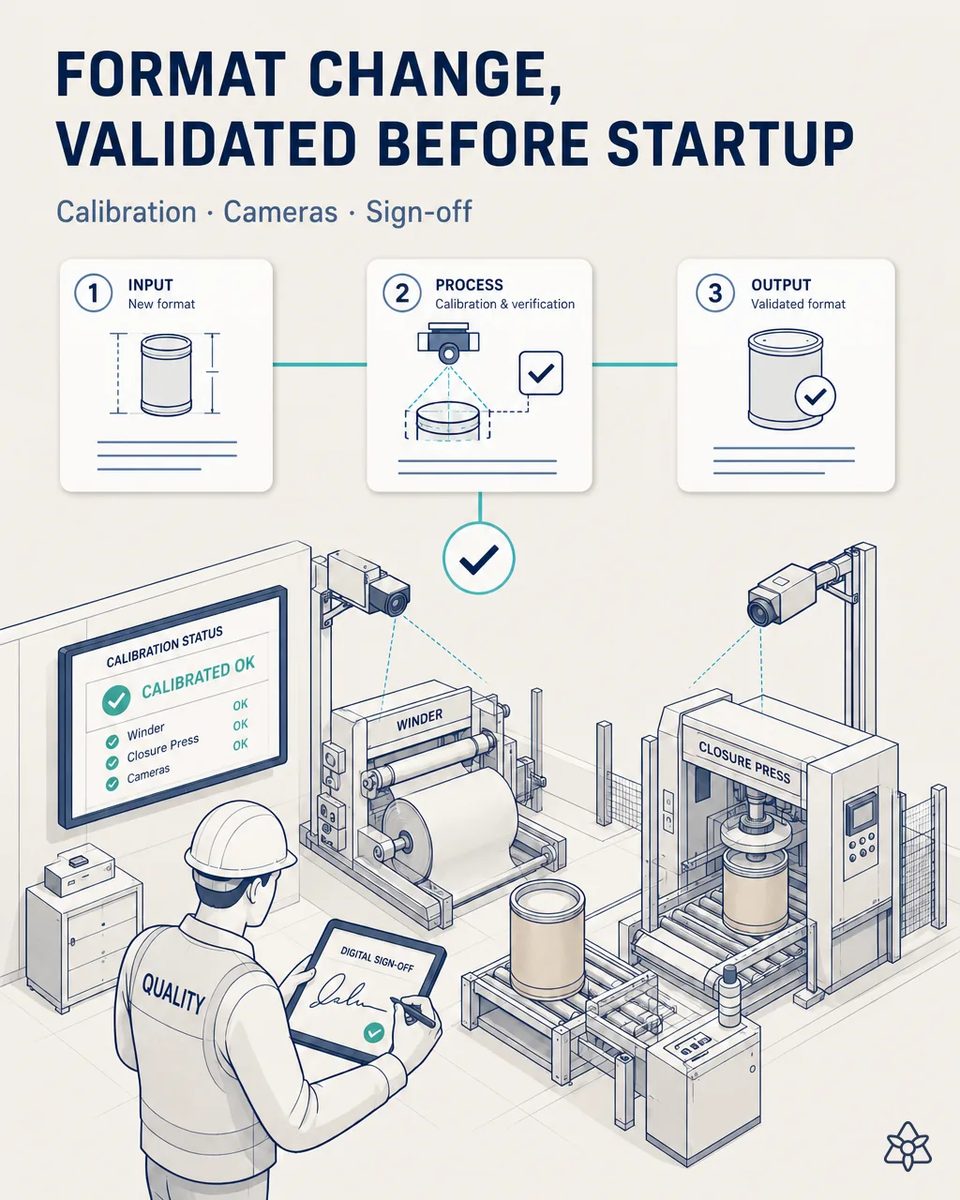
The word "calibrated" is signed today with nothing to look at.
Switching drum diameter, or moving to a more demanding packing group, forces recalibration of the winder and the closure press. If the change starts badly, the first batch can come out of tolerance — or worse, pass testing by human error and ship with a rating it doesn't actually meet. Today it depends on a human signing off "calibrated" with no objective visual evidence.
- Switching drum diameter, or moving to a more demanding packing group, forces recalibration of the tube winder and the closure press. Mandrel, paper width, layer recipe and closure tooling all move at once.
- If the change starts badly, the first batch can come out of tolerance. Wall thickness, closure fit or hoop seating can all drift with a badly set machine.
- Worse, it can pass testing by human error and ship with a rating it doesn't actually meet.
- Today the whole change depends on a person signing off "calibrated" with no objective visual evidence behind the signature. It is not bad faith: under time pressure, a signature is the only thing available.
Edge with JIDOKA AI — no startup until every camera reports OK.
Fixed cameras on the winder and press compare the current state against the calibrated reference for the new format. The line won't start until every camera reports OK and the quality lead signs off on visual evidence, not blindly — JIDOKA AI blocks startup if anything doesn't match.
The camera does not replace the quality lead: it gives her something to sign on. Each critical point is compared with the calibrated reference for the new format, and the line only starts when the images match and she has seen them. That record also feeds the evidence pack, so the change is documented without extra work.
Format change sign-off today versus sign-off on visual evidence
| Aspect | Today | With iLEAN Edge |
|---|---|---|
| What "calibrated" is based on | A signature | Images checked against the reference |
| Winder set for the new diameter | Assumed | Verified by camera |
| Closure press for the new format | Checked by eye | Verified by camera |
| First batch after the change | Risk of out-of-tolerance | Started only when every point is OK |
| A mismatch at startup | Found at testing, or not | JIDOKA AI blocks the line |
| Record of the change | A ticked box | Images, time and who signed |
Before: a blind sign-off with risk of an out-of-tolerance batch. After: a sign-off based on visual evidence at every critical point.
Impact estimate — to be validated with your format change frequency.
The block below is an estimate to be validated against your plant's actual data. We put it forward so the committee has an order of magnitude; we refine it during the assessment.
- We don't set a payback range here, because it depends on how often you change format; we calculate it with your own changeover count.
- What it protects is the rating itself, and with it access to dangerous-goods customers. Losing the rating closes a market; that is the exposure the cameras reduce. No figure we could invent would describe it better than your own changeover count.
- From a blind sign-off with risk of an out-of-tolerance batch to a sign-off based on visual evidence at every critical point. The quality lead signs knowing what she saw, not what she was told.
- And each format change leaves its own images as proof, which the certification dossier can use later. An auditor asking how a format change was released gets images, not a ticked box.
Protects the rating (access to dangerous-goods customers). Payback depends on how often format changes occur. Estimate to be validated.
And the fair question from the production manager
“Won't the camera hold up a changeover over nothing?” — it stops on a verifiable mismatch against the calibrated reference, not on uncertainty. Comparing a known setup with its reference image is an anchored task, where the best models drop below 1.5% error [1]. When the doubt is the model's, it escalates to the quality lead instead of blocking silently. Nobody is left wondering why the line will not start.
[1] OpenAI paper "Why Language Models Hallucinate", 2025 — on the reliability of AI in anchored tasks.
What people ask about validating a drum format change
Which points are checked on the winder and the press?
The ones that define the new format: mandrel and diameter settings on the winder, tooling and closure format on the press. They are agreed with your maintenance team at commissioning. Adding a point later is a configuration, not a project.
Does moving to a more demanding packing group change the check?
Yes. Each format and rating has its own reference, so a stricter packing group is checked against its own calibrated state. The more demanding the rating, the tighter the reference.
How long does the camera check add to the changeover?
Seconds. What lengthens a changeover today is the uncertainty, not the verification. The time spent double-checking by hand is usually longer than the camera check.
Who has the final word to start the line?
The quality lead. The cameras give the evidence and JIDOKA AI blocks on a mismatch; the sign-off remains human. What changes is what she signs on.
What if we need to start urgently and a camera reports a mismatch?
An exception can be signed by the quality lead and is recorded as such. What disappears is the startup with no trace of who decided it. The exception itself becomes part of the record.
More cases from this series
- The batch exists in the system from minute oneThe production sheet and the drum's control label, digitized with one photo at batch startup. No routine…
- The defective closure no longer reaches the customerAn Edge camera with a trained CNN detects a misaligned closure or off-center hoop in milliseconds and…
- The customer's email, read at zero latencyiLEAN silently monitors customer emails and flags the concrete action before the wrong batch gets made.
- The test spreadsheet stops living in a world of its owniLEAN absorbs the rating-test spreadsheet and syncs it to the validated ERP, cutting quality-module…
- Two taps before any data reaches the ERPNothing iLEAN captures reaches the ERP without a human confirming it with 2 taps on a line-side tablet.
- The knowledge that used to die at shift endThe shop foreman dictates issues while walking between the winder and the closure press; iLEAN…
Ask us to calculate how many format changes you run per month and what they put at risk.
We work on your plant's real data, not ours. Assessment with no commitment.
Request estimated ROI within 48h ‹ See all cases of fiber drums See packaging