The test spreadsheet stops living in a world of its own
The quality lead fills in a spreadsheet every batch with rating tests — drop, stacking, leak-tightness — in a folder the ERP never sees.
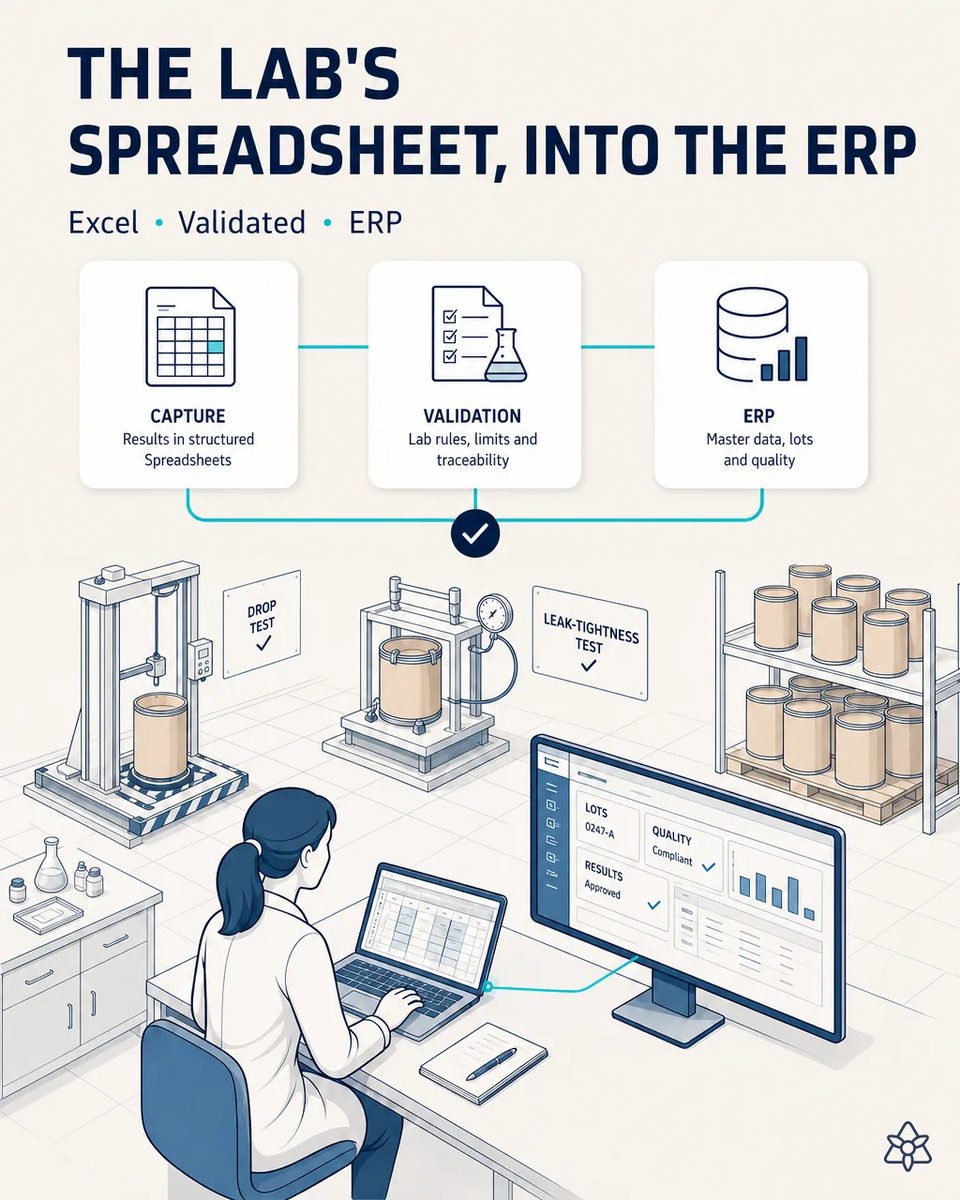
The real test results and the official ones live in two different places.
The quality lead fills in a spreadsheet every batch with rating tests — drop, stacking, leak-tightness — in a shared folder the ERP never sees. It's two parallel worlds: the real spreadsheet with live data, and the official ERP with data transcribed late by someone who spends time every month copy-pasting, and sometimes makes mistakes.
- Every batch, the quality lead fills in a spreadsheet with the rating tests: drop, stacking and leak-tightness, plus notes on board moisture or adhesive. Each row is the proof that a batch earned its rating.
- That spreadsheet sits in a shared folder the ERP never sees. It is the most up-to-date quality record in the plant, and the least connected.
- The official ERP holds data transcribed late by someone who spends time every month copy-pasting — and sometimes makes mistakes. A drop height typed wrong or a stacking load in the wrong column looks valid until someone compares it with the original.
- The gap between the real test and the ERP record runs to days, which is exactly when a customer asks whether a batch passed. Then someone opens the spreadsheet anyway, because the ERP cannot be trusted to be current.
Connect listening inward — it reads the folder when the file is saved.
iLEAN Connect's "listen inward" mode reads the shared folder when the file is saved — it doesn't watch the person. It parses every cell with an anchored LLM, and after the lead's validation, it automatically syncs to the ERP via API.
The quality lead keeps the spreadsheet she already trusts. What changes is that the result exists in the ERP as soon as she validates it, so the answer to "did this batch pass the stacking test?" stops waiting for the end of the month. And nobody spends an afternoon copying cells into a screen that already had the answer elsewhere.
The rating-test spreadsheet today versus the spreadsheet synced
| Aspect | Today | With iLEAN Connect |
|---|---|---|
| Drop and stacking results in the ERP | Days late | On validation |
| Monthly copy-paste work | Recurring | Zero |
| Typing mistakes in test values | Found when a customer asks | Not introduced |
| Layout of the test spreadsheet | Must be respected | Read as it is, even if it changes |
| Lab licenses in the ERP | Several named users | A single validation license |
| What the quality lead does | Fills in, then transcribes | Fills in, then validates |
Before: a days-long gap between the real test and the ERP record, plus monthly transcription time. After: zero latency, zero transcription.
Impact estimate — to be validated against your license invoice.
The block below is an estimate to be validated against your plant's actual data. We put it forward so the committee has an order of magnitude; we refine it during the assessment.
- 💰 CFO angle: typical 50-80% reduction in quality and lab module licenses, from several user licenses down to a single validation one. The saving recurs every year, which is why finance usually looks at this case first.
- Estimated payback 4-9 months.
- From a days-long gap between the real test and the ERP record to zero latency, and zero transcription.
- And the test history per batch is in the ERP when a chemical or pharma customer asks for it. That history is also the raw material of the certification dossier. Nothing has to be copied twice.
CFO angle: typical 50-80% reduction in quality/lab module licenses (from several user licenses down to a single validation one). Estimated payback 4-9 months. Estimate to be validated.
And the fair question from the production manager
“That spreadsheet has merged cells and notes everywhere — can it really parse it?” — yes. Reading a spreadsheet whose columns and units are known, even when the layout moves, is an anchored task, where the best models drop below 1.5% error [1]. And nothing is synced until the quality lead validates what was read. A value outside the expected range is flagged, not pushed.
[1] OpenAI paper "Why Language Models Hallucinate", 2025 — on the reliability of AI in anchored tasks.
What people ask about syncing the rating-test spreadsheet
Does the lab have to change its spreadsheet in fiber drum making?
No. iLEAN reads the file as it is today, with its own columns and notes. Forcing a new template is the quickest way to lose the lab's goodwill. If the layout changes later, the reading adapts.
Does it track who opens the file or how long they spend?
No. It reads the file when it is saved. It does not follow the person, only the folder. The lab works exactly as before.
Does it handle tests that finish days after the batch, like stacking?
Yes. Each result is read when it is entered and saved, and attached to its batch whenever it arrives. The batch record shows which tests are complete and which are still pending.
How is the license saving checked?
Against your current ERP contract. If several people log in only to enter test results, they stop needing to; that is why it is framed as an estimate to validate. We check it with you against last year's invoice before promising anything.
Are board moisture readings captured too?
If they are in the spreadsheet, yes. They often explain a failed drop test better than any other column, so they are worth keeping linked to the batch. Kraft paper that arrived wetter than usual leaves its trace there first.
More cases from this series
- The batch exists in the system from minute oneThe production sheet and the drum's control label, digitized with one photo at batch startup. No routine…
- The defective closure no longer reaches the customerAn Edge camera with a trained CNN detects a misaligned closure or off-center hoop in milliseconds and…
- The customer's email, read at zero latencyiLEAN silently monitors customer emails and flags the concrete action before the wrong batch gets made.
- No startup until the camera says it's calibratedEdge cameras and JIDOKA AI won't let a drum format change start until calibration is visually verified.
- Two taps before any data reaches the ERPNothing iLEAN captures reaches the ERP without a human confirming it with 2 taps on a line-side tablet.
- The knowledge that used to die at shift endThe shop foreman dictates issues while walking between the winder and the closure press; iLEAN…
Run a quick audit of how many ERP licenses your lab pays for today.
We work on your plant's real data, not ours. Assessment with no commitment.
Request estimated ROI within 48h ‹ See all cases of fiber drums See packaging