The batch exists in the system from minute one
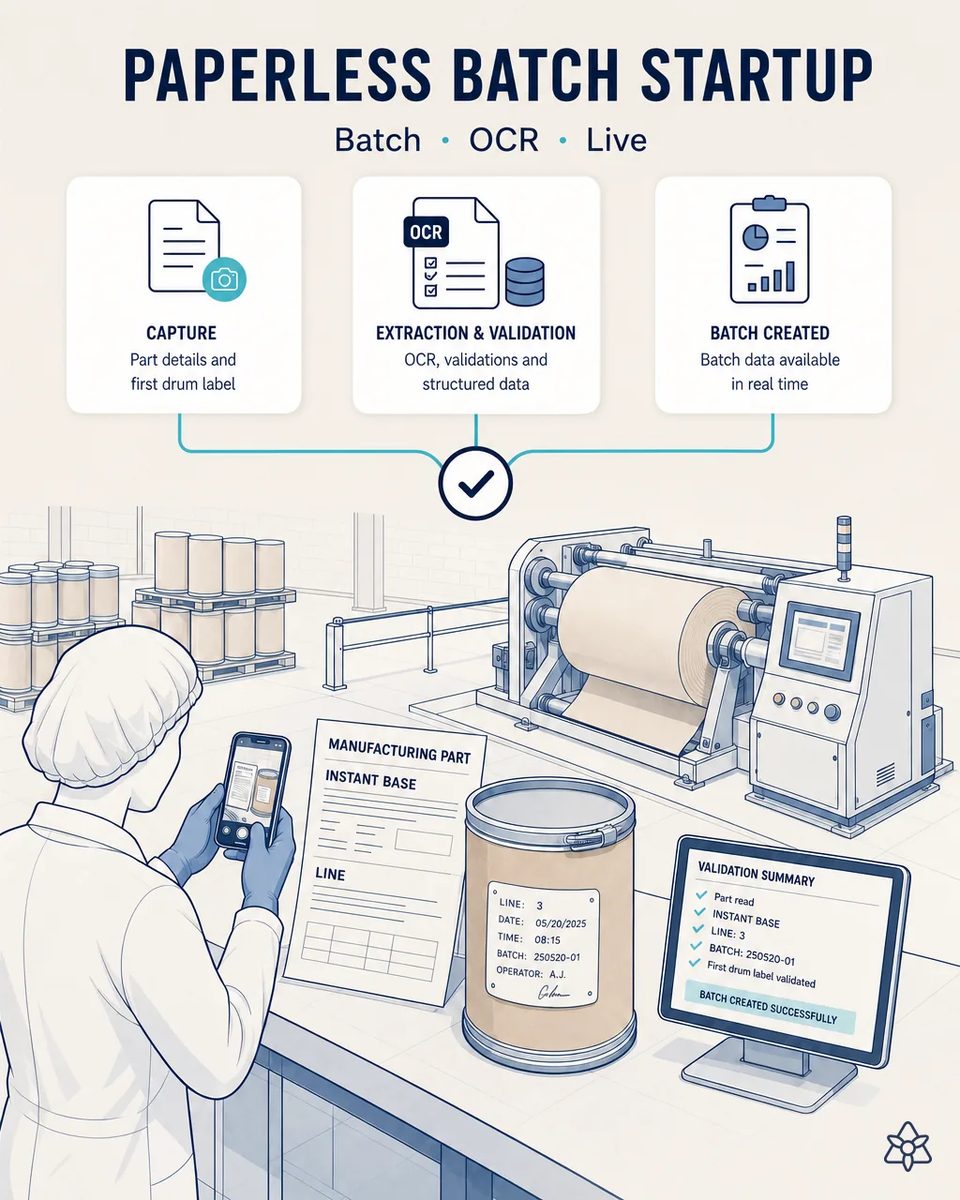
At batch startup, the operator takes two phone photos: the production sheet and the first-drum control label. Nothing else changes.
The batch's rating lives on two sheets of paper nobody has typed yet.
At a kraft fiber drum plant, the production sheet is filled in by hand with the order's data — format, closure type, required dangerous-goods rating — and the first-drum control label is also handwritten by quality policy. Both documents can sit undigitized for hours, piling up in the production lead's office folder. If someone needs to reconstruct which rating a given batch carried, today that means tracking down the physical paper — and sometimes it isn't where it should be.
- The production sheet is filled in by hand with the order's data: drum diameter and height, closure type, steel hoop or not, liner, and the dangerous-goods rating the order requires.
- Quality policy also asks for the first-drum control label to be handwritten, with batch, line, time and the operator's initials. It is the reference for the whole batch if anything goes wrong later.
- Both documents can sit undigitized for hours, piling up in a folder in the production lead's office while the batch is already being wound, assembled and palletized. Nobody outside that office can see what is being made or for which rating.
- If someone has to reconstruct which rating a given batch carried, today that means tracking down the physical paper — and sometimes it isn't where it should be.
Connect in photo mode — two photos at startup, and the paper stays as it is.
With iLEAN Connect's photo mode, the operator takes two phone photos at batch startup: the production sheet and the control label. An anchored LLM recognizes the document structure and extracts batch, format, closure type, required rating and notes, storing them in central memory at zero latency — without the operator changing anything in their routine.
The operator keeps filling in the sheet and the label exactly as quality requires. The only new gesture is two photos, and from that moment the batch, its format and its rating can be queried from anywhere in the plant instead of from a folder on a desk. When a chemical customer calls about a batch, the answer is on a screen in seconds, with the photo of the original sheet attached.
Drum batch startup on paper versus startup captured by photo
| Aspect | Today, on paper | With iLEAN Connect |
|---|---|---|
| Time until the batch exists in the system | Hours, sometimes a full shift | Minute one |
| Required UN rating per batch | Written on a sheet in a folder | Extracted and tied to the batch |
| Closure type and drum format | Readable only on paper | Structured fields, searchable |
| First-drum control label | Handwritten and filed | Photographed, read and linked |
| A sheet that goes missing | The rating can't be proved | The photo is already stored |
| Operator's routine | Fill in and file | Fill in, two photos, carry on |
Before: hours of latency before the sheet gets digitized, paper that sometimes goes missing. After: the batch is queryable from minute one, with its rating traced by photo.
Impact estimate — to be validated with your numbers.
The block below is an estimate to be validated against your plant's actual data. We put it forward so the committee has an order of magnitude; we refine it during the assessment.
- Estimated payback 4-9 months, depending on how many batches you start per day.
- It comes from reclaiming the production lead's transcription time, which today goes into typing sheets that have already been written once.
- From hours of latency to a batch that can be queried from minute one, with its rating traced by photo.
- And the question "which rating did that batch carry?" stops depending on finding a sheet of paper.
Estimated payback 4-9 months depending on batch volume per day, from reclaiming the production lead's transcription time. Estimate to be validated.
And the fair question from the production manager
“What if it misreads the packing group on a handwritten sheet?” — reading fields from a document whose structure is known is an anchored task, where the best models drop below 1.5% error [1]. And there is a second net: the rating is checked against the active order in the ERP, and any mismatch goes to the line tablet for a person to confirm before it is stored. A rating that disagrees with the order is never filed silently.
[1] OpenAI paper "Why Language Models Hallucinate", 2025 — on the reliability of AI in anchored tasks.
What people ask about capturing drum batch startup
Do we have to redesign the production sheet?
No. iLEAN learns the structure of the sheet you already use, including the boxes for format, closure and rating. Changing the paper would only add friction on the floor. And the sheet is often part of the quality system, so changing it means paperwork of its own.
Can it read the handwritten control label on the drum?
Yes. The label is short and always carries the same fields, so it is one of the easiest documents to read. A value with low confidence is flagged instead of guessed. The operator's initials and the time are read too, so the label keeps its value as a record.
What if the sheet and the order disagree on the rating?
That is the most valuable catch of the case. The mismatch is raised at startup, while only one drum has been made, not when the batch is already on the pallet. Correcting one drum is a nuisance; correcting a pallet of drums wound for the wrong group is a lost shift.
Does it work on a phone with gloves and kraft dust around?
It works with an ordinary phone or an industrial one. Two photos per batch is the whole interaction, so gloves are not a problem. The photos are taken where the sheet already is, so nobody has to leave the line.
Is this a good first case to start with?
Usually yes: it has no dependencies, it does not touch any machine and the result is visible the same day. That is why it is often the first to be approved. It also builds the batch record that every later case leans on.
More cases from this series
- The defective closure no longer reaches the customerAn Edge camera with a trained CNN detects a misaligned closure or off-center hoop in milliseconds and…
- The customer's email, read at zero latencyiLEAN silently monitors customer emails and flags the concrete action before the wrong batch gets made.
- No startup until the camera says it's calibratedEdge cameras and JIDOKA AI won't let a drum format change start until calibration is visually verified.
- The test spreadsheet stops living in a world of its owniLEAN absorbs the rating-test spreadsheet and syncs it to the validated ERP, cutting quality-module…
- Two taps before any data reaches the ERPNothing iLEAN captures reaches the ERP without a human confirming it with 2 taps on a line-side tablet.
- The knowledge that used to die at shift endThe shop foreman dictates issues while walking between the winder and the closure press; iLEAN…
Tell us how long a drum batch takes to exist in your system today.
We work on your plant's real data, not ours. Assessment with no commitment.
Request estimated ROI within 48h ‹ See all cases of fiber drums See packaging