Two taps before any data reaches the ERP
Nothing iLEAN captures — photo, voice or parsed email — reaches the central system without a human seeing it first.
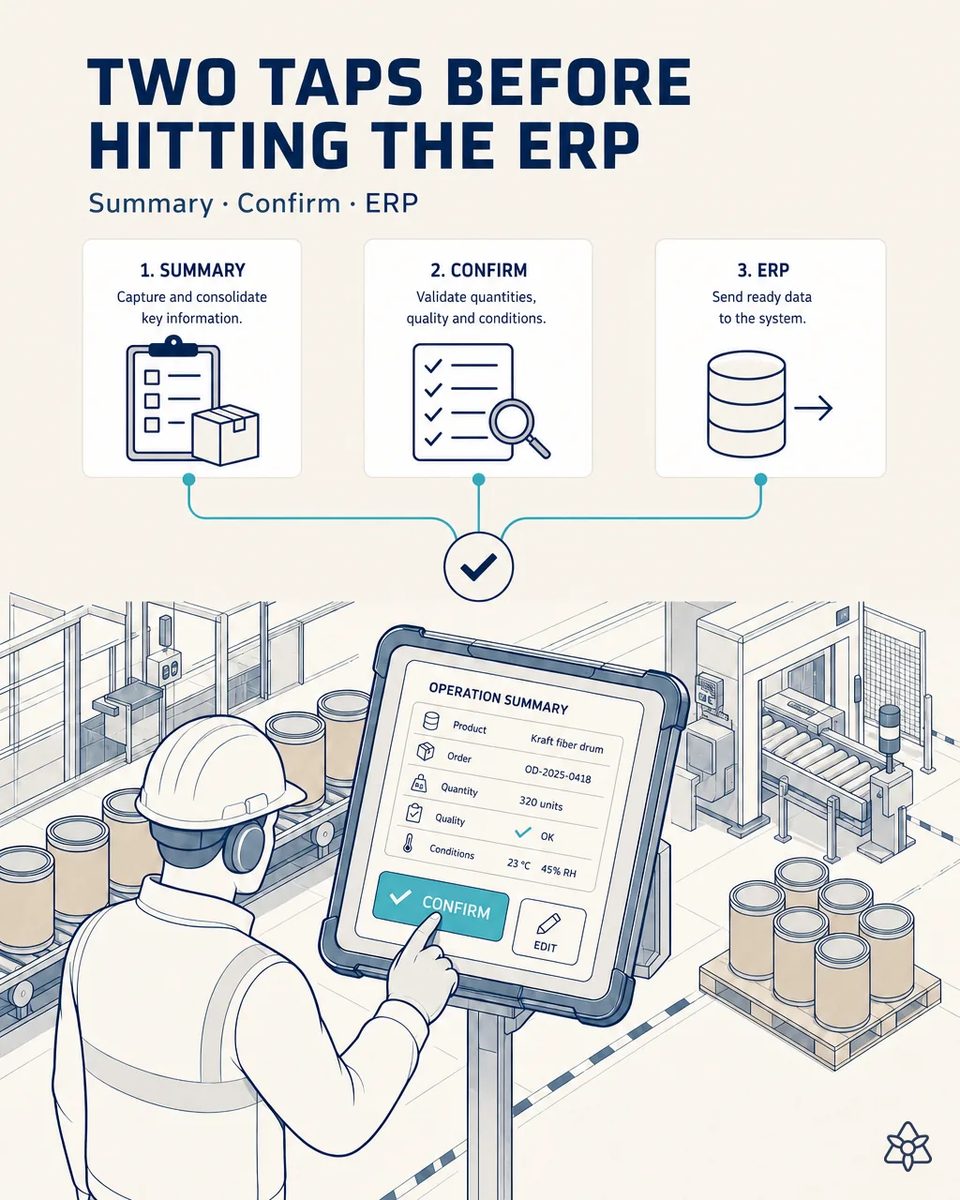
Nobody wants AI writing a dangerous-goods rating into the ERP unchecked.
The fear that AI "enters data on its own and someone has to clean up the ERP master later" is the main cultural brake on digitalization at a drum factory — especially when what's at stake is a dangerous-goods rating. But the operator doesn't want to type either.
- The fear that AI "enters data on its own and someone has to clean up the ERP master later" is the main cultural brake on digitalization at a drum factory.
- It is a reasonable fear when what is at stake is a dangerous-goods rating: a wrong packing group in the master travels to labels, certificates and the customer. Cleaning it up afterwards is slow and leaves doubts about every record around it.
- But the operator does not want to type either. He is there to assemble drums, not to fill in screens. Every form added at the line is a form filled in late or not at all.
- So plants stay stuck between unvalidated data contaminating the ERP and data that is never captured out of distrust. Neither option supports a rating that customers audit.
Connect with human verification at the line — two taps, no form.
An industrial tablet at the assembly line shows a 2-second visual summary of any recent capture — photo, voice or parsed email. The operator confirms with two taps: ✓ goes to the ERP, ✏️ fix before it enters. No training, no change of habit.
This is the piece that makes the others approvable. Without it, nobody signs off on photos, dictations or emails feeding the system a UN rating depends on; with it, every record has a person who saw it before it entered. That is what the plant's quality system needs before it lets any automation near the rating.
Data entry today versus data confirmed at the line
| Aspect | Today | With iLEAN |
|---|---|---|
| Who sees a capture before the ERP | Nobody, or nobody captures it | The operator at the line |
| Time to confirm | Minutes at a terminal | A 2-second summary, two taps |
| A wrong packing group | Found when the label is printed | Corrected before it enters |
| Photos, voice and emails | Three separate worlds | One confirmation screen |
| Corrections made by people | Lost | Stored to improve extraction |
| Learning curve | A new screen to master | None: confirm or fix |
Before: unvalidated data contaminating the ERP, or data not captured at all out of distrust. After: data captured and validated in seconds, the master always clean.
An enabling piece — no standalone payback, by design.
The block below is an estimate to be validated against your plant's actual data. We put it forward so the committee has an order of magnitude; we refine it during the assessment.
- No standalone payback: it is the enabling piece of the whole iLEAN matrix, and its value is strategic, not directly monetizable. We say so plainly instead of inventing a figure for it.
- Without it, the other pieces don't get signed off by quality or by management. The return of the matrix runs through this tablet even though none of it is booked here.
- From unvalidated data contaminating the ERP — or no data at all — to data captured and validated in seconds.
- And the master stays clean, which is what every certificate and every rating record downstream depends on. A clean master is what lets the dossier for a UN-rated batch be trusted.
The enabling piece of the whole iLEAN matrix — without it, the other pieces don't get signed off. Strategic value, not directly monetizable.
And the fair question from the production manager
“If a person confirms everything, what does the AI save?” — the assembly, not the decision. Extracting batch, format and rating from a photo or an email is an anchored task, where the best models drop below 1.5% error [1]; the operator only checks a summary that arrives already built. Two taps replace a form, and each correction is kept so the system learns where it fails. Over time, the operator corrects less and confirms more. That is the sign the system is learning your line.
[1] OpenAI paper "Why Language Models Hallucinate", 2025 — on the reliability of AI in anchored tasks.
What people ask about the verification tablet in fiber drum making
Can anything reach the ERP without being confirmed?
No. It is not a setting that can be switched off: data crosses into the ERP only after a person taps confirm or fixes it. That is architecture, not configuration.
What does the operator actually see in fiber drum making?
A short summary of the capture: order, product, quantity and, where relevant, the rating or packing group. Enough to spot an error at a glance. The original photo or message is one tap away if something looks odd.
What happens when the operator taps fix?
The field opens for correction before anything enters. The original value and the correction are both kept, with the name of who changed it. That trail is what quality looks at when a record is questioned.
Does the tablet work with gloves on the assembly line?
Yes. It is an industrial tablet with large targets designed for gloved use, mounted where the operator already stands. It does not ask anyone to walk to a terminal.
Is it needed if we only deploy one other case?
Yes. Whatever the first case is, this is what lets quality approve it, which is why it is usually deployed alongside it. It is the piece that turns an AI pilot into something the plant signs off.
More cases from this series
- The batch exists in the system from minute oneThe production sheet and the drum's control label, digitized with one photo at batch startup. No routine…
- The defective closure no longer reaches the customerAn Edge camera with a trained CNN detects a misaligned closure or off-center hoop in milliseconds and…
- The customer's email, read at zero latencyiLEAN silently monitors customer emails and flags the concrete action before the wrong batch gets made.
- No startup until the camera says it's calibratedEdge cameras and JIDOKA AI won't let a drum format change start until calibration is visually verified.
- The test spreadsheet stops living in a world of its owniLEAN absorbs the rating-test spreadsheet and syncs it to the validated ERP, cutting quality-module…
- The knowledge that used to die at shift endThe shop foreman dictates issues while walking between the winder and the closure press; iLEAN…
Ask to see the verification tablet working on your assembly line.
We work on your plant's real data, not ours. Assessment with no commitment.
Request estimated ROI within 48h ‹ See all cases of fiber drums See packaging