The defective closure no longer reaches the customer
At assembly line speed, the human eye tires and lets through misaligned closures, off-center hoops or fiber creases.
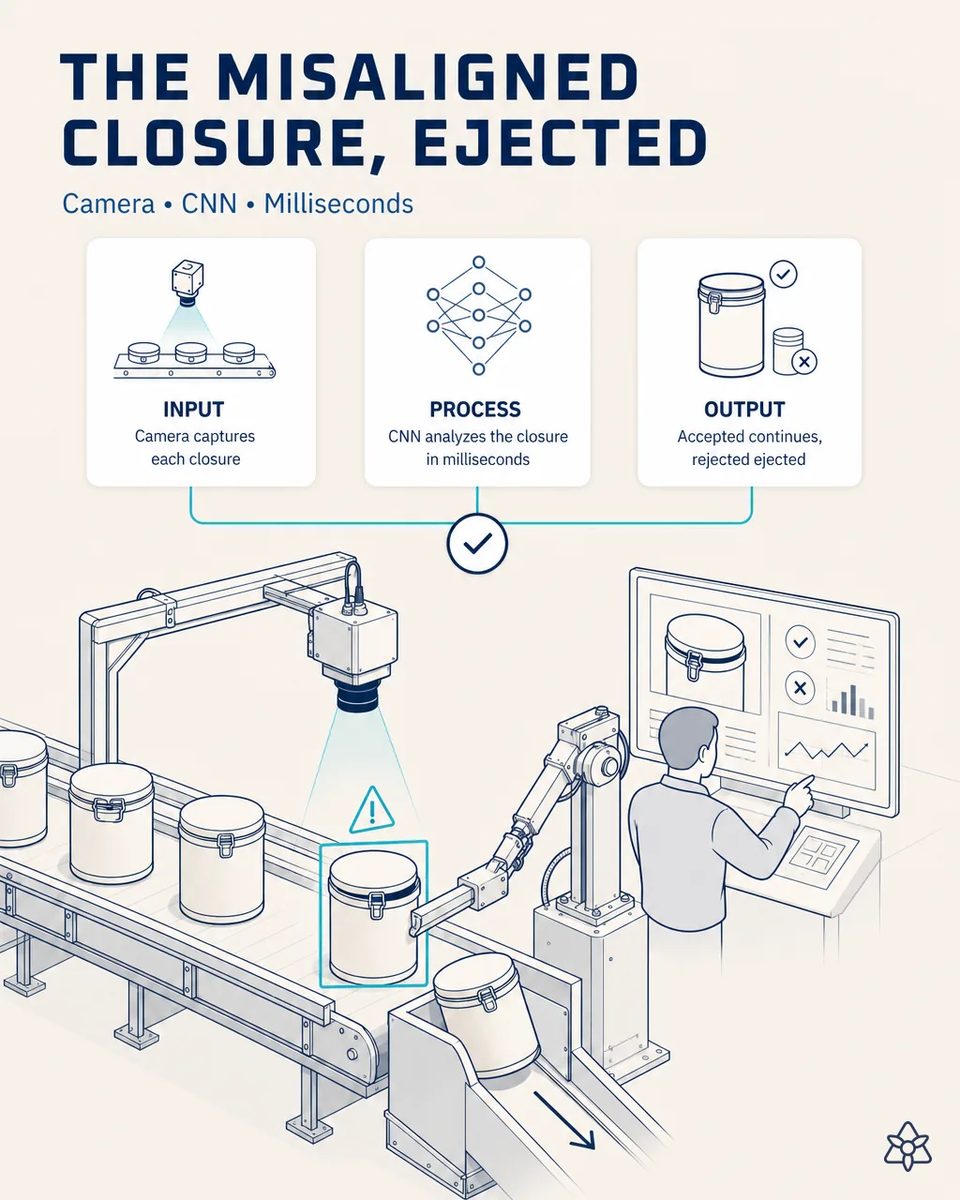
At line speed, the eye lets through exactly the drum that opens in transit.
At assembly line speed, the human eye tires and lets through misaligned closures, off-center reinforcement hoops or fiber creases. 100% human visual control is impossible at real line speed, and sample-based inspection leaves gaps — that defective drum reaches a chemical or pharma customer with a risk of accidental opening in transit.
- On the assembly line the human eye tires and lets through misaligned closures, off-center reinforcement hoops or fiber creases in the drum body. Each of them can turn a sound kraft body into a drum that opens or leaks.
- 100% visual control by a person is impossible at real line speed. Nobody keeps the same attention on the thousandth drum as on the first.
- Sample-based inspection leaves gaps between samples, and the defective drum falls into one of them. The sample passes, the batch ships, and the defect travels with it.
- That drum reaches a chemical or pharma customer with a risk of accidental opening in transit — with a dangerous good inside. A single claim like that weighs more than a year of sampling costs.
Edge — a local CNN classifies every drum in milliseconds and ejects it.
A camera over the line, with a local CNN trained on the customer's specific closures and hoops, infers in milliseconds per piece and ejects the defective drum before it reaches testing and shipping.
The model is trained on your closures and your hoops, under your line's lighting, not on a generic catalog. That is what keeps false rejects low enough for the line to trust the ejector. And every ejected drum keeps its image, so quality can check any decision the camera made.
Sampling the closure today versus inspecting every drum
| Aspect | Visual sampling | With iLEAN Edge |
|---|---|---|
| Drums inspected | A sample | 100%, in line |
| Misaligned spring-latch closure | Seen if sampled | Classified and ejected |
| Off-center steel hoop | Easy to miss when tired | Detected on every drum |
| Fiber creases in the body | Depends on who looks | Same criterion, every shift |
| Where the defect is stopped | At the customer, sometimes | Before testing and shipping |
| Where inference runs in fiber drum making | — | Locally, in milliseconds |
Before: partial sampling, defects slipping through. After: 100% drum control, in line.
Impact estimate — to be validated with your numbers.
The block below is an estimate to be validated against your plant's actual data. We put it forward so the committee has an order of magnitude; we refine it during the assessment.
- Estimated payback 5-12 months, depending on your current reject ratio. The higher it is today, the faster the camera pays back.
- It comes from reduced customer claims for drums with closure or hoop defects. A claim from a dangerous-goods customer costs far more than the drum itself.
- From partial sampling with defects slipping through to 100% drum control, in line. The same criterion applies on the night shift as on the morning one. Fatigue stops being a variable in what ships.
- And every ejected drum keeps its image, which turns claims into a defect history by closure type and line. Maintenance gets data to act on instead of a complaint to defend.
Estimated payback 5-12 months depending on current reject ratio, from reduced customer claims. Estimate to be validated.
And the fair question from the production manager
“What if it starts ejecting good drums?” — that is the real risk of any vision system, so the model is trained on good and bad drums from your own line. Telling a seated closure from a misaligned one against reference images is an anchored task, where the best models drop below 1.5% error [1], and doubtful cases go to a person rather than being rejected blindly. Every human decision feeds back into the model. The longer it runs on your line, the fewer cases it needs to escalate.
[1] OpenAI paper "Why Language Models Hallucinate", 2025 — on the reliability of AI in anchored tasks.
What people ask about closure vision on the drum line
How many drums are needed to train the model?
We start with around 20 good and bad drums of your own, which is why the first step is bringing real defects rather than describing them. Rare defects are added as they appear on the line. Twenty drums is a start, not a ceiling.
Does it handle different drum diameters and closure types?
Yes. The model switches with the active format, which is normal in a plant that runs several diameters a week. Each format has its own reference images.
Does it see fiber creases as well as closure defects?
Yes. Creases in the body, an off-center hoop and a misaligned closure are classified as separate defects, so you know which one is growing. That tells maintenance whether to look at the closure press, the hoop station or the winder.
Does it need the cloud to decide in fiber drum making?
No. Inference runs on a local device at the line, so it keeps up with line speed and does not depend on the network. Images are stored locally and synced when the network allows.
Does it replace the drop test?
No. The test remains the rating reference. The camera stops defective drums before they reach it and before they reach the customer. Testing stops spending samples on drums already known to be wrong.
More cases from this series
- The batch exists in the system from minute oneThe production sheet and the drum's control label, digitized with one photo at batch startup. No routine…
- The customer's email, read at zero latencyiLEAN silently monitors customer emails and flags the concrete action before the wrong batch gets made.
- No startup until the camera says it's calibratedEdge cameras and JIDOKA AI won't let a drum format change start until calibration is visually verified.
- The test spreadsheet stops living in a world of its owniLEAN absorbs the rating-test spreadsheet and syncs it to the validated ERP, cutting quality-module…
- Two taps before any data reaches the ERPNothing iLEAN captures reaches the ERP without a human confirming it with 2 taps on a line-side tablet.
- The knowledge that used to die at shift endThe shop foreman dictates issues while walking between the winder and the closure press; iLEAN…
Bring 20 good and bad drums and train the model on your own real defects.
We work on your plant's real data, not ours. Assessment with no commitment.
Request estimated ROI within 48h ‹ See all cases of fiber drums See packaging