Submarine manufacturing with AI — a bead out of window is not an incident, it is a life.
The pressure hull of a submarine stakes every bead on parameters that forgive nothing: hydrogen input, interpass temperature, bead geometry. iLEAN Edge watches while the weld is laid, Connect cross-references the WPS with the hull number and the certified welder, and an agent assembles the dossier per system and per hull. The signature stays with the certified person — the system never closes anything on its own.
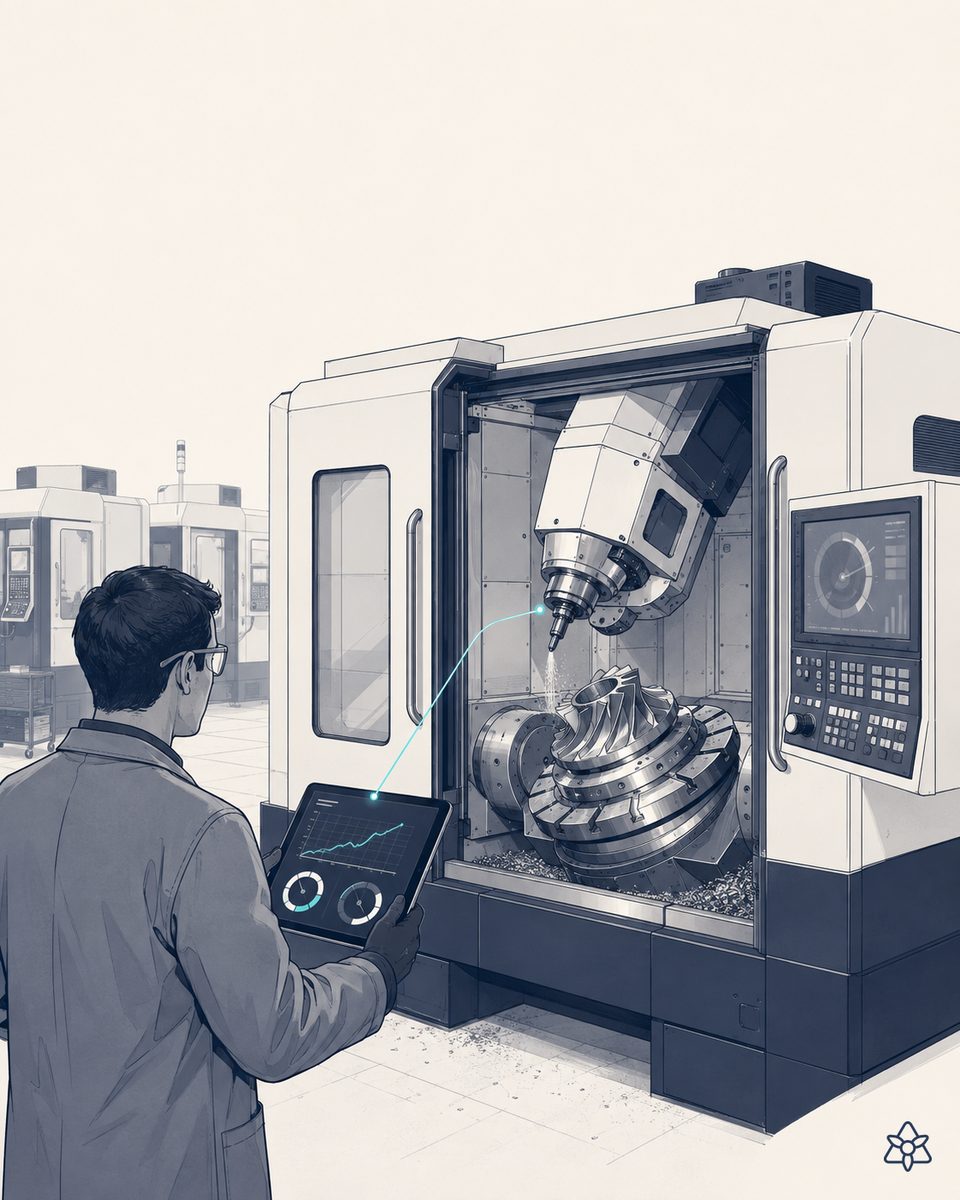
The pressure-hull bead does not accept 99% — it demands 100%.
A submarine shipyard is nothing like a merchant shipyard: every bead of the pressure hull works at pressures several times atmospheric, on high-yield-strength steels (HY-80, HY-100 or equivalents in other programs) that forgive little. Three typical pains coexist:
- The WPS window — the procedure demands controlled preheat, interpass temperature within a narrow window, minimal hydrogen input and geometry with no undercut. Today it is measured with handheld thermocouples and the welder's notes. A bead out of window that passes visual and fails RT/phased-array UT means hours of grinding out and rewelding.
- Traceability per hull number — every bead of the pressure hull and every submersible piping system is tied to a certified welder, a WPS, a material certificate and an NDT. The program audit and the classification society ask for that file already assembled. Today it is rebuilt by hand when the surveyor arrives.
- Hydrostatic tests — the hull is pressurized following a curve, the systems are tested against leaks. The test equipment's data lives on a local screen or on the test lead's sheet — and when it has to be cross-referenced with the system drawing and the material batch, it is detective work.
The program manager, the welding inspector and the test lead live in parallel worlds that only cross at a weekly meeting. Every bead that fails NDT is program days a boat does not deliver on schedule.
iLEAN does not change your WPS or your welding equipment — it seals the crack between the bead, the dossier and the test.
The submarine problem is not buying more equipment: it is that the welding equipment, the thermocouple, the hydrostatic test rig, the program ERP and the plate supplier's certificate do not talk to each other in real time. iLEAN acts as putty between the systems without touching the WPS, without changing the Lincoln/ESAB equipment or the PLM.
Edge watches the bead as it is laid and IR measures the interpass in real time. Connect captures material, WPS and test data. The agent assembles the dossier per hull number. The signature stays with the certified inspector — always.
The three iLEAN pieces applied to a submarine shipyard:
- iLEAN Edge — cameras with CNN + IR over the welding station. Vision detects geometry, undercut, spatter and bead deviations. IR measures interpass temperature in real time and triggers an alert if it drifts out of window — before the bead is finished in conditions that will not pass NDT. It works without a network: the prefabrication shop and the covered slipway are environments where connectivity is erratic.
- iLEAN Connect — reads the welding lead's WPS, the supplier's plate and filler certificates (PDF, EDI or a photo of the delivery note), the hydrostatic test equipment's data (a modern interface or a photographed screen on older gear) and cross-references them with the hull number and the system. The forgotten spreadsheet with the test parameters becomes usable data.
- iLEAN Agents — the agent cross-references bead ↔ certified welder ↔ WPS ↔ material ↔ NDT ↔ hull and assembles the dossier per system and per hull. It does not sign: it prepares the file and hands it to the welding inspector or the test director. The human signature is sacred; the three safety rings are there precisely to protect it in classified environments.
Manual submarine program vs. a program cross-referenced with iLEAN
| Aspect | Manual + thermocouple + spreadsheet | With iLEAN Edge + Connect + Agents |
|---|---|---|
| Interpass temperature | Spot thermocouple + welder's note | Continuous IR, alert if it leaves the window |
| Bead geometry | Inspector's visual check after the bead | CNN during the bead, candidate + validation |
| Bead ↔ welder ↔ WPS traceability | Signed sheet, physical archive | Automatic association + dossier per hull |
| Hydrostatic tests | Curve on the equipment's screen, photo by the test lead | Connect capture + cross-reference with system + hull |
| Dossier for the program audit | Manual reconstruction, weeks | Generated by the agent, signed by the person |
| Operation in an isolated plant | n/a | Edge keeps capturing, syncs on reconnection |
Impact estimate for your plant — to be validated with your numbers.
The block below is an estimate to be validated with the specific data of your program. We put it forward so the committee has an order of magnitude; we refine it during the diagnostic.
- Submarine shipyard in short or medium series, pressure-hull welding on HY-80/HY-100 or equivalent, submersible piping shop, hydrostatic test bench.
- Edge pilot on one pressure-hull welding station + screen capture of the hydrostatic test equipment. First value expected within a few weeks: the system sees the out-of-window interpass the WPS forbids and the welder could not catch in time.
- Expected reduction in bead rework ≥30% and in per-hull dossier preparation time ≥50%. Indicative payback between 4 and 9 months, depending on the frequency of program hold tags and the technical director hours spent rebuilding traceability.
- The hard lever is the program days recovered per boat: in submarines, every day of delay is slipway holding cost, contract escalation and program credit.
And the program director's reasonable doubt
"What if the CNN invents a defect on a critical bead, or misses a real one?" — hallucination is a problem of free generation, not of anchored tasks. Flagging candidate defects on a bead and comparing them against the WPS reference is an anchored task: the best models brought error below 1.5% [1]. And even so, the system does not decide — it proposes, flags, records. The signature of the certified welder, the inspector, the test director stays where it belongs. The three safety rings are there precisely for this: the decision on a pressure-hull bead is not closed by an AI, it is closed by a certified person.
[1] OpenAI paper "Why Language Models Hallucinate", 2025 — on the reliability of AI in anchored tasks.
What people ask about submarine manufacturing with AI
What makes the welding of a submarine pressure hull so special?
The pressure hull works under pressures several times atmospheric, on HY-80/HY-100 steels or equivalents (in other programs, similar high-yield-strength alloys). That imposes extremely narrow WPS windows: controlled preheat, interpass temperature within window, minimal hydrogen input, bead geometry with no undercut. A defect that passes visual inspection but fails NDT (RT, phased-array UT) is a bead to grind out and redo — and a weld bead on a submarine is not a weld bead on a merchant ship: it is a human life submerged on its warranty.
How does iLEAN assist the certified welder without replacing them?
iLEAN Edge watches the bead as it is laid (CNN vision + IR for interpass temperature) and records geometry, heat input and deviations in real time, tied to the certified welder on shift, the WPS applied and the hull number. If the interpass drifts out of window, it triggers an alert to the welder in the booth and to the inspector — before the bead is finished in conditions that will later fail NDT. It works without a network. The verdict is signed by the certified person; iLEAN exists to empower the welder, not to replace them.
What about hydrostatic / tightness tests?
Hydrostatic tests of the pressure hull and of the submersible piping systems leave pressure-vs-time curves and possible leaks detected by sound or pressure drop. iLEAN Connect captures the data from the test equipment (a modern interface or a photographed screen on older gear), cross-references it with the system drawing, the hull number and the test lead's signature. The agent assembles the test file per system and per hull. The test director's signature remains their own — the system takes away the dumb work of rebuilding traceability.
How is an AI system protected in a classified shipyard?
With the three safety rings of the iLEAN architecture — designed precisely for environments where the OT network is isolated by standard (IEC 62443, military customer requirements). Ring 1, where the PLCs of the automated welding equipment, the hydrostatic test data and the primary database live, accepts no inbound connections. Inference and AI live in ring 3, outside the critical perimeter. Critical calibration does not depend on the Internet or WiFi, and operation continues if the plant is cut off.
How much does it cost and what payback to expect in a submarine shipyard?
The order of magnitude of an Edge pilot in a submarine shipyard is close to that of any Edge pilot in a plant with high unit value and long lead times: an initial investment covering terminals + cameras + IR + integration with welding and test equipment, plus the annual license. The hard levers are the bead hours saved on rework and the program hours saved on the dossier per hull number. Indicative payback between 4 and 9 months — estimate to be validated with your numbers. We send you the estimated ROI in 48h.
Related: Shipbuilding with AI · Defense missiles with AI · Defense radar with AI
More cases in other sectors
- UV coating cure with measured dose — real mJ/cm² tied to the batch, not faith in the lamp.How iLEAN ties radiometer-measured dose (mJ/cm²) and irradiance to every batch and every UV lamp, and…
- Varnish and resin filtration — the filter change is called by the real pressure curve, not the clock.How iLEAN tracks the real differential pressure of every varnish or resin filter and flags the true…
- Wet film thickness control in coating — measured while you apply, not discovered at dry film.How iLEAN Edge captures wet film thickness in line during coating application, checks it against volume…
- Technical textiles — when the garment is PPE, the seam is a legal requirement.Documented iLEAN cases in technical textiles: EN 361 and EN 388 seam control, GOTS and OEKO-TEX…
- A pore in airbag fabric is not a defect — it is a recall on the finished vehicle.How iLEAN Vision inspects airbag fabric in line, detecting pores, irregular seams and weft defects…
- Roll-to-VIN traceability is earned day by day — not at 10 pm when the call-back lands.How iLEAN Tracer builds the traceability of every airbag and seat-belt roll up to the vehicle VIN with…
Tell us about your submarine program and in 48h we'll send you the estimated ROI of this AI project for your shipyard.
We work on your program's real data, not ours. Diagnostic with no commitment.
Request estimated ROI in 48h See other sectors